Why do we humans experience subjective reality, of being, loving, hurting or just plain-old being hungry? Why is the past untouchable, unvisitable, unviewable except through memories? Why does it seem that the future is unwritten, and that we can create our own future? Why do we exist only in the here-and-now? The present moment seems to rocket into the future, leaving the wake of the past behind. We seem to have free will, the ability to chose what will happen next; limited, to be sure, by our surroundings, our upbringing, our genetics and character, to be sure, but still, a freedom to talk and act as we wish.
It is no accident that all these occur together. I claim that the subjective experience of being, living, existing, feeling, experiencing and acting arises precisely because we have free will, because we have the ability to direct and create a future. I claim more: being trapped in the here-and-now is a fact of physics; it can be mathematized. I claim that any agent with executive control over it’s future will also feel alive and aware and experience the subjective inner life of feelings and emotions. This includes not just animals, but also plants and even bacteria.
Conscious agents are not limited to biological organisms. It appears that portions of the abstract Platonic realm are able to ingress into our present reality of physical atoms. The human brain, but also abstractions like evolution can be understood as sensori-motor agents: they peer into Platonic space, observe portions of it, and bring those into physical reality. The sensory organ perceives what can be; the agent selects a possibility; the motor organ makes it happen, bringing it into reality.
This blog post develops the above in detailed steps. It bounces between physics and math and philosophy, with glimpses of biology and sociology. This blog post is long, but is still just a collection of bullet points; there will (soon?) be a detailed paper, expanding each bullet point into paragraphs or pages of support and details. Even so, what is presented below is imprecise and hand-waving. The “hard problem of consciousness” remains hard, but I hope I’ve made a dent, here.
Here and Now
Lets dive in.
- We appear to live in the “here and now”. Our conscious awareness is only right here and right now, with no access to the past or future.
- The “here and now” appears to be a physical reality (i.e. hardcore physics). We have no machines or devices that can visit or view the past or future.
- The past “does not exist”; we cannot send even single atoms “back into the past”, never mind machines that could take a look at it. We can only examine the traces that it left behind in the here-and-now: memories, photographs, writing. The past, if it exists, only exists as a “pure platonic form”.
- The future does not yet exist; it is being constantly created, on the fly. Part of the creation process is under conscious, willful control. Aka “free will.”
None of these bullet points should be particularly controversial: poets in ancient antiquity have noted these points, as have medieval philosophers and random facebook memes. It is perhaps only the formally schooled modern Westerners, raised on the idea of Newton’s clockwork universe and some vague understanding of relativity, that appear to be uncomfortable with these ideas.
The Physics of Here and Now
The next set of bullets are a highly heterodox set of claims about physics. I don’t think anyone has said them before. Formally-trained physicists will find it easy to dismiss these as nonsense. For the record, I am formally trained with a PhD in theoretical particle physics; I understand QFT and GR intimately, significant parts of string theory, cosmology and large tracts of very abstract mathematics. I make the claims below not because I am stupid, but because they appear to be correct. (More or less. Mostly.)
Also: I’m not interested in debating any of this with anyone who does not have formal and rigorous training in theoretical physics. Sorry.
- All of quantum mechanics appears to be confined to here-and-now, and here-and-now appears to consist of all possible future worlds, coexisting “simultaneously” “right now”.
- Here-and-now has a thickness, varying from femtoseconds to billions of years, depending on where “here” is, and which direction one looks. Here and now are all the atoms (fermions), plus the “null lightcone”. Its attoseconds or femtoseconds thick for chemistry, millions or billions of years if the rhodopsin in your eyeball is quantum-entangled with photons from distant stars or galaxies. Entanglement is non-local, and the current state is the current entanglement state.
- Quantum wave function collapse determines the trailing edge of here-and-now; the trailing edge being where present freezes/solidifies into the unalterable past. Such collapse simultaneously forces the leading edge to materialize.The range of possible futures gets selected here. The only possible futures are the ones a few hbar (Planck’s const.) away from the classical action (Lagrangian) of “right now”; the rest are exponentially damped.
- There is only one past; this is forced by the “no-cloning theorem” and its dual, the “no-erasure theorem”. The so-called “many worlds” of quantum exist only in the here and now; the past is singular. There’s no forking of realities; the no-cloning theorem prohibits forking.
- In this sense, the MWI is “wrong”: if one considers the “wave function of the universe”, this wave function can be neither cloned or erased. MWI requires that it be cloned every time a measurement is made (every time collapse happens). The resolution of the paradox is to limit the many worlds only to the here and now: right now is when they all exist. Not in the past, not in the future.
- The thickness of here-and-now appears to be related to TIQM, the transactional interpretation of QM. This uses the TSVF (two state-vector formalism) to resolve measurements of non-local entanglements of states. “Right now” starts when an entangled state is created, and ends when it is resolved (measured).
The above set of claims are extremely difficult to formalize and express algebraically. There are many subtle and delicate issues that lurk in the details; all of them would need to be resolved so as to conform with mainstream textbook QFT. I’ve been trying; there are dozens of open questions; they are all difficult.
Consciousness
Lets move on to consciousness.
- Despite talking about QM, it is not clear and seems unlikely that human consciousness is quantum, or that it has direct control over quantum states. This leaves open the question of “how does free will actually work?” and this is totally befuddling. I’ve crawled over many mechanisms, and none are satisfying. Won’t fit into this blog post.
- Consciousness is trapped in the here and now. When Heidegger talks of Dasein in his book “Being and Time”, this is what he is saying. It’s a hundred-year-old book, published in 1927.
- The term “consciousness” is problematic, since it has multiple distinct and sometimes conflicting definitions in psychology, medicine, philosophy and neuroscience. I prefer the idea of subjective awareness: the experience of being, of emotions, of positive and negative valance states as direct, immediate awareness. The feeling of being-ness. Thus, Dasein feels more appropriate, as opposed to some psychological definition of consciousness.
- As far as I can make out, anything having the structure of the “agential model” is “subjectively conscious.” The agential model is developed below; it is general enough to include biological organisms, but also much more.
- There appear to be two levels of subjective consciousness: weak and strong. Being strongly self-aware means that an agent posses reasoning and inference systems that can think about itself: thus, self-awareness.
- Not all agents will have the ability to reason about themselves. Such agents will be subjectively aware of hunger, danger, joy, without being directly aware of self. It is the self that experiences; but experiencing self-hood is not necessarily among the collection of qualia. This can be called “weak subjective awareness”.
Sensorimotor Agents
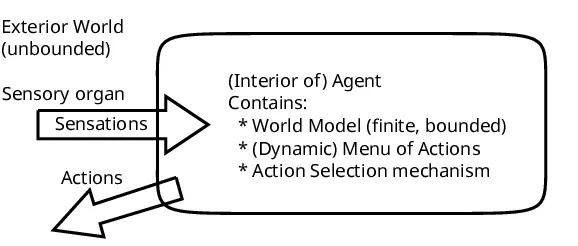
For this text, a sensorimotor agent is given a very specific definition. It is as follows:
- There is a distinction between a finite, bounded “inside” and an unbounded “outside”. Between these two there may be a literal barrier, but it could also be a more abstract grouping, in that the interior parts are more tightly bound to each other than they are to anything outside.
- Sensory organs straddle this boundary, and admit flows from outside to inside. These flows are invariably limited and filtered; they are not channels that conduct anything; they can only carry what they are capable of sensing.
- The inside contains a world model; it is a representation of what was perceived to be on the outside. The world model is updated with incoming sensory information.
- If the world model includes a model of the self, then the agent can be said to be self-ware. Not all agents will have an explicit model of the self.
- The world model is used to guide the agents actions, to plan, react, respond. It is used to select or choose a course of action. It helps guide willful actions.
- The agent has motor mechanisms that effect actions. There are a large variety of places where motors are needed:
- To literally move or orient the agent in some space; often a 3D space but also perhaps an abstract space, e.g. a filesystem.
- To focus attention. This might include moving eyes to look in a certain direction, but also to focus attention on certain thoughts or ideas.
- To perform internal updates of the world model. As sensory experience flows in, motors can effect changes to the world model.
- An action-selection mechanism. This is the most subtle part of the definition. Clearly, actions can be selected from a menu of choices. But if the selection is truly mechanical and deterministic, once cannot say the agent has “free will”. In this way, action selection appears to be the centerpiece and crux of the issues discussed in this blog post.
Below is a simple block diagram of the idea of an agent. In the examples section below, it will be tailored to specific examples.
The above definition can be axiomatized, turned into a collection of algebraic expressions. This should not be hard to do. One possible starting point is a restructuring and extension of membrane computing. This is a collection of syntactical production rules that include rules for creating and destroying barriers (membranes) and installing/removing communications channels across them. I find that specific axiomatization inelegant, mostly because I dislike production rules, and wish to replace them by jigsaws. A different approach would be to extend π-calculus to provide explicit primitives for the construction and maintenance of barriers. In either case, the biggest stumbling block is that a “minimal” axiomatization might be too awkward to use in practice.
The utility of an axiomatization seems limited: it would be required to prove theorems that relate ideas discussed here; but the nature of any such proofs remain foggy. An axiomatization might be a fun starting point for playing with a-life. Possibly even creating autopoietic systems. Play often provides insights, and so this is a worthy undertaking on its own. It’s not clear that such play will shine any light on “the hard problem of consciousness”.
Conscious Agents
Central to the thesis being developed here is that certain agents, the ones possessing free will, are also subjectively conscious. This claim will be established only at the end of this essay; it is mentioned here because if you are willing to believe this a priori, it is worth keeping in mind.
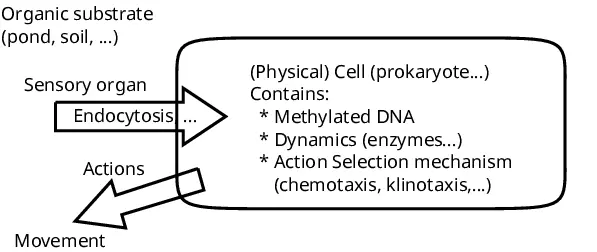
Example: Biological Cells
This is perhaps obvious. Prokaryotes and eukaryotes easily fit into the agential model. As a corollary, the claims of basal cognition follow. Leaping to the endpoint, the CBC — Cellular Basis of Consciousness, is supported. Of course, this is a controversial idea with little academic support; this essay attempts to establish more evidence.
Example: Evolution as Ingress
The agential model encompasses Micheal Levin’s concept of ingress. Ingress was discussed earlier, by Daniel Dennet in the 1990’s, but I believe it was Levin who gave it that name.
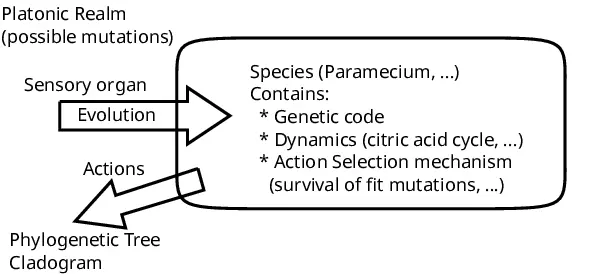
Evolution is but one example of ingress, but it is the original and primary one.
- Evolution fits into the agent model:
- The “outside” is the Platonic space of all possible DNA strands. This is a crazy-huge number, far larger than the number of particles in the universe. Although it can, in principle, be enumerated by a computer, it would take crazy-huge multiples of the age of the universe to do so. In this sense, it does “not exist”, and could never exist in (the physical reality of) our universe.
- The “inside” is the space of all actual, existing DNA strands in the physical space of atoms, the 3D here-and-now.
- The “sensory organ” is mutation; out of the vast space of all possible DNA strands, it selects those that can be reached thermodynamically, i.e. in room-temperature wet environments. The “here and now” is the set of all possible mutations that are reachable in this way. It’s a few E/kT in thickness, in that chemistry happens with a Boltzmann factor of what currently exists in the here-and-now.
- The “world model” can be taken to be either the set of physically existing DNA strands, or as the abstract phylogenetic tree encompassing these strands. It is a “model” of the Platonic space, in that it consists only of the actually-useful genetic sequences; the vast expanse of cruft and noise is ignored.
- Natural selection means some mutations die, others live “forever”. This factors the (classical) symplectic manifold of the here-and-now into the unstable and stable manifolds. Things that die sit on the unstable manifold (atoms of a decaying dead body follow trajectories with a positive Lyaponov exponent) while things that live, are on the stable manifold (they don’t fly apart; zero or negative Lyapunov exponent.)
- Action selection is the actual thermodynamic chemical process of mutation. Is mutation deterministic? No. Is it random? I suppose. Is it willful? Because if it is, that would means that “evolution is subjectively conscious”. This sounds both crazy and mind-blowing; it illustrates a corollary of free will in the agential model.
- Natural selection happens on biological time-scales. That would imply that, if there is “free will” in the evolution agent, it also operates at biological timescales. I do not know how to reconcile this with the quantum-thickness of here-and-now. I can’t even tell if there is a paradox here, if there’s a conflict, or if its just fine. Working through this is a to-do item.
Ingress through Minds
The human mind appears to be able to probe Platonic realm of “all possible things” and select some of them, realizing them in the physical universe. This includes art, architecture, engineering and poetry.
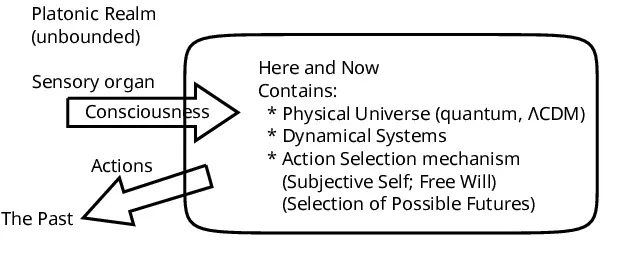
The physical, reductionist model of (human) thinking requires neurons and neurotransmitters. These are composed of atoms, but they are warm and wet, and so the role of QM is dismissed. And yet, neurotransmitter release and reuptake in synapses fundamentally requires QM to describe the hydrogen bonds and the general chemistry.
Thus, one way of thinking of what happens inside the brain is that there are atoms (electrons) that, for the most part, sit within a few hbar of the classical action. Here, hbar is Planck’s constant, and the action is the integral of the Lagrangian. QM happens within a few hbar of the classical action because the partition function has a factor of exp (-i S/hbar) in it: S is the action. This can be thought of as a tube around the classical action. Inside the tube are all of the many worlds that are near the current world (the current here-and-now) This is the set of possible futures: none are very far from the deterministic time evolution of the classical action.
Somehow, one of these possible futures is selected; it becomes the new here-and-now, while the current here-and-now freezes into the past. That is, the state of a human brain right now is quite close to what it was a moment ago. The time evolution cannot be deterministic, foremost because it is immersed in a thermal bath of random noise. But also because, ultimately, the neurons, the neurotransmitters and the thermal bath are all made of atoms, and these follow many-world quantum paths, not very far from the classical path. Just a few hbar away from it.
Ingress, here, is the creation of art, architecture and poetry by the human mind. Things that did not exist, denizens of the non-existing Platonic realm are manifested into physical being, first as arrangements of atoms in the human mind, and later, as arrangements of paint on canvas, ink on paper. What is ingressed, while it is still only in the mind, is necessarily only a few hbar away from what was before; the partition function guarantees the size and shape of this tube of future possibilities.
Now, for a key insight:
- Evolution is very, very slow because the Boltzmann factor of E/kT around chemistry defines a very very small volume around the classical action. Only this tiny volume can be explored by evolution. By contrast, human engineers are “fast”, because the volume of a few hbar around the classical action of the neurons in a human brain is millions, billions of times larger.
I do not yet have any good way of characterizing this volume. I don’t have an algebraic formula for it. Very naively, it seems doable. It’s a volume, after all. But doable does not mean easy.
Thus, ingress through evolution is “the same as” ingress through the mind: both peer into the Platonic realm. Just that the human mind has access to much more of it.
Parts of the Platonic realm can be accessed purely deterministically, with digital machines. For example, the Great Mersenne Prime Search (GIMPS) is a project that searches the Platonic realm to discover certain very large prime numbers. These inhabit the Platonic realm, in that there is a formula that defines them. However, only 52 are known in our actual, physical universe. When GIMPS finds a new Mersenne prime, that number is brought into the physical reality of atoms. It ingresses first into the transistors of the digital computer, and later, into the minds of humans, published mathematical papers, blog posts and the like.
The same idea applies to LLM’s, except that they encompass a much, much larger volume of the Platonic realm.
Thus, it would appear that ingress is not limited to the willful action of living agents; purely deterministic agents can enumerate new states that have never existed before. Ingress alone is not a reason to think that LLM’s are alive or subjectively conscious.
Ingress in Sociology
Specific examples of ingress can be understood as agents in the sociological domain. For example, what does a single mathematician do?
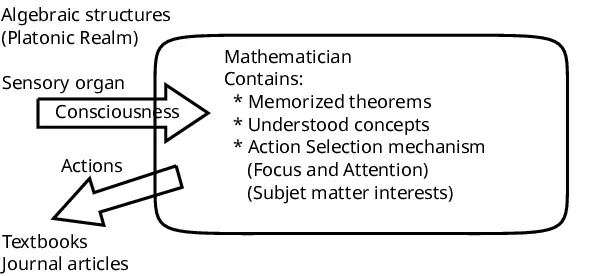
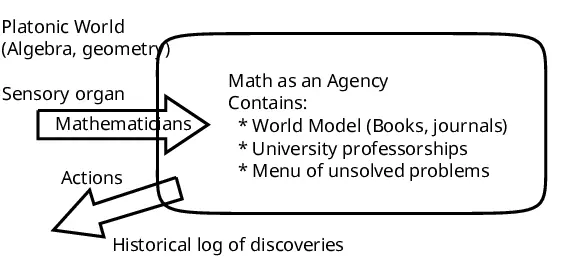
Systems that are not humans can still be agents. For example, mathematics itself can be considered an agency:
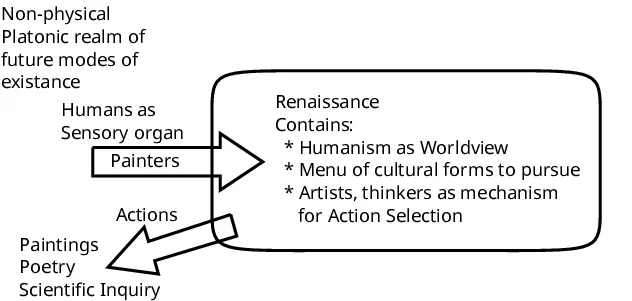
So can the Renaissance:
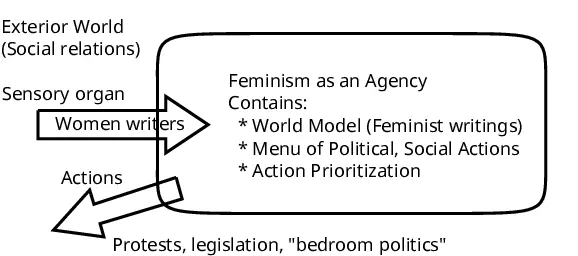
Political discourse can be taken as an agency. Feminism, for example:
More generally, ideology:
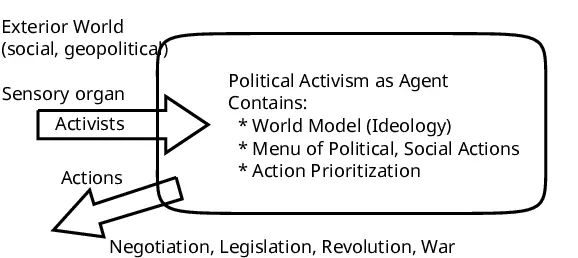
Perhaps the universe itself is an agent:
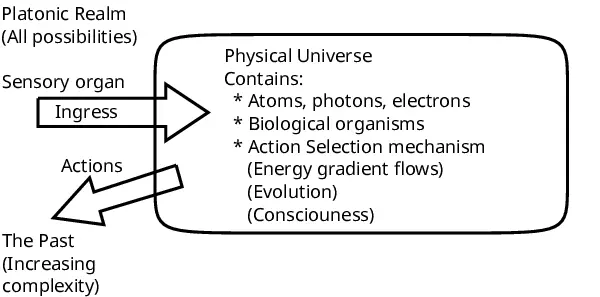
This collection of examples can be taken several ways. One way is that they are just silly, or perhaps empty or trite. Or perhaps the agent model is so generic and broad that it allows almost anything. Almost anything can be jammed into the agent model.
Yet, that is the point: it is so broad, so that it can allow almost anything. Recall that agent systems can be axiomatized: the axiomatization does encourage a (model-theoretic) model of all things that could be agents. This is analogous to Turing machines, which can compute anything computable, or to syntactic grammars, that show how to write anything writeable. So here, the agentic model can represent any agent; and this is a large class indeed. Is there a Yoneda lemma for agency? Perhaps.
Structure and Hierarchy
In general, agents are made of parts, and those parts are made of sub-parts; the organization is hierarchical. This is obvious, in general. Two questions arise: what is the best way to describe structure, and what are the dynamical origins of this structure?
The best way to describe structures appear to be with assemblies of jigsaws. This has strong advantages over saying “oh, structure is just some network graph”. Network graphs connect anything to anything; they’re too loose, lacking in form and structure. Jigsaw connectors have (type-theoretical) types, and only matching types can be connected. One molecule can be connected to another; neither can be connected to a software algorithm. Nature is filled with examples of jigsaws: microbiology consists of parts that connect to other parts because they have specific 3D shapes that fit together. More abstract examples abound: in natural language, dependency grammar and link grammar. In mathematics, axioms and inference rules. In physics, tensors and spinors. In police detective work, pieces of supporting evidence link as jigsaws.
Jigsaws are natural for describing hierarchical arrangements. A set of jigsaws, with some of their connectors linked to one-another, will, in general, have other connectors that are still free, unlinked: Thus, such a collection can be understood as a larger single jigsaw. Formally, this means jigsaws obey the axioms of a pre-sheaf.
Jigsaws provide a natural means for understanding the thermodynamics and statistical mechanics of structural reorganizations. For example, consider the update of the world model driven by the arrival of new sensory information. Most updates are small, confirming the existing structure and changing a few minor details. Some updates are mid-size, requiring larger reorganizations. Very rarely, massive reorganizations occur. Such reorganizations, sorted by size, have a Zipfian or a square-root Zipfian distribution.
Such distributions are characteristic of systems near a second-order phase transition. Reorganizations resemble avalanches seen in the abelian sand-pile model, the prototypical example of a self-organizing system. Psychological examples of small, medium and large reorganizations are clear. Learning a new fact, requiring only a minor update to what one already knows is generally a small change to the knowledge graph. The “a-ha!” moment is a mid-size change, sweeping away large tracts of earlier confusion. Large changes include the nervous breakdown, where suddenly core presumptions and all that depend on them, collapse into disarray. In police detective work, the arrival of a critical piece of evidence that suddenly alters the entire presumed chain of events.
Such dynamical avalanching provides a way to apply ideas from statistical mechanics to abstract domains, justifying the use of Boltzmann distributions and free energy.
Language and Hierarchy
The dynamical origins of structure appears to be through language.
- Agents communicate through language. Bacteria communicate via bacterial quorum sensing. Humans communicate with words.
- Language allows larger agents to be built from smaller ones. The slime mold consists of individual cells, but these communicate via small polypeptides to solve the explore-exploit problem and find food. That is, the slime mold colony as a whole is “an agent”, too. It is made of smaller agents.
- So are anthills, etc.
- The human brain is a colony of neurons. Some parts are more interconnected than others.
- For example, the amygdala, responsible for love, fear, various emotions is indirectly connected to the speech-generation centers. These are indirectly connected to the rational, common-sense analytic part of the brain. That’s why we have trouble controlling our emotions (the rational part would like to, but it’s hard) That’s why we have trouble articulating emotions (writers are good at observing and writing; most people are terrible.) The psychological concept of “Integrated Family Systems” (IFS) is the subjective mirror of the objective neural wiring.
What is the correct way of briefly summarizing structure?
- The Tononi Phi IIT Integrated Information measure is a (deeply flawed) attempt to measure the connectivity provided by communications and messaging networks.
- The Tononi Phi is wrong mostly because it focuses on trying to find a single cut. Sure, one may cut the vagal nerve, and remain “conscious”. Doing so makes the subjective-me smaller. The more is trimmed, the smaller the subjective self gets: cut off arms, legs, ears, eyes, and what’s left really is smaller.
- Focusing on a single cut runs counter to the idea that agents may be made of sub-agents that are also conscious. Scattering an ant-hill may destroy the ant-hill, but it does not destroy the consciousness of the single ants.
- One may sever language processing centers from visual processing centers; famous case studies indicate what happens. A person with this cut cannot verbalize what he sees, but can still draw it. Exactly what part of consciousness was damaged when separating these two parts? Is there one “self” inside, or two, one mute, one verbal?
In light of this critique, a better measure might be a sum over pairs of parts, each pair multiplied by the bandwidth between them. This acknowledges that, for example, the enteric brain contributes to the overall level of subjective awareness. Bandwidth to the enteric brain is relatively small, but it allows me to feel hunger, breathing, heartbeat and a full bladder.
- From basal cognition, we “know” that muscle cells are each individually conscious, subjectively aware of “reality”; however I cannot “mind-meld” with the consciousness of my muscle cells because the communications between them and me are very minimal. Mostly, they excrete creatine and lactase into the blood–stream during exercise, and that’s it. That’s the only message I get from them. I get a bit more via neurons embedded in my muscles, which have sensory organs for additional state sensing. But still, it’s a very very thin, low–bandwidth communications channel.
- That is, just because two different agents are conscious does not mean that they will each be aware of the other. The bandwidth of the communications channel between them matters.
- Highly integrated (sub-)agents form a distinctive self, isolated from the rest of the world, precisely because the bandwidth between the self and the rest of the world is low.
- That is, highly integrated selves are also necessarily isolated, alienated and cut off from the rest of the world; this follows as a lemma from high integration.
- This isolation creates practical problems of acknowledging the existence of alien intelligences. Most people are not willing to grant that a flower or tree is “conscious”; the bandwidth between plant and human consciousness is absurdly tiny. Most people are not willing to grant that the nicotine-industrial complex is an agency, or that World War One was an agency (intent on killing young men); the bandwidth between those organizations and individual humans suppresses recognition of these as valid agencies,
Subjective Being follows from Free Will
In the development above, I’m trying to resolve dualism, by saying that there really are atoms, neurons, and the grand-total of what is possible in the near futures is determined entirely by (the physics of) atoms, neurons. From the “inside”, however, the present and the future possibilities are felt subjectively. Very roughly, psychological states are in correspondence with physical states.
The Tononi Phi does highlight one important idea:
- Conscious-me does seem to be executive-function, free-will-deciding me. One may cut away huge parts of me, reducing large parts of my subjective experience, but I only become unconscious when the executive-decider function is damaged.
- I conclude that the subjective experience is “one and the same thing” as the executive free-will exercising device. The ability to choose a future is what makes me (you) “conscious and aware”.
- This last bullet point is what ties everything together. We select one possible future out of many by exercising free will, and we perceive ourselves as being conscious as the side-effect(?) of exercising choice. This “possible future” is literally the physical reality, the hard-science of atoms, etc. and the subjective experience is literally that thing that philosophers and psychologists debate.
- To repeat: we are subjectively aware precisely because we have the ability to willfully create a future. These are welded together; they are manifestations of the same thing.
Have I made a dent into the “hard problem of consciousness”? I dunno. But I’m rather certain no one else has strung together this particular string of beads.
Conclusion
To conclude, the co-occurrence of the subjective sense of self, the exercise of free will, the non-existence of the future, the immutability of the past, and a present here-and-now that encompasses all possible, potential futures, this is not an accident, not some random coincidence. Rather, it is the deep structure of physical reality, as it actually is.
There are some sticking points, rather deep and difficult ones. It is worth summarizing them.
- The conception of here-and-now presented here needs to be reconciled with textbook QFT and GR. This will require some radical re-interpretation of the mathematics and a fundamental challenge to the current prevailing orthodoxy in physics.
- The conception of the “thickness” of here-and-now needs to be precisely articulated.
- The idea of an accessible volume of the Platonic realm was introduced, noting that evolution accesses only a small volume, the human brain accesses a volume billions of times larger, and LLM’s a volume larger still. What might the (algebraic) formula for this volume be?
- Large parts of physical reality appear to be entirely deterministic; this is not just the steam engines and the digital computers, but also biology. How do deterministic devices interface with the mechanisms of willful decision-making? This remains as mysterious as before. This essay perhaps narrows the places where one can search for this; it provides a structural framing for reconciling willfulness, ingress and physics.
- Are there any experiments that can distinguish the exercise of free will from the statistical ensemble of deterministic behaviors? A collection of purely deterministic agents can behave in a stochastic fashion, due to environmental noise, or due to built-in sources of randomness. How can this be distinguished from agents making willful decisions?
- The agent model described above really does need to be axiomatized. This will enable prowling the neighborhood of related ideas in a more structured, rigorous manner.
Then there are some topics that appeared only in passing, but need fuller attention:
- Subjective states include positive and negative valence. Can this be reduced to “thermodynamic” principles? For example, socializing usually “feels good”. Do agents like to “socialize” and communicate, because this minimizes/maximizes some measure of entropy, energy, complexity?
- How might problems of ethics and the existence of evil be articulated in this agency framework?
- In statistical mechanics, there are phenomena, such as percolation, that happen as phase transitions when a certain minimum threshold of a parameter is exceeded. Perhaps this applies to the idea of panpsychism: consciousness appears only when some minimal threshold of complexity is exceeded? For example, does an ant-hill posses collective agency only because it is sufficiently isolated from the external world, while being sufficiently integrated internally?
- Are there any universal sensations or valency sates? For example, one may assume that bacteria feel hunger. Do all agents feel hunger?
Thank you for your attention!

Leave a Reply