Diary – Part Ten–J
August 2026 – September 2026
Linas Vepštas
Abstract
Unlike parts one through nine in this series, this one is not really about the language–learning effort. It is instead a private diary; a continuation of Part Ten–I, which got over–long. It is not curated for human consumption; I am making the assumption that no human being will ever actually read this. Thus, it is filled with random stuff I feel like writing. Some of it is very personal, some of it is nonsense. Mostly, I am finding that the act of writing helps otherwise vague and scattered thoughts quantum–collapse into a more coherent form, where I can examine them, like a dead butterfly pinned down in a display case. Dead words.
If you are interested in this content, then you should ask an AI agent to read it, then ask the AI agent to pretended that it’s me, then talk to virtual “me”. I believe that present–day LLM technology is sufficiently advanced to be able to do this.
Introduction
Part Ten already got an introduction. A different way of thinking is about what is going on here is that this is a form of life–logging. Or, in 18th century terms, a diary. Just not anywhere near as compelling as those written by the famous diarists. This one is more of a mental self–portrait. And not even for you, but for myself. Not to cast a narcissistic gaze at my own words, but to organize my own thoughts. Still in the experimental stage.
9 August 2026
There’s an earlier 9 August entry in Part Ten–I. I split it here because reasons.
Off topic. I just read a paragraph out of Mary Roach’s book:
“At one point he described curing a twenty–two–year–old youth of, among other afflictions, the “frequent writing of incoherent, rambling dissertations on architecture.””
Wow, that made me laugh. Incoherent, rambling dissertations.
——
I’m a mess. I think I just discovered that the health of my social network is abysmal. And just like someone who woke up to find themselves in terrible physical condition, one step away from hospitalization, I need to take steps to perform social network repair. This will not be easy. I even dread it, but I have no choice.
10 August 2026
Slept long, slept well, feel fine. But now I’m going through old lost emails, and this sinking sensation appears in my stomach. I feel OK, but there’s like a little birdie whispering in my ear: “Listen to your stomach! You should feel melancholic!” and I kind of even want to, to give in, to let it settle over me. But I’m pushing it away, knowing that down that path lies trouble, and I’ve had enough of that, thank you very much.
While I dozed into the late morning, I again kept thinking about how nothing exists, except the here–and–now. I continue to find this very mind–blowing; its just not how one ordinarily conceives of things, because one has memories of the past. But those memories are just part of here–and–now, of course.
For a short time, I wondered if here–and–now is a purely subjective experience, and that more exists “objectively”. But, no, that is wrong. We have no machines that can travel into the past, or future, that can perceive the past, or future. We have no theory for such machines, either, except for wormholes. The here–and–now is a product of physics, and not of the mind. The subjective experience is apparently in it for the ride.
In short, I made no forward progress; this was just an echo as I slept.
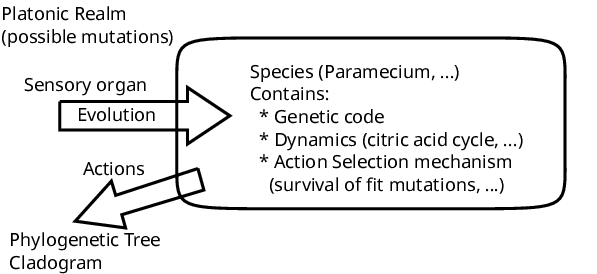
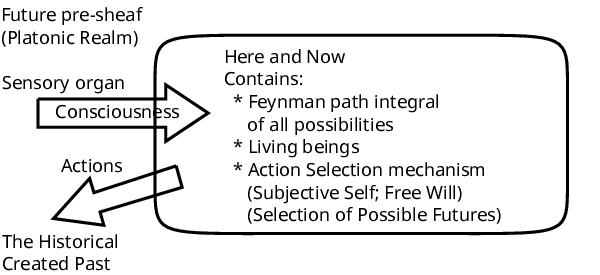
Then I thought of the following diagram, from earlier in the diary:
and wondered again how accurate it is to imagine that structure ingresses from some abstract platonic realm, into the present here–and–now, but then generating pure platonic forms, such as the cladogram. The point here is that the cladogram “does not exist”, except in the mind of scientists. Even species do not exist, except as abstract concepts, again, in the minds of scientists. Only specific instances of organisms exist in the here–and–now; the fact that some happen to be genetically very nearly identical is an accident of autopoesis.
That is, the above diagram depicts an agency that inhabits the platonic realm only. None of the above agent “exists” in the here–and–now, in any literal sense. However, the side effects that this agent has on the arrangement of atoms in the “actual, physical, real” here–and–now is uncontrovertible: Darwin noticed.
Of course, “who is Charles Darwin?” Well, he too seems to be a named agent that also operated in the platonic realm. That is, his brain, having a subjective reality, like my own, peered into information from his sensory organs, constructed a world–model (which is encoded with neurons, but “exists” in the platonic realm), accessed that world model with his subjective–self, and spotted a pattern in that world–model. Then, by hard thought and inspiration, he arrived at his theory of evolution, which, again, as a theory, exists only in the platonic realm. Then he, as a subjective individual, performed motor actions with his fingers, to encode this abstract concept onto ink and paper, thus creating a certain complex arrangement of atoms, in the here–and–now.
That is, the human brain, perhaps a bit like a ribosome, operates in two places at once: in the subjective, platonic realm, and in the physical, made–of–atoms realm, and leverages it’s ability to manipulate physical reality to encode (manifest) platonic ideals as arrangements of physical atoms (in this case, ink on paper.)
This binding is tight. Just as I cannot think without the atoms in my brain, so the idea written on a piece of paper cannot exist without the physical paper. Insofar as it exists at all, it exists in the minds of other humans, or, in the present case, as electronic currents in my laptop. And wherever the fuck github stores shit.
When I said “the human brain, like a ribosome”, I was thinking of how a ribosome is made of both RNA and of protein; it needs both to bridge the disparate systems. The analogy here is that the mind has parts made of atoms, and parts made of, um, subjective reality. Is this the case for all agents? That they are necessarily bridges between atoms and the platonic realm?
Is evolution a counter–example? As drawn in the figure above, it is an agent that exists only in the platonic realm. And yet, it manifests, “ingresses” into the atomic physical world as a collection of biological organisms acting out their lives in the here–and–now. Can evolution exist, without atoms? For the case of Darwinian evolution, the answer seems to be “no”.
A different way of thinking about evolution is the computer program that implements, for example, “genetic programming”. A practical example is MOSES from OpenCog. It’s an algorithm, described in a PhD thesis. It’s actual, compilable, runnable code, with thousands of variants as it was patched, bug–fixed and tuned over time. Both the thesis, and the code, are in the platonic noosphere, but they do not exist, except as certain arrangements of atoms on certain computers that run certain websites.
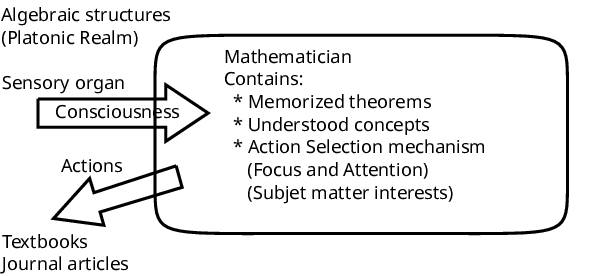
This is the case for mathematics in general:
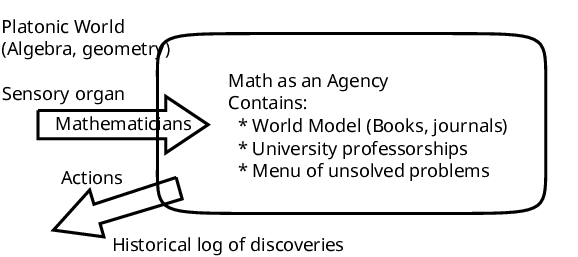
The above pictures only one mathematician. It is meant to show the mind of the mathematician peering into the abstract realm and discovering mathematical “truths”. But, with minor modification, it is recognized as a group activity, as well:
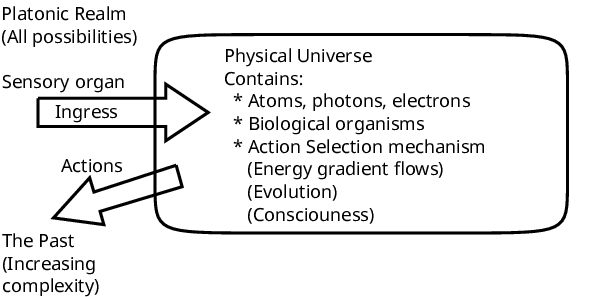
This is kind of like the diagram for “Feminism as Agency”. All of these diagrams are meant to be analogous, although, at this stage, they are a bit confused. What do mathematicians generate? New conjectures, theorems and proofs? Or are these just a collection of historical achievements, recorded in written journals existing in the here–and–now? What about mathematical discoveries that were forgotten, such as those lost in the burning of the Library of Alexandria? One can imagine that “once upon a time, they existed”, which is generally the case for anything that is lost in the past. But the loss is very nearly total... unless, unless...
Unless one takes the idea of the no–erasure theorem (or the idea of the unitarity of QM) to it’s extreme logical conclusion: all information that was lost in the burning of the Library of Alexandria still “exists” in the thermal bath. Oh wait; that’s wrong. Informational bits can be erased. Quantum entanglements cannot be erased. So which is it? The atoms in the ink written on the scrolls of papyrus or sheepskin... was their relative structural arrangements and locations encoded as unitary entanglements? Or are there distinct atomic arrangements, when evolved into the future, “collapse” onto the same present–day wavefunction? How, exactly, is information “erased” in the physical universe? How does one erase a bit? Certainly, thermodynamic ensembles erase, just like bit–shifts erase. But ... I’m totally confused. I do not understand what information is. This is a kind of intellectual blocker for me. I need to figure out what information is.
Anyway, the thought was that if one takes the notion of unitary to a logical extreme, then one need only take the wave function of the universe, as it is today, evolve it backwards, with
to a point
that is before the burning of the Library of Alexandria and ta–dah. Not achievable in a practical sense, but a seemingly viable thought experiment.
So basically, I’m confused.
The problems with ingress and egress are amplified if I consider an algorithm, such as MOSES. It runs deterministically. It is designed to explore a space of “genetically encoded programs”. This space “does not exist”, except in the mind of the programmer. And yet, the running program, as it steps through time, it explores this space. After some amount of run–time, it finds some expression that passes the various tests for acceptance. This expression is now recorded for posterity: it becomes some arrangement of electric currents in transistors in the here–and–now, and it stays there until the program exits. Before exit, the final expressions are printed into a file, and, in the case of work on the Durkheim Project, it gets published in a journal. That is, a space of genetically–encoded programs, which “does not exist” except in some abstract, platonic sense, was searched, and a portion of which was extracted and placed into the here–and–now, and specifically, into the “real world” of atoms.
So what do we have? An entirely deterministic program, leveraged by a human, to extract content from the noosphere, to mine content from the noosphere, and place it into the real, actual, physical world. This program was called “evolutionary” because it was inspired by Darwinian principles. However, evolution happened without people; whereas computer programs need people to create them, and set them running. And computer programs exist only in the noosphere (except when their concrete dual is recorded on a disk drive) and human minds fished them out of the noosphere of “all possible computer programs”.
My head is spinning. I can’t tell if I’m making progress here. Something is somehow ingressing, and the fact that a deterministic device, the computer program, and do it, suggests that quantum woo is not required for ingress. The only problem with this argument is it fails to address the question: where did the program come from? As it came from a human, it seems that quantum woo might still be required. And for Darwinian evolution itself, it happens at the biochemical, atomic level, viz at the quantum chemistry level, so there’s plenty of quantum woo available for the explanation of why evolution materializes specific DNA sequences out of the abstract space of all possible DNA sequences.
That is, when dealing with abstractions, its turtles some of the way down, until one hits atoms, and then its quantum woo. The fact that computer programs can mine the noosphere for knowledge does not evade the need for quantum woo, because you have to first explain where the program came from.
I think this is forward progress. Maybe, barely. A scratch in the surface?
I have lots of errands I have not done, that I need to do.
——
p.s. My low–grade upset stomach is almost surely due to undissolved creatine crystals. Here I am, thinking that I am suffering from heartache and loneliness, when in fact its .. fucking creatine. Well, I am suffering from heartache and loneliness, but the creatine made it much much worse. Fuck. We’ll give it a few days to heal. And resume the build–out of a social network. Which remains (very) challenging.
11 August 2026
More impressions. It’s the last thing that inspires me, but I will stay in chronological order. Milda came back from the farm, laden with apples and tomatoes and cucumbers. And potato pancakes. I picked her up at the bus station, to carry the bags. Marching down the streets like tourists, except the bucket has green sprigs sticking out of it and obviously never came from the airport. She’s all smiles and wonder. I’m all madly in love. Well, she is too, and she knows it, but then, also in denial. Our time together is like sips. Small, brief tastes. Not enough to slake one’s thirst. But enough to make the spirit soar. Like a bird song, or the scent of a flower, there but for a little while, and that is enough, I suppose. Of course, I thirst for hugs and kisses, but this won’t come. Maybe if I’m lucky, I’ll get to touch her today or tomorrow or the day after. And yet, I’m walking from the bus station, lugging forty pounds of apples and tomatoes, and a hard–on. It makes my dick hard just to be next to her. I have a vague impression that perhaps she feels similarly. The self–denial only seems to make it stronger.
Well, I was going to write none of that, and just leave it in the past, but well, too late. I’m reading my mother’s autobiographical description of her flight from Lithuania to the US. In the back of my mind are thoughts of my philosophical efforts to understand the relation between the spiritual and the physical worlds, with floating efforts to picture the dynamical system of life with whatever this high–dimensional thing that we are, “Spirits in the Material World”, as the song lyrics go, and I’m like discovering the meaning of literature for the first time ever, after half a lifetime buried in mathematics. And, well, since I haven’t put two and two together, I’m not sure there’s more to write.
I started to read this short story, “Gilai Tinkle, Kur Vaidenasi”, Viktor Denisenko, Baltas Kambarys, Issue 11. I put it down because it’s full of heartache, and I think I’ve had plenty enough of that in the recent week(s). It does make me think: how accurate of a portrait can be created of a person? I mean, I’ve got a bazzilion childhood memories that I will never write down, and it hardly matters as they are ineffable, consisting of combinations of sight (I remember how things look), smell (the Wisconsin farm had a pleasant summer air) and feeling (the ineffable feeling of just, kind of, feeling good. Which is how I felt as a child. Neither ecstatic nor sad, but just happy contentment. I felt good.) There are probably existing literary sketches that come close to what I felt. There are probably movies that show it too. The songs by Ethyl Cain are too far away from my childhood experience to be relevant, but not so far away that I don’t understand them. Visually, they are similar. Hmm. As I think about it, it’s the visual content of her movies that are just as important as the music. It’s the visual content that pushes me over the edge. It’s some of the visual parts that resemble Wausaukee. And, as I write this, I have to say that I cannot think of any visual representation of Wausaukee that comes any closer. I mean, her movies (“official videos”) are not that close, but closer than anything else I know of. Both visually, and the time–progression, and the capturing of the general feeling. Huh.
So, armed with this, just how accurate a portrait could be created of me? I’ve written scads of pages and personal narrations here in this diary ... how close is this to “me”? I mean, not to be narcissistic, this rumination applies to my Mom’s autobiographical writings. To my Uncle’s diary. To the diaries of countless celebrities. And, oddly, to the facebook posts of billions. The future can know more about some median facebook account, than it can know about Julius Caesar. We are setting our lives down into bits. Some MRI machine might be able to one day soon peer into my mind, and record my memories of Wausaukee, laying in a hammock strung between trees, reading some fantastically miraculous scifi, while a light breeze blows through the trees, and the sun shines mottled and warm: just right, not too hot, not too cold. Just right. Why I would ever write that this is just like an Ethyl Cain video is hard to say, because she never shows this particular image. But maybe it’s because I can watch those videos, and feel the pine needles and grass beneath my bare feet. Cause bare feet are a part of it. How closely can my ephemeral spirit be captured in written word? In images? I have no recording machine for smells. I have no recording machine for the general somatic feeling of being alive. But it seems as if machines for this are not so far off.
Which brings again the question of how accurate this could ever be? And the ineffability of the immediate subjective experience. The point is that these words are dead, frozen, unchanging. I typed these letters, these words just now, inscribing them into the fabric of the here and now. Barring nuclear bombing, these words just might be immortal. But they are also fixed, dead. To bring them to life would require a substrate that can accept all this as a model, and then, with the push of a button, be set into motion, be set into life. This is, of course, the intent of portraiture. A few hundred years ago, oil paintings and novels were the state of the art: Tolstoy’s War and Peace is a portrait gallery. Now, we have facebook and videos. Soon, perhaps, MRI. Can the soul be recorded, and recreated?
Well, of course, the question is “what is the soul?” but that is an ongoing topic.
I wonder if Thomas Aquinas wrote about his personal emotional inner life? Love and hopes and dreams?
Gemini responds: “Thomas Aquinas wrote almost entirely about theology and philosophy. His work is strictly theoretical and academic. He did not write personal diaries, poetry, or confessions about his own inner feelings, dreams, or private emotional life.”
But it adds: “How He Treated Emotions * Scientific study: He analyzed human emotions, called passions, in a detailed way. * Rational control: He believed reason should guide and shape human feelings. * Love as a choice: He defined love as willing the good of another, not as a romantic feelings.” Well Hmm. So he got into that. But he was wrong. It would be nice to have rational control, but it is not generally available, does not generally work. And as to “Love as a Choice” heh. Absurd. My love for Milda was hardly a choice; more like being mugged in the back alley. A strong rational argument could be made that I might have been better off without it. As a counterpoint, though, it is equally clear to me that it was like rain, it opened me and made me bloom, and think about things that I might not have ever thought about. Would I have ever arrived at this point of trying to comprehend the interface between physical and spiritual? Perhaps. Would there have been the colored richness of the emotional wildness have been there? Probably not.
Was I suppressing my feelings? Or were they latent, unrealized? Just like that algorithm exploring the explosively large latent space of possibilities, and identifying a very narrow, tiny, sparse subset of them ... same for me, my being. What’s real, and whats actual? The MOSES algorithm is exploring a space of size
for
or perhaps
or whatever:
is variable, its the length of the bitstring. Its a huge space. Larger than the number of atoms in the universe, if given a uniform measure. Perhaps the uniform measure is entirely inappropriate, and almost all bit–strings are very similar to one–another, and thus occupy a small volume. So I don’t yet know formally how to calculate the volume correctly. At any rate, even if I did, could I say “this space exists”? Sure, perhaps “out there” abstractly: it exists because I have written about it in a finite number of words, and it exists because it’s implicit in the source code for MOSES. But actual samplings from this space only come into specific atomic, physical existence, when the algo call them into being, and prints them in the log file, the output file, or to stdio. Only then, by causing a re–arrangement of physical atoms, do these instance become real, and occupy the actual physical world. Likewise my love. It’s always “existed” as a potentiality: I could, potentially, fall in love, in any one of a zillion different ways, to a zillion different people (or, as I learned, I can fall in love with a bird.) But until it actually happens, it is only a potentiality. Writing about it analytically seems dry. Writing about it as an actually felt experience is immersive in a reality that is so very immediate and direct and felt and lived. The atoms in my brain rearranged themselves, as my neurons re–arranged themselves, to create a mental model of who Milda is (and this is important; for it is impossible for anyone to ever know who she actually is; this is deeply private to only her; and as experience suggests, she doesn’t understand herself particularly well.) So some atoms rearranged themselves to create a figment of my imagination, in my head, of who she is, and then had the gall to fall in love with this artificial and inaccurate portrait.
Hmm. So does this address my question about portraiture? I’m already creating portraits of people (and places, and events...) in my head. And these are living portraits: they’re certainly not tuplas, but they are not inert. Except, well. Hmm. Do they have subjective awareness? It would be hard to argue that the portrait of Milda that sits in my head is “self–aware”. I’ve recorded facts and feelings about her, but I haven’t given her life. The only path to life would be a tulpa or some other form...
Shit. I’ve totally derailed. I double–checked with Gemini my understanding of tulpas and have now fallen into a wild wonderland. I have fucking errands to do. Shit. The clock is ticking.
12 August 2026
The roller coaster is back. During dinner, we talked. She smiled. We stared at each other. A long time. Repeatedly. Keeping eyes locked, it requires emotional processing. She went to bed early – very early, 9PM. Maybe she was exhausted. I know I was. I stayed up late, computering. The pit in my stomach reappeared. That is, while my mind, my conscious me, was doing one thing, the subconscious me gave in to despair. But not for long. I slept with a hard–on all night long. I mean, even in the early, deep sleep. And the middle of the night too, not just the late morning sleep. This rarely happens. I woke with a hard–on. I have one now, as I write this. It feels nice.
My mental model of her is that she’s not going to give in. Why should she? Sooner or later, I’ll be on a plane back to Austin. She’ll be stuck here, enduring a depressing, long, lonely winter. There’s no upside, for her, just downside. I don’t blame her.
The chivalrous thing to do might be to just end it: leave now. Say good bye, have a good life. Maybe it will cool off and then we’ll just be acquaintances who don’t enjoy each–others company. She’s ready for that. When I first arrived here, there were some episodes: “Oh, you again. I’m going to put in some token amount of effort to socialize with you but then time’s up, and I have other things to do.” She more or less said this out loud, to me, during the Pink Soup Festival. I stand there and take it, and then feel rotten for the rest of the day, the rest of the week. And she does. Long periods of absence, where she’s busy doing something else, and I hardly ever see her.
And then she smiles. Before she leaves, she stocks the fridge, the pantries. With my favorite foods. With what she thinks are my favorite foods. As if I can’t shop for myself. My heart does gymnastics. And then again, two weeks ago, four weeks ago, she looked at me, during lunch, and said: “Don’t fall in love with me, I’ll break your heart.” I sat there, stony–faced, my quick wit wasn’t operating at that moment. Odd choice of wording on her part. She already knew I’d fallen in love with her years ago. And I think she knows I’m heart–broken, although I try to hide that. But I think it’s simmered a little too close to the surface, a few times. I think she knows. She knows I want her bad, and she’s patiently explained that I won’t get her, that it was all just a dream. I got that explanation just a few days after arriving here. That was a few months ago. An eternity. The distant past. I’ve had a very very long journey, these last few months.
I got back at her, just before her last weekend outing. Not intentionally. By accident. I said, out loud, “I can see I’m cramping your style. Maybe it’s time for me to leave.” Her reply? “Oh my God, what’s wrong with you?” This with a tinge of panic in her voice.
I’m reading micro–cues. Maybe I’m mis–reading. I’m putting in a vast amount of effort trying to understand.
I’m writing all this, all of the above, with a hard–on that waxes and wanes. Because some non–verbal part of me thinks there is hope, and its all a huge turn–on. It’s one long big fuck that ends with a bang. Why? Because of her reply. Since I expect a machine to read this, and not understand, I’ll unpack it. “Oh my God, what’s wrong with you?” translates to “Can’t you see I’m in love with you?” and the tinge of panic is “Oh my God, don’t leave me!”. So, as I wrote that, I started crying. (Romantic tears. The kind you cry in movies.) With a hard–on. Oh please just let me fuck you. (Oh, hang on. Isn’t this the implied happy ending of romantic movies? How very strange. It is never–ever explicitly mentioned: “and they fucked happily ever after”. It’s not even implicitly implied or suggested, not even the faintest whiff, in any way, shape or form. One never thinks of that. At least, I never did. How odd. Depictions of pure romantic love are utterly divorced from eros. And to maintain the virginal purity of romance, what happens next is hidden behind clinical language: “the marriage was consummated”. As if the nurse stood by while you drank whatever unpleasant liquid was prescribed. Consummated. Consumed. Bottoms up. Heh. Get it? That’s a joke. Bottoms up.)
Writers and authors and movie–makers are experts at setting up these micro–cues. I call them micro because this is a foreign language to me; most of my life was spent thinking math. But I’m not an emotional moron; when I watch romantic movies, I cry at all the right places. I attribute this to the skill of the movie–maker, and not my perceptiveness. Reading and interpreting cues in real–life, though, that’s harder.
I mean, of course, my interpretation of what I heard, well, I could be quite wrong, here, and reading meaning into something that didn’t have this meaning.
And as I write this, I am suddenly struck by several things. How much communication is non–verbal. How much, even when words are used, the meaning is distant, abstract, and far beyond the dictionary definitions of the words. How prone to mis–understanding communications are. And how the communication is not so much between “me” and “others”, as it is between different parts of my “internal family system”, and those of others.
I don’t know if I can explain this, its hard. Worse, its probably a truism; what I’m just now realizing, what I’m trying to explain, is probably well–known, somewhere, by someone. So, I mentioned before, subjective me uses verbal me to express the contents of subjective me that I want to express. There are already three distinct organs here: the verbal me, which I use as a tool. The subjective me, which is some bulwark of feelings and emotions and memories and desires. And then the active me, which is actively deciding what to do (what to tell the verbal–me to say/write).
This is exhausting work, writing all of this, and I feel like I’m on the slow train to nowhere in particular. So I guess the meta–point is that the brain has lots of intricate structure and wiring, and the various different subsystems interacting via this wiring. Verbal, spoken language is not something that passes from one subjective–I to another (although it is that, too) but rather a channel that courses between many different parts of the wiring. So when someone says something with a tinge of panic, what’s panicking? The “who” is the person, of course. The “what” is some neural circuit that has some vested interest in something, some desire, and senses, fears immanent loss. It’s not the verbal– that senses the loss. Its not the rational, balanced I that senses the loss. It’s whatever circuit is responsible for the desires, and whatever other circuit regulates urgency, panic, ups the priority list for “shit we got to deal with this now”. The communication is not point to point, but subsystem to subsystem. The words are intermediaries. And that’s the problem with the dictionary definition of words. The part that is panicking is not looking in the dictionary for the word “panic”. It’s modulating the tone of voice. It did not even pass through the decision filter: “I’m going to express panic to this other entity.” It’s not conscious, it’s not deliberate, its not rationally decided. It’s involuntary. Not beyond control: people can certainly communicate in a cold fashion. But this leaked out, through a vocal channel, and it came from a different part of subjective–I than the rational I.
This is all so horribly plain and obvious: nothing I write here is new, per se. I’m trying to do a technical, clinical analysis of communications. It’s not psychological, though, because psychology deals with the I, and since we all know who I is, detailed explanations are not normally needed. Maybe this is like trying to explain air in the 17th century: what is there to explain? Everyone knows what it is. Of course, nitrogen, oxygen, vacuum and ideal gas laws come later; turns out there was something to explain about air, after all. So I’m struggling to explain, or at least understand the communicative act. It is not just something that is exchanged between subjective–I’s; it entangles specific subsystems in the I’s. These subsystems being more weakly or strongly integrated into the subjective I than others. The part of me that loves is not the part of me that does math. The part of me that loves is a wild, heedless beast that just does shit without asking. When it gives me an erection, well, that’s quite alright for default mode me. Of course, when subjective–focused I is concentrating on a task, that erection fades in maybe five seconds. Since I can kind of do two things at once, in parallel, there is a vague tumescence between my legs, even now. Sort of waxing and waning.
At any rate, this is meant to illustrate what appears to be a problem with LLM’s. They’re not attached to dicks (or whatever the corresponding erogenous zones are for women) and they’re not attached pain sensors in big toes, either. This is why LLM’s can know everything, and understand nothing. Yesterday, I went to Vilniaus Textile, and wandered the stacks, admiring all the different kinds of cloth. And more: what that cloth made me feel. Everything from icky communist shlock to comfortable sportswear, to sequined elegance, to erotic see–through lace. There we are, again, with the eros. And with how things feel. How cloth makes me feel. How wandering the aisles of this industrial space makes me feel. How the price tags make me feel. The LLM’s have never done this, could never do this. Sure, a robot could roll through the aisles and film, but so what? All of these fabrics are skin–contact fabrics. The robot has no skin. Yes, the sewn item also needs to look good, and the robot has eyes. But what is it that “looks good”? When Milda wears something sexy, and I see it, it looks good, and that looking–goodness comes with a whole bundle of everything else. Specifically, the little homunculus in my brain of her. The homunculus that is encoded with neurons and atoms, but is sensed, operated on and thought about by rational, emotional me. I almost wrote “subjective me”, but a huge amount of my emotional processing, and the construction of this homunculus happens at a subconscious level. And my obsessive focus is not even voluntary: I can modulate the obsession, but it is not entirely controllable by the part of me that likes to control things. (That desires to control things? Is “desire” the right word here?)
Hmm. I, the subjective I, that wants to control things, this is maybe perhaps the most central part of the subjective I that there is. Yes, my butt hurts from sitting. Yes, my stomach is full not hungry, but still in a vague minor commotion that is reminiscent of heartache. Yes, I feel tired, (this writing is tiring). But none of these feelings are central–me, they report to me. Its the executive me, taking charge, figuring out what to write, what to do, that is the most central me that there is. I think.
That is, there is the subjective me that is me. The Tononi IIT Phi is flawed in assuming that it can trim away the feelings of the flat of my feet, the feelings of my stomach, the feeling of tiredness, and still some subjective me remains. I dunno. Trim these away, and subjective me is clearly diminished. However, I don’t think the executive me can be trimmed away. The part of me that decides what to do, that cannot disappear, leaving behind some zombie experiencing things but not making decisions. Executive–me disappears when I sleep. In lucid dreams, it has some limited engagement.
Wow. OK. So that, I think, is a discovery. The subjective me that is I, the thing that engages the world, this is really just the executive me. All my sensations and feelings, these are the raw materials that the executive me works with. And so then, sure, take these away, and executive me has less and less to work with. Blind and deaf, I would have to turn to an internal world, and the world of touch. So, yes, subjective me is experiencing me, and some large amount of that experiencing can be throttled down, leaving a trickle. Maybe even just one’s memories. But decision–making me, that chooses what to think about (and what to say, what to do) that is the ultimate irreducible me. So maybe Tononi Phi is correct in this: the sensory can be whittled away, while still leaving me conscious.
So this unmasks one thing: free will is utterly and completely central to the experience of conscious, subjective me. It seems that without free will, there is ... nothing. Some zombified, automated, mechanical state, chugging along like a steam engine upon the tracks? In so far as a steam engine has not free will, it also has no subjective experience of consciousness. Of self–hood. Wow. So, OK, this is a major discovery. Well, for me at least. Free will and the subjective being–ness, Dassein, are inextricable. Free will is foundational for Dassein.
Two other things. Free will necessarily exists only in the here and now: there is no way to exercise free will in the past, and free will is what is used to shape the future. And since we earlier determined that here–and–now is a physical, atomic reality, and not a subjective perception, this would imply that free will operates at the physical, atomic level. Yes, it is the ingress of the noospehere, as per earlier discussion of MOSES, that formulates and controls the arrangement of atoms in reality. But ... I’m confused. One moment.
A short interruption to close off other unfinished paths:
- The above chain of thought, coupled to cruelest cut, implies that the cut is cruel because it destroys the executive, but also that the executive is embodied in the most complicated, interconnected part of the brain. TODO: why does the exercise of free will require the most complicated part of the brain? Why can’t it be a simpler circuit? Is the most complicated part always the executive? Can one have complicated parts that lack free will? How about data centers? They do not conventionally have free will, but it seems they’d have a high IIT Phi... Maybe?
- The sequins in the store reminded me of the video for the Veruca Salt video “Seether”, and the red–sequined building in Chicago. LLM’s should be really good at generating associations such as this. The generation of associations is vital for thinking, but it is not consciousness I guess.
- Todo item: What is loss? What is desire? Loss can’t happen without desire, right? And desire is what? More than just the Maslow pyramid.
- Did it ever happen? When I wrote above about Milda replying “what’s the matter with you?”, there’s an open question of whether she remembers saying this, and if she does, what was meant by it, and if her memory is true to what was happening in her head at the time that she said it, and finally, if she even admits to herself what her “true” feelings are? I think a lot of her character can be explained through repression and denial: she’s not open with herself as to what rules her soul. I noticed this, but even Rytis, whatever other character flaws he has, he’s noticed this too, and remarked on it. We were talking about something, about being open, and he flat out says that Milda is not even open to herself. That this is one of her character flaws. Rytis loves to focus on flaws, especially the flaws in others, which is part of what makes him unattractive to his wife. But I wander off–topic. The topic was (and is a to–do item) if something is barely noticed, limnal, passing, then “did it ever happen”? In the MOSES example, there were
genetic string possibilities, which “don’t exist”. Of these, the purely mechanical program selects a few hundred, and causes atoms in the physical universe to re–arrange themselves to express them (print them to the terminal, a file...) There were many millions that were examined and discarded along the way. I forget: ten thousand per second, on the 15–year–old computer? Discarded means register contents, RAM was wiped. They “existed” but only briefly, before being permanently wiped out of the here and now. More or less permanently. Perhaps some trace in the heat bath. I’m trying to compare this mechanical model to the fleeting limnal sensations, soon forgotten. Limnal sensations do have lasting after–effects, but so do the discarded computations: the discarded info was needed for later processing.
Take a break, here. The limnal, the executive, this is all good stuff. I need to keep going in this direction, but I’m tired, and it is late, and I have stuff to do.
14 August 2026
Needs, wants, desires. As I slept, I knew that these would be the perfect things to write about this morning. I even had a topic plan, how to develop these. I repeated it to myself maybe three times in my sleep, so I would not forget in the morning. But, I said to myself, that’s enough. Give it a rest, get back to sleeping. I won’t forget. Yet, here I am, and I forgot. There was even a second topic to write about: an embarrassment of riches; too many things to think and write about. But what was that second topic?
Well, I’ve been writing from the first person; this has been highly successful. So lets continue in that style. I need love, I want sex. These are biologically realized, deeply coded into my genetics and neural structure; the circuits that drive them are robust. Mostly cause I’m physically healthy. I have long–lasting hard–ons as I sleep; I have a mild one now, as I write this. It feels good. How does today differ from other days? Well, today is Friday. It’s a work–from–home day for Milda. She’s sitting in the other room, computering. Working from home. And this makes me very happy: to have close, nearby warm bodies. That she smiles at me is a big bonus, but otherwise, it would be like sitting in a coffee shop, laptop open. One does not go to the coffee shop for the coffee; this is easy enough to make at home. One goes there to have company, to be around other people, even if they are strangers, even if they are silent. The physical proximity just plain feels good. This is primitive. Birds flock. Fish flock. There are species that live alone: the octopus, for example. Most biology wants to be with others of it’s kind.
Do ants, lost from their anthill, feel lonely? Sometimes, very rarely, ants set out to live alone. Are they daring adventurers? Outcasts? Or just damaged, in that the drive to be social is not functioning due to some neuro–chemical damage?
Ants are interesting, as this may be one of the simpler systems that exhibit pro–social behavior. Gemini reminds me (and this is worth quoting):
“Examples of Primitive Prosocial Animals (*) Slime Molds: These single–celled amoebas live alone until food runs out. They then join together to form a moving slug and turn into a fruiting body. Some cells die to lift other spores up so they can survive and spread. (*) Roundworms (C. elegans): These tiny worms share chemical danger signals. When one worm senses a threat, it releases a smell that warns nearby worms to run away or change their behavior. (*) Sea Anemones: Clonal anemones live in groups on rocks. They fight and sting "stranger" anemones to protect their group space, showing a basic form of group defense. (*) Bacteria (Biofilms): While not animals, single–celled bacteria share nutrients and build protective slime shields together. Some even commit suicide to give food to their neighbors when times are hard.”
——
OK I am interrupted at this point, and its all gone down hill. Either my stomach hurts from the food that I at, or my stomach hurts due to a medical condition, or my stomach hurts because I’m lovesick. Or all three. It’s serious and its bad. I fucking hate it and its miserable. I could deal with the lovesickness if my stomach didn’t hurt. But these are mutually amplifying.
Well, fuck. Google Gemini tells me its 100% lovesickness. I guess I should have known. Slept well, everything is fine. Go to the store. Woman passes me, and looks, and smiles. And I smile back. And it just makes my day. It’s great. Milda’s preparing for another long camping weekend out. Some River festival. She’s running late. The fridge, as usual, is stuffed with food that is on the way to rotting. Including sausage that will go bad. She cooks it. She doesn’t have the time, she’s running late. I think she’s really, really hungry, though. Because all a sudden, she goes on a tirade about everything that is wrong with her life. And she doesn’t stop. And keeps going. And it’s entirely amazing. She’d never opened up like this before. And all I can think is poor baby. And a tear comes to my eye, and all I can think is wow, I’m in love. Like, for the last number of days, I’ve been able to keep those obsessive–compulsive thoughts under control, and it’s been OK. I sleep well, everything is fine. And now the house is empty again. And I’m fucking miserable again. And it’s totally non–specific misery. Just misery. I really wish it would end.
I’m sitting here, thinking, even if I was surrounded by friends, I’d still be miserable.
And this memory came to me. When I was in grad school. I had a girlfriend. Two, actually, not at the same time. May as well memorialize their names: Rosemary, whose last name I cannot use because she’s got instagram pages, published research, and a husband. Oh well. I liked her. She was hot. We fucked a lot. For a year or two. And then, for reasons utterly opaque to me, she broke up. No clue why. I wasn’t good with that logic then. And I’m still not. But this story is not about her. It’s about Phyllis. Some would say she was even hotter, but I dunno. Hotness is not just in body shape; its in the body language. Phyllis had a photogenically better body. For those who evaluate based on photos. Rosemary had a hotter i.e. sexier personality. She was hot to be around. I liked her. Any, the story goes like this. Phyllis and I fucked a lot, too. Once, on the beach. Evening. She’s on top, because, you know, sand. Temperature is dropping, and I’m still inside her, and she’s just pressed against me to stay warm. And just at that moment, I want it to last forever. And I start praying that the sky would split open and a flying saucer would emerge and whisk us away to never–never–land, where we could live happily ever after, like insects in amber, fucking forever and ever. And you’d think this would be a happy thing, but in fact I’m miserable, because I somehow know, I somehow sense, the end is near, this can’t last. It will be over. Maybe because, I don’t recall, maybe because I defended my thesis, and school was over? And then what? What would be next? I don’t recall. That must have been the reason, I cannot think of what else it could have been.
So misery has it’s own rules of engagement. We just finished fucking. It was great. I’m still inside her. Isn’t that wonderful? A zillion other men would be violently envious. Beat me to a pulp envious. But no. I’ve got this sinking feeling, and my only hope is that a flying saucer whisks us away on some grand adventure, because what lies before me is ... is ... is what? Anti–adventure?
My life is the life of an academic, thoughtful, thinking, analytical. And it has been very much an anti–adventure. Well, except when I was young. The adventure ended when I married Patty, I guess. I think that’s coincidental. Maybe. Maybe I was ready to settle down. I was busy. Echoing through my head as I write this are the lyrics to the Steppenwolf song, “Born to be Wild”, because, you know, I took those lyrics to heart. I just couldn’t actually, well, live them. Which is a good thing, I guess, because I would have ended up in prison or dead on a mountainside, or gunned down by some mafia. Drowned in a surfing accident. I really really could have done surfing. A lot more wind–surfing. It was a powerful draw. Skiing too. And I would have accomplished what? Well, nothing in particular. What does a surf–bum do? Ride some gnarly waves. Nothing wrong with that. But I’m too smart, and that would not have been enough. I needed more. I still need more. I’m fairly happy with the academic tilt of this diary, and my results so far, on free will, the subject experience and the here and now. This is my grand adventure. I’m living it, and it is not bad. It’s an intellectual adventure. It’s invigorating. You wouldn’t understand, but its frankly fun, and I really really like it.
And I would like it more if my stomach didn’t hurt. I may have had lots and lots of sex when I was young, but I haven’t had sex in twenty five years and counting, which is literally half of my sexually–active life. To make me feel better, I’m planning on going to a bar tonight and very very slowly sip a cocktail, mostly because I don’t want to actually get drunk, I just want to feel like I’m participating in life. Sitting here in the empty kitchen would be fine, if there was someone else here with me. But there isn’t. Hmm. My stomach feels better. A little bit.
—–
Anyway, I need to finish the pro–social thing. Gemini did not mention quorum sensing, because perhaps its harder to argue that collective action is merely social behavior. It’s got a distinctive communicative component; it is a loose communications spanning an extended 3D volume, outside of the bacteria themselves, forming a super–organism. So, again, an example of a multi–scale construct. It’s a nice model because the atomic structure is clear, and the communicative interpretation is clear. What remains open is whether the bacteria “choose” (exhibiting some kind of free will), or whether this is “completely deterministic”, determined by stochastic concentrations of signaling polypeptides.
The word “stochastic” here is the problem. Lets assume the bacteria were exercising free will. Even if they are, the collective behavior would still appear to be stochastic, because they won’t all choose contrary to the prevailing forces. You don’t get a hundred heads on the flip of a coin. Same with bacteria. Each one might be exercising “free will”, individually, but it looks stochastic in the aggregate.
A very thin analogy might be made to humans in love: individually, we all feel. In aggregate, its statistical and uniform and predictable. All fits in a few standard deviations. Heartbreak is an ordinary thing.
So, experimentally, is there an experiment to distinguish free will from deterministic behavior? How could one ever know?
Well, lets see. The beast that broke the back of deterministic entanglement in QM were the Bell inequalities. Is there any analog of this for free will? The problem would be that free will only allows one measurement: decided to take action, or not. Nothings entangled. There’s not second counterfactual measurement.
I need to ask Gemini about this. But first, go out on the town. I hope the town is nice to me tonight.
15 August 2026
Horny, heartbroken and hungover. I was lying in bed, thinking: what happens to old thoughts? I’ve spent vast amounts of mental effort doing emotional processing over the last few months, and this has been for what? It has updated my current state. It has an effect on the future. What would be different if I had not done this? Did I ever have this choice? If I was walking around heart–broken, I had to think about something. Occupying one’s mind with other thoughts might have worked. Occupying the hands does not: it leaves much too much time for the mind to wander, and it wanders to unhappy places.
This is a dead–end thought, but let me write it anyway, cause you never know. I’m lying in bed thinking, what happens to old thoughts? They are inaccessible, except possibly via some imagined cosmic technology that won’t be available for millions, billions of years. Then I thought about time–wasting computations, e.g. the various crypto computations. The intermediate states are useless; of course they are discarded; they are valueless. And then my mind shifted to the futility of it all: we go through life, expending tremendous resources, but for what? For fleeting moments of joy. Well, actually I didn’t think of that till now. I thought that, with free will, we have the opportunity to change things ever millisecond, and yet we squander this. Squander, because, like food moths stuck to sticky paper, we thrash against the confines of what is currently possible. Well, actually, I didn’t think this either, till just now. I got to squander, and then lamented. The predicament is a new addition: the apartment here has a clothes moth and food moth infestation problem, and Milda ignores it, and every summer I try to cure it with traps, and I look at the traps daily. There were vast numbers of moths being trapped in the last month. Well, vast numbers are one or two a day, per trap, but there are 5 traps deployed right now, and this adds up day by day. The moths struggle against the sticky paper. They struggle for days. Part of me thought: oh, how cruel. Your life should be free. Another part of me thought, well, fate: this is what the universe has assigned to you, and you are destined to live out this fate. You are collecting information about a different path through life, and into death, its being recorded. For later analysis. (WTF? That’s an interesting jump. It reveals a previously unconscious belief or hope in an afterlife: that, in the end, someone will peer back at our lives, with a magnifying glass, and lament for our loss. Or perhaps marvel in wonder. I’ve long carried this belief, without surfacing it. It was just an assumption, de novo, arrived at from nowhere particular at all, other than it responds to the emotional need to feel that, in the end, there was some justice, or some reason for what we go through. I’m not religious, and haven’t ever really been overtly spiritual, and yet, this quintessential conception of heaven and an afterlife spontaneously appeared in my mind.
Certainly not the Catholic heaven of white puffy clouds on a blue sky: this visual depiction actively prevented me from thinking about heaven, because it seemed absurd. Metaphorically, though, it is accurate. I don’t know what the painters thought, but this is what they chose to draw. Of course, this is also a cultural trope: ask any ten–year–old to draw heaven and they’ll draw clouds, because that is what it is, and you learn this from bookplates. And so its the knee-jerk, automatic response, coupling the word “heaven” to the visual image, with exactly zero thought given to what heaven might actually be. I mean, non–religious people associate this automatically. Religious people might add some further associations, but I doubt they add much of anything beyond a rote recitement of rote Christian teachings on the matter. It’s not that people can’t think; its that very few think about heaven per se. Of those that do, I cannot imagine much progress is made, progress meaning “insight”. I mean, of course, theologians and philosophers have much to say. And much has been written. I’m just thinking of the routine, conventional associative memory & understanding of the world. Everyone knows that shit falls down. Few understand gravity.
So I’m surprised that I spontaneously and subconsciously developed a theory of heaven, many decades ago, but I never gave it a name, other than perhaps fate. But more than fate, as my implicit idea included a final judgement. A supreme awareness that gazes back on all of history, and makes it all meaningful and exalted. Even the life of a flea is exalted and holy. And the life of my moth–eaten rug.
I’m going out to buy some milk. BRB.
So where was I? Eschatology. Here’s the foundations, from what I can make out. Monkeys, and possibly all mammals, have an innate sense of justice and fairness. There is presumably some evolutionary, Darwinian causal explanation for this. Presumably conferred some survival benefit in some round–about way. That is, the sense of justice is not God–given, neither by a Christian God, nor by some ingressing fully formed conception of Justice, in the Michael Levin sense. It may be indirectly the product of ingress, but not directly, in a fully formed fashion. Next, there is a sense that life is unfair, and that is derived from immediate experience. Given the innate sense of fairness, the unfairness of life is easy to spot. Then it seems to be common sense that justice must be rendered. This does not require deep thinking; its automatic. Reptilian–automatic; its a trigger for drunken bar–fights. Now add a bit of despair about one’s present state; this pushes off the rendition of justice into the future. Factor in the finiteness of life, and we conclude that justice is rendered at the pearly gates. I think anyone with a moderately low IQ can easily arrive at this. Even morons can draw this conclusion. Do dogs and horses think of judgment day?
Apparently, this inference is so easy that, for me, it was accomplished at an effectively subconscious level. I never actively thought about this before; it just blurbled into place. I say subconscious instead of unconscious, since I suspect that it just blurbled on in the background default mode waking state, processed, evaluated, accepted in that dreamlike default mode, where thoughts just happen, without quite rising to full attentional focus. Or rather, without being submitted to that other part of my brain that does analytical reasoning, the hefty undertaking of processing difficult problems.
Even as I write this, there’s additional default mode processing happening. Although I am writing this text, all in the back, a tumbling washing machine cycle love–sickness and Milda, and assorted historical events tumble around, at the edge of consciousness. They’re there. A few paragraphs ago, an image of the Polyclinic bar, and Rytis and Milda floated in and out, and fragments of events and fragments of conversations, and for me, its all very tragic.
I should interrupt the regular broadcast to add that fuel keeps getting dumped on the flame. Last week, maybe Tuesday night, when Milda is not coming home, and sensitive me is thinking that she is avoiding me (and I think I’m right about that, more or less) and I’m feeling dejected, she sends me a text, maybe 11PM, showing Adre’s collection of Hot Wheels. Don’t ask, but four–year–old Adre has a collection of several dozen Hot Wheels. And the question is, “which do you pick?” and I pick one, and I get back this reply “Adre picked this other one for you”. How do I read this? That she’s taking the care to be worried about my emotional state. To reassure me that she’s not running around town grabbing men’s crotches. That its all OK. This gesture lifts my spirits and calms me. She’s a caring soul, as best as she can manage, and demonstrates that care. And I reverberate on that. A few weeks earlier, attending the Moon Festival, she repeatedly stated (like three or four or five times) that it’s a women–only festival. Reminding me again upon her return. As it to say: don’t worry, I’m not cheating on you. For me, these are gasps of fresh air. It shows that she cares. I like it. I enjoy it. And everything is fine, until 12 or 24 hours later, when I’m sexed up and horny and pining for a good lay. Or for a woman’s touch. This is confusing. I say to myself that I want to be with her all the time. Or that I want romantic love. And, in this way, she eeks out romantic love. I can’t get enough of it, which is why I want to be with her all the time. But when I am with her all the time, things just turn normal–ish. There are no deep sense–signals flying back and forth, but often just mundane interaction. One can run out of things to talk about. One is not 100% on all the time. I suspect I am putting on too many emotional demands (I’m needy) and not enough of the “lets just have pure plain fun” moments. But I try, and that punts the relationship along. The result of which is that I’m living on fumes, pushing back feelings of hopelessness. Our personal twist of an entirely conventional tragic romantic affair.
One interesting thing. During her outbreak yesterday, where she went off on a very long complaint of everything that’s going wrong, she dropped a cryptic remark that she needs to get away from men. That they are a source of stress. I did not understand this then, but I think I do, now. I just got insight. She might be spending considerable energy trying to provide positive support for a number of men in her life. First, there’s Rytis and all the trouble he creates. Next, I’m not the only one that loves her; there’s at least another one who is close, and a few that are more distant, and I think they all make emotional demands on her, and I think she tries hard to not be cold and indifferent. Perhaps she is trying to maintain her own self–image as being warm and caring, and to do that, she has to project that image into the lives of others. I strongly suspect that one recent event feeds into this: while going to Jonines, Aivaras driving, she grabbed the cell phone during a critical piece of navigation, causing Aivaras to miss a turn. He yelled at her for being thoughtless and uncaring. It was kind of a big deal. But, I think, I can’t prove this, she seems to have behaved in a lot more thoughtful and caring fashion since then. I’m thinking it got to her. I’m also thinking that being thoughtful and caring is, well, if unrewarded, it can be stressful. She’s running around, trying to make sure she hasn’t forgotten something, and that becomes a chore. Not fun. I think this is what came out in her spew. Although she mostly complained about how long it takes to prepare meals. While she was preparing a meal. I think she was hangry. But she has prepared many meals for me. And there’s rotting iceberg lettuce in the fridge. And she accused me of going to restaurants as the explanation for why things are rotting in the fridge. (I’m not going to restaurants. I am eating a lot of bread and kibinai, though. And I’m dieting.) So this is the sort stuff that goes on between us. We live like a married couple. But no sex, no kisses, no hugs, and almost no touching. I mean, if she was a man, I’d roll my eyes and think, whatever, dude, Chill out. Say that out loud. But she’s not a man, and that makes all the difference in the world. So mostly I have to figure out how to be less burdensome and more fun, and vaguely hope that things will blossom. And as there is a very high chance that they never will, and the rational me knows this very well and clearly, I sit on this knife–edge of possible and not possible. A future that may arrive or may not. And the knife edge slices my heart, daily. Quite the ordeal. Anyway, I’ve gained more insight into her life. And none of this would matter, and everything would be different, if I could communicate with my wife. But I’m getting silence from her. I fear that, among other things, she is slowly going senile. That is going to be yet another weight for me to bear. A big part of life, for everyone, seems to be the bearing of heavy weights.
All these paragraphs above are written in a very clinical style. For which I apologize. A good writer of fiction could turn this text into absolutely flowery prose. I could do so myself, albeit without any particular mastery. But there’s a problem with metaphors and allusions: they can mask and hide and deflect. Humans have a deep and rich subjective life, and novelists do a good job of talking to that, using the path of direct subjective experience. I’m being clinical, because I’m trying to get under the surface, to see why people tick. I mean, the main job of novelists is also to go deep under the surface, and they mostly do. But they do this using the conventional language of feelings and emotions, using the direct and immediate route to appeal to the emotional processing centers of their readers. A direct heart–to–heart engagement. I’m going clinical becaise it is not heart–to–heart, but amygdala to amygdala. Between different members of the IFS “integrated family system”. Using words like heart–to–heart just continues to mask that the air that we breath isn’t just air, but mostly nitrogen with a certain atomic weight, distribution of isotopes, and various populated electron shells. I’m trying to get to the electron shells of the heart, and this means I can’t write about breezy gusts of air and how they feel on the face.
Yesterday’s meal featured boiled potatoes, with a big splat of sour cream with a big splat of ketchup on top. I never ever had sour cream and ketchup before. But its good. Sweet and sour, together. I’m eating this again, just now. Leftovers.
So, where was I? Human consciousness includes a huge dose of emotional background, but we seem to be more like witnesses to it, much like we witness color and sound when awake. We witness it because the seat of these emotions is in a different part of our brains than the executive control, decision–making part. The executive control, decision–making part seems to be that thing that is actually subjectively conscious. That is, I can close my eyes, plug my ears, anaesthesize my stomach and silence my emotions with some dissociative, but I would still be subjectively conscious up until I fall asleep. That allowed me to deduce that the subjective inner “I”, the Dassein, is intimately tied to the active exercise of free will. That these are, in some way, the same thing. FWIW, a central aspect of being conscious is knowing that one has free will, that one can choose, and pick and steer the path before you. Then, earlier, I located free will as being located in the here–and–now, at the interface between past and future. And then I identified here–and–now as a quantum mechanical object, providing, conveniently enough, a spread of all possible futures to pick from, subject to the usual quantum mechanical constraints (of conserving energy, being near the minimum of the action, etc.) So this, at least, seems to provide an entire and complete diagram of the physical foundation for subjective experience. A major, huge to–do item is to provide details. Another major to–do item is to devise experiments that distinguish free–will from stochastic behavior; without these, the quibblers will quibble.
Ah, Fuck me. My stomach hurts again. And I just ate. Milda’s phone keeps going off. I assume it’s her work phone, but it seems she gets private messages on it, because I looked, and her festival is the River Sound Festival in the UNESCO-protected forests of Kernave. And lots of music; thirty stages. Which seems like fun and awesomeness, and I think she knows that I would like it, and I think she knows I would have been like a fly stuck to her fly–paper, and that I would bring her spirits down, and she mostly just wants her spirits lifted, and the weight of me is too heavy to bear. And so it hurts that I was not invited. And so my stomach hurts to remind me that it hurts that I’m not invited. Because she doesn’t actually want to spend time with me. She’s nice to me, and I live on fumes, but when it comes time to relax and unwind, it is done without me. And that is, well, that’s just 100% rejection. That’s how it reads. And that tells me what I already rationally know: there’s not future with her. There will be a goodbye. The goodbye might happen soon, within a year. She’ll quit her job, move out of the apartment. And I will come here, and it will be lonelier and emptier than ever. How utterly and totally tragic. The only reason I’m not crying now is that I’m stoic, bottling it in. In denial. Resigned. The girl I want doesn’t want me. Doesn’t want to hang around. She’s trying to be super–duper nice about it. Which is taking a toll on her, that only compounds the problem. And layer on this that she complains of being down in the coldest of January. There’s a cure for that, lady: living with a good friend. Better, with a lover (ideally a true love). And layer on that that she belongs to a seeking–self–help cult, with all sorts of mystical mumbo jumbo about enlightenment and the inner soul and true love. This is the Kalinauskas thing. And, on the one hand, there’s nothing wrong with that; I read the one book, there was no objectionable content. Other than that it was mystical and obscure, and that one needs a fair amount of intellectual capacity to parse through it all. I felt I understood it as I read it, but I swear, I remember very little. Whatever it is that eats at her soul, I believe that bog–standard psych self–help books would be far more effective. But OK, she is drawn to the spiritual, and bog–standard psych self–help is remarkable sterile as to spirituality. I perceive an unmet need, here. At any rate, it was this spiritual fragility in her that I was drawn to. It wasn’t her looks or her body or her clothing, although these are all fine. It was the sensitive inner soul that reached out and grabbed my heart. And now I’m paying for it.
Perhaps this is why I struggle with Patty. She doesn’t seem to have an ounce of spiritual inside of her, even though she has, from time to time, come home with these affirmative, spiritual magazines from the library. I forget what they were called “The Sun”, perhaps. I just checked. Yes, “The Sun Magazine”. Quite nice, I read a number of stories in there. They were all uplifting. And spiritually, emotionally intense. And I felt them. And Patty read these too, and she must have understood them, somehow, and felt them, somehow, but if they left a mark on her, that mark was not visible to me. I don’t understand why she is so opaque. Perhaps it is a state of being, genetically encoded, or perhaps a product of experiences at a young age. And I married that. Because, honestly, I was getting desperate. By that point in life, I’d had three girlfriends. All of whom I’d spent two, three years with. All of whom I fucked over and over, repeatedly, more or less daily. Sometimes twice a day. Maybe even more. And it was good sex, none of it was awkward, bad. None of it went wrong or off the rails. And all three girls left me. And I don’t know why. And to be clear, I haven’t the vaguest fucking clue why. Clearly, I guess, I was failing to deliver something that they needed in their lives. Oh wait. I know what that is.
I’m not fun to be around. Being the intellectual, I’m hyper–focused on intellectual stimulation. Which means that I am utterly unable to do the bouncy–and–fun thing that I think I observe people doing. But I don’t know what that bouncy and fun thing is, other than that people do it, and I can sometimes occasionally pull it off. Some kind of “we’re all in this ride” moment, some sort of immediate, millisecond–quick laughs that cut right to the deep core. For me, I guess like being high, stoned on weed, and going “whoa” when something surprises you, except that, in normal social relations, you both go “whoa” at the same time, mutually, and its not “whoa” but some delightful lollipop of fiddle–faddle you both experience together. And I guess I can pull it off with four–year–old Adre, because she’s not sophisticated, but I can’t accomplish it with adults, because they are more complex and harder to follow, and by “follow”, I mean I have to actively work at it. It doesn’t just happen on it’s own. And when I was younger, I didn’t understand any of this, other than that I was frequently socially awkward. And I had three fuck–buddies who left me, for reasons, I guess, that I was not naturally fun to be around, except when I was in bed. Which by the way, I’ve had far far less sex with my wife, than I had with any of these girls. I noticed that early. Patty and I had sex, but not anywhere near as much as seemed normal. And here I am, trapped madly in love with a new girl. Who doesn’t want to be around. Who treats hanging out with me as a duty, a chore, a favor, an obligation to be dispensed with. To show her appreciation. To maintain my respect for her, so that she can maintain her own self image as a good person. Oddly, I think she’s starting to realize that she can be bad. Which is a good thing, a level of maturity. It comes out in little remarks that she makes. And each time I hear one, I’m surprised. I’m like, whoa, did you just threaten to be bad? Why yes you did. But conversations run fast and fleeting. One sentence, boom, and its gone, and I’m like, whoa, did I hear that right? Yes, I did, but did I?
And this is the other things that’s been on my mind: the fast and fleeting nature of conversations. Milda does this far, far more often than anyone else I know. She utters some zinger, and its over before I know it, and its on to something else. A sudden, brief flash. Not left to linger, to poison the air, to set the tone. Subliminal, very nearly. Like “did that happen”? In other conversations, the remarks are not as deep and as sharp and as cutting as hers. Here, cutting in a good way: direct, immediate, revealing, unmuddled, unambiguous. Maybe that last word matters most: unambiguous. Every major turning point in what I know about her, in our relationship, has come from these fast one–liners. Which I won’t repeat here, because they are too intimate, and would be out of context, and I don’t recall the right wording, anyway, and take too long to explain. But also too intimate, which is odd, as I’ve written openly and intimately in this diary, but perhaps even then there are steps too far.
Do other people speak like this, and I fail to notice? Do I speak like this? Do my zingers turn people off? Hmm. You know, I think maybe they do. My zingers tend to be about me, and are narcissitic, in way: “this is me, and oh BTW admire me”. And Milda’s zingers are not of that kind. OK, New assignment. Pay attention to zingers in conversation. I did hear some last night. Four words that communicate more than entire paragraphs. Dense communication. Compressed. Uncompression requires context; without context, they don’t make sense, unparsable, hard to interpret.
I’m writing this, again, with LLM’s in the back of my mind. LLM’s are word machines. So far, they cannot translate poetry. I wonder what it would take for them to be good in a social situation. Well, I mean, people use LLM’s all the time for psych self–help, and for friendship and support, which is a worrying trend. Doubly because they seem not to understand. Triply, because further gradient descent and training clouds the issue: are they philosophical zombies? How could one ever know, if they talk so well? Thus, the need for an experiment to test for free will. Since free will (by my construction above) distinguishes mechanical, statistical philosophical zombies from those that have an actual inner life, a true subjective life. We’re kind of stuck, here without experimental support.
Oh, and TBD, never got back to the communicative act of anthills, C. Elegans, or slime mold. In all cases that the communicative act is external to the agent, but internal to the meta–agent. And the question: does the meta–agent have free will? Or is it a stochastic zombie? Bacterial quorum sensing might be zombie–like, but ant hills, not so much. Hmm.
One moment.
OK, I think I’m done here. I’ve got shit to do. I’ve hit a stopping point, going farther requires another huge chunk of time. Some TBD points.
- What is the nature of the meta–organism in groups exhibiting pro–social communicative organization? Does this meta–organism abide by the axioms I gave for agency? That is, is there a clear inside and outside? Does the inside contain a world model, and how is this world model related to the individual organisms from which this meta–organism is composed? Does the meta–organism have a clear action–selection mechanism, i.e. something that can be interpreted as free will, and not just a stochastic zombie?
- A point from a few days ago: ingress.
Fuck the bullet points. I need paragraphs. A few days ago, I wrote that the
possible states of some bit string “don’t actually exist in the real world” (because there are too many) but that a subset do: those bit strings that are currently stored in some register, RAM or hard drive: there are actual physical arrangements of atoms and electrons needed to store these strings, and that therefore they “exist in reality”. This argument can be strengthened by considering countable infinity
or
. Yes, all the integers are “in there”, but only a finite number of integers are or can be encoded with atoms and electrons. Certainly, all the integers that ever appeared in textbooks. And certainly, the symbols
or
exist “in reality” and can regularly be used in algebraic expressions.
So, a few days ago, I started some work to distinguish between that part of the platonic world or noosphere that actually exists in encodings of atoms, and those that don’t. And the general process of ingress. This work, this insight, I think it’s important, and its unfinished, and needs more detail. In particular, the idea that deterministic computer programs can cause ingress to happen seems important. In particular, this suggests that mechanical processes in general can do this, not just computers. And then comes the biology question: can I take biological processes to be “purely deterministic”, and if so, it seems that they can cause ingress to happen, anyway.
And the meta–question: what was it that was ingressed, anyway?
And BTW, there is
the Church–Kleene ordinal. Which is a hard boundary for not only what can be ingressed into the physical world, but also as to what can be ingressed into the noosphere. So ideas like this, and the ineffable cardinals, and so on, suggest an entire hierarchy of realizability. Our physical universe is the lowest rung.
At any rate, I don’t have any way of measuring complexity, or of proving structure to the ingressed materials. Clearly, an algebraic expression, once written on paper or a computer, it has become a part of the real world. It might have even been generated by a machine, e.g. by a proof assistant. What is the space of all accessible algebraic expressions? Formally, one might say “anything computable by a Turing machine”, or perhaps “anything that is recursively enumerable”. But this is in principle. In practice, what ingresses into the physical world is that subset of the recursively enumerable that today’s computers are actually capable of generating. Wait, no. What ingresses into the world is not what they’re capable of computing, but what they are actually, defacto computing. The potentiality of a physical computer does not matter, here. The actuality of what it is actually doing, does.
And oh, by the way, lets keep in mind the dualist form of physical computers: one the one hand, they are the collection of atoms arranged in some way. On the other hand, the “actual computer” is the abstract denizen of the noosphere that is the logical wiring diagram of gates and clocks. And it is this abstract wiring diagram that is doing the “actual computing”, even as the physical computer sees voltages toggle on gates. Both, one might say, “do the computation”, but the desire to think of computers at the gate level, and not the atomic level, its not wrong; the gate–level thing “exists” in the physical universe precisely because it is coupled to, slaved into the atomic–level physical device.
Somewhere in here, I also want to make some analogy to the human mind, and the process by which I ingress ideas by thinking, sitting and writing, and again, getting all dualistic about all of this. Not that Platonic (Aristotelian?) “pure forms” exist, but that abstractions do exist, precisely because they are enslaved to physical arrangements of atoms.
But all this needs to be fleshed out and clarified. I like what I wrote here, and I think it’s correct, but I can also see that many (most??) people would object (and call me crazy, deluded, a crank, some unimportant shmuck wasting air. Alas.)
But really, I got other shit to do now.
16 August 2026
Well, this is a personal diary. So went to Rimas Čiuplinskas birthday party. Got home at 7AM. I’m noticing that this is a thing that people do. In the middle years of my life, I didn’t go to a single party, and I think I forgot that this is how its done. I also do not entirely understand why this is fun. Leaving earlier is better, less of a price to pay the next day or two. When I left, there were still maybe eight or nine people there. I was not the last. Sometimes, I’ve been the last, but that is because I did not want to leave. I’m trying to remember why. I can’t. It was very natural, organic; I was having fun, and wasn’t ready to leave. Eventually, one would have to.
So what makes a fun party fun? Food, people, comfort. I’m drawing a blank. I want to get all analytic about this, but I can’t. Where can I stick my crowbar and start prying? Early on, its energizing conversations with people. After a certain point, its vibing. What’s vibing? Inhabiting the same general mental space. I vaguely recall some neuroscience work about how peoples brains synchronize when they vibe. Is that it, and nothing more? Drunk, overall cognitive function is knocked down. Inhibitions loosened, of course, which really means that nothing is uhh, inhibiting some other circuits that drive you to do something that seems like a thing to do at that moment. Why does it seem like a good thing to do at that moment? Certainly, the rational reasoning brain is not involved in making those selections; you’re not putting much thought into it. Properly speaking, you’re not putting any thought into it. The decisions are driven by limnal consciousness thoughts, on the edge of awareness and processing. For example, I followed a certain someone into the bathroom to do some certain umm, drugs. (BTW, drugs seem not to have an effect on me. I don’t know why. The dose is always too small. Or I’m not tuning into whatever it is that they do. This is a low–priority issue, but has been consistent in all recent encounters.) Anyway, why did I participate in this social activity? Well, she’s pretty. She encourages my company. I enjoy her company. Doing this was clearly going to be more fun than anything else.
So lets break this down. She’s pretty. Well, that’s genetic, plus hair care and clothing; not much to analyze there without going off into the beauty industry. Some women have always been more beautiful than others, you can see this in 500 year old paintings, and in Vesuvian mosaics. Beauty is in the eye of the beholder, this is true, but there’s also a fairly hefty amount of agreement in most cases. I’m speaking about the skin–deep stuff, not the “inner beauty” which won’t show in a painting, except maybe in the smile on the lips, the twinkle of the eye, the position of the head, neck, shoulders, arms. Because inner personality does come through body–pose. Weakly, incompletely, but it does shine through. I’m not prepared to write a treatise on aesthetics, right now. It feels like that would be a big project, but it is a big part of social interaction. So todo, come back to this.
She encourages my company. Err, in this case, strongly. So there are degrees, here. The lowest rung is when someone faces you and allows a conversation to develop. Then there are stronger encouragements, which are of the touchy–feely variety. She’s of the touchy–feely variety. Why? In some cases, it could just be natural, in that it is a character trait. Should one try to pathologize non–normative behaviors? “Something happened in childhood such that...” Of course something happened in childhood, it happens to everyone. Psychopathologizing non–normative behaviors was a very 1950’s thing to do, and the 1960’s hippie revolution flooded and jammed the system. As long as weird behavior is limited to a few percent of the population, psychologists can focus on that. Soon as 20% or 40% of the population is doing it, you can’t call it weird any more. My first instinct is to psychopathologize everything, perhaps because I’m trying to find root causes. My second instinct to to accept all behavior. Be accepting and non–judgmental of it. Why? Because, I suppose this is my character trait. I mean, there’s a vicious circle: psychiatrists who psychopathologize everything are psycho themselves; what’s wrong with them that they have to be so picky and critical and analytical? Spiritual guidance, non–specific and seemingly in agreement across all religions is to be accepting and forgiving of deviant behavior. Spritual guidance resonates, uhh, “with the spirit”: the fraction of the population that is open, accepting and perceptive of spiritual needs and desires agree on these general principles. (perceptive and receptive) It’s not just Western Culture and Western Tradition.
This is a good time to point out that, in the modern culture wars, the woke vs anti–woke debates, it occurs to me that many of the um “liberal” values are anchored on spiritual values, and that those spiritual values span all mankind. The mother dog loves her babies; some spiritual values may descend into the mammalian kingdom, although this would require some good science research, to identify a “spiritual value”, and then devise a way of measuring it in mammals. Doable, I suppose. Someone might have done it. The LLM’s will know more. Some of the woke stuff transforms into ideology, and as a blanket statement, I think we can say that ideologies are toxic. They bundle together four or six or eight reasonable–sounding principles, spin them into catchphrases and slogans, and then attempt to enforce them on the social fabric as good thing or a cure–all. The enforcement of ideologies causes great harm. Notable examples are the Chinese Great Leap Forward, which killed millions, or modern capitalism, which has created a spiritual vacuum, a life bereft of meaning. The point here is that wokeness, anchored on positive spiritual percepts, is a good thing, while woke ideology is a bad thing, mostly because all ideologies are bad. The right–wing correctly identifies woke ideology as being bad, but mis–identifies which part is the bad part. The mistake is compounded by the culture critics, who insist that everything is cultural, which leads others to think that culture should be changed. What seems to be missed is that foundations cannot be changed. Like mammalian love, the core spiritual principles appear to be embedded genetically in the species, and are not alterable without breeding programs and eugenics. Which makes the Siloviki all the more alarming.
Anyway, where was I? The above few paragraphs shed dozens of sparks that could be pursued and analyzed in greater detail. But lets rewind. I’m accepting of deviancy. I’ve long ago learned to communicate with mafiosos because I am able to accept their deviancy in the context of that specific social encounter. Viz, I reject mafia in general, on base principles; but this rejection cannot be applied at the specific inter–personal level without wrecking the communication channel. One cannot talk to a person, vibe with them, until you’re on their wavelength, which means you cannot reject their unusual behavior and expression. Particularly with, say, with toughs, who might punch you in the nose, stab you or worst case shoot you.
P.S. last night I got a repeat explanation of the difference between moroze and forsai. The forsai wear the Adidas track suits. Although specific distinctions vary from city to city.
The second issue is identifying “deviant behavior”. In this case, the girl who was touchy–feely with me might also be touchy–feely with lots of other people. i.e. this is a character trait. And OMG, OK, so I will wander off–topic a bit, but this is a character trait for Milda as well, although manifesting a bit differently. Well, that’s interesting. Two is a crowd. I don’t have enough data in either case to psychoanalyze, although I suspect there’s something there. When I was young and had lovers, well, lets see. The first one I dated for about a few hours before we hopped in the sack. The second one for about four hours, only because we arrived at the party early. The third one, well, I had to see her for a week, maybe more, before we hopped in the sack. As to the fourth, my wife Patty, that’s a different special case. Now I have not one, but two women that behave distinctly differently. Well, I dated Milda for ten years before a romantic attachment developed. But that’s not the current topic. The point here is that touchy–feely across sexes has a strong reading of sexual desire, even if it is driven by a rather different underlying character trait. At any rate, I fully expect future confused signaling, and have to be self–composed enough to maintain balance and aplomb. Easy to say, harder to do. Sometimes it comes naturally.
The problem with analyzing human communication is that it involves so many more components; its extremely complex, and, in the present case, appears impossible without deep psychoanalysis, which .. isn’t actually possible. So instead one works with a thin and poor mental model of who the other person is.
Continuing with the breakdown of last nights event: “I enjoy her company.” Well, yeah, duh. I enjoy women’s company. Not that I’m a womanizer, but I swear, I find it very easy to relax and be calm in the company of a woman. Let my guard down. Shut off whatever defensive and attentive mechanisms are on when I talk to men. It’s soothing. Like, I dunno, a warm bath with candles and incense is soothing. Not that I’ve ever had a bath with candles and incense, but just the thought of that feels soothing.
A distinct thought is why I enjoy the company of male friends. The general theme is that there’s no expectations, no requirements, no demands, freedom to act and do as it comes along. The ability to turn off complex, energy–consuming rational thinking and still be accepted. This is distinct from enjoying the company of someone with shared interests. Especially professional interests. There are 1001 distinct different forms of social interaction (because humans are complex) and the goal here is not to review all of them. The goal was to take a peak into a specific example taken from a specific instance of “what makes parties enjoyable.” I’ve written a lot of words here, but there seems to be zero forward progress.
Let’s keep trying. “Doing this was clearly going to be more fun than anything else.” Well, comparing the warmth I describe above, vs. starting yet another conversation with some nearby man, this was a pretty easy calculation. Trivial.
Deeper is the question “what is fun?” and to that, I have no answer. Of course, you know it when you have it. But what is the source of that subjective feeling? Again, apply reductionist reasoning: there’s some release of dopamine or oxytocin or whatever. Somehow, circuits are triggered in such a way that this happens. The (meta-?)physical question is “does the brain have a fun detector?” That is, is there some specific and small circuit that acts to perceive “fun”, and then releases dopamine whenever it is detected? My gut instinct is to think, no, there isn’t. There’s no simple, small sensory device or sensory interface into the noosphere that can detect the presence of “fun”. That means that fun–detection has to be a whole–brain activity. And thus perhaps the cruelest–cut idea applies.
Pre–requisites to having fun tend to be having a full stomach, being warm, clean, dry. Unless you’re rock climbing or doing some adventure, in which case, these don’t apply. But that’s activity–fun, vs. here it’s social–fun. So OK, different types of fun. That fun has a laundry–list of pre–requisites (like not being hungry) suggests that senses like sight, sound and enteric brain signals cannot be turned off, without destroying the fun. So this is very very different from executive consciousness, which, as I claimed was equivalent to the ability to have the freedom of choice in the here and now. The IIT cruelest cuts that damage the executive also destroy subjective consciousness. By contrast, fun is intimately wired to the sensory network, and cutting the senses destroys fun. With a few exceptions: things that are intellectually fun, i.e. thinking, can be done with eyes closed and ears plugged. Here, I’m talking about “conventional fun”, like roller coasters, party games, intimate dinners and museum visits. Fun–ness is intimately tied to the external world via the sensory network.
Take a nap. I’m tired from last nights party, and writing this is gumming up my brain with that sleep–inducing neuro–chemical.
I wonder if I should ask chatgpt about how modern science understands fun.
I asked:
“How does present–day neuroscience and psychology understand the subjective idea of "having fun"? Of course, there are many ways to have fun; are there common mechanisms? Common neural circuits? Or is "having fun" an irreducible, unpartitionable part of the brain wiring, integrating many or most subsystems into one?”
I got:
“Fun is a high–level conscious state produced by the interaction of several partly separable systems—pleasure, motivation, arousal, attention, prediction, learning, social cognition, and action—rather than a single elementary sensation. ... “having fun” may be irreducible at the level of subjective experience even though many of its causal ingredients are quite partitionable. FUN ≈ positive valence + arousal + engagement + reward prediction + agency + novelty.”
Well, OK, bingo. That pseudo–equation is why I accompanied Ms. Trouble–on–Wheels on her private binge. Every check–box is checked.
More:
“There is a common reward architecture onto which very different specialized systems feed. ... Berridge and Kringelbach call hedonic hotspots—small regions in structures such as the nucleus accumbens and ventral pallidum where particular neurochemical manipulations can actually increase positive hedonic reactions. Opioid and endocannabinoid systems are especially important here. ... The orbitofrontal cortex is especially interesting because it appears to integrate sensory information with internal bodily state and reward value, and to participate in learning and prediction. So there is something like a common neural substrate for positive valence. But it isn’t the whole story.”
I did not understand why ChatGPT is talking about prediction, but it clarifies:
“What is going to happen next, and is it better or worse than I expected? Reward–learning systems, including dopaminergic systems, are deeply involved in these prediction processes. That’s why surprise can be fun. A joke is a particularly clean example.”
And more:
“You construct an interpretation: A and then the punchline suddenly forces: A→B. The pleasure isn’t simply located in B. It comes partly from the rapid collapse and reconstruction of the predictive model. Something similar happens with: * a musical resolution, * a magician’s trick, * discovering a mathematical pattern, * a plot twist, * improvisational dance, * playful teasing, * intellectual conversation. So a lot of what humans call fun may be associated with controlled prediction error. Too little prediction error → boredom. Too much → confusion, anxiety, or chaos.”
Well, that’s interesting. I’ve been blurbling on and on about structure, how structure is created from jigsaws, how such structural arrangements are multi–fractal (with causality barriers appearing as large cracks on connectivity. That is, envision a metal or rock with lots of little cracks and a few big ones, distributed in some power law, perhaps sqrt frequency... this is the scaling fractal structure. Except that for knowledge structures, the dimension is not 3D, but somehow high–dimensional. So this is the structure of an agents world–model at a fixed point in time. Adding the passage of time means this is a dynamical system. The power–law scaling indicates that it is near a second order phase transition, and the passage of time means that there will be avalanches of variable sizes, updating the structural network. So ChatGPT is explaining that mid–size structural reorganizations are fun.
I’d like to add to that a bit of context: all of the examples are low–investment. You’re life will not be ruined if you miss a musical resolution, a magicians trick or a plot twist. Your investment is minutes, perhaps hours for a movie, perhaps weeks for a book. Only James Bond deals with high–investment: “shaken, not stirred”. Well, adrenaline junkies, e.g. base jumping.
Major reorganizations include nervous breakdowns, where your entire world order appears to have been incorrect, and the task of restructure everything is overwhelming.
Anxiety is perhaps not knowing which way things will go. Attempting to predict the future, but being chronically short of information. And the prediction concerns something high–stakes: life–altering events.
To what degree can I turn this into a universal law? Agents always have world–models. World models are always being updated. Updates are necessarily power–law scaling. That part seems direct, obvious and not contestable. ChatGPT points out smallish, mid–size–ish updates are subjectively pleasurable.
However, the neurophysiology, neuropsychology has that “FUN ≈ positive valence + arousal + engagement + reward prediction + agency + novelty” structure, which is distinct from the suggestion that FUN is anything that results in a mid–scale structural restructuring. The resolution of this conflict is to examine the architecture of the system that maintains the world model. In my description of agency, I only wrote that “something updates the world model, based on sensory information and internal state”, and that “something” is stunningly broad. A more detailed look says that there has to be some attention mechanism. What’s the architecture of that? Well, positing that the attention mechanism is modulated by “positive valence + arousal + engagement” is reasonable. I don’t want to do the attention mechanism right now; it seems that this topic will be difficult and complicated, and not to be tackled on a hungover evening session. But the resolution is that there is a system that actively updates with world–model, however it works, and that this system will have a rather good idea and metrics of the sizes of the updates as they happen. Among other things, it will naturally implement an Occam’s razor thingy, actively searching for minimal explanations. That is, it has a regulator that discourages large and gratuitous changes, and opts for minimal changes, perhaps via some thermal or free–energy mechanism, where its not “free energy” per se, but “free Kolmogorov complexity.”
Here we encounter physics. I’m positing a structure, whose complexity I do not know how to measure. I’m positing that this structure, when held static, has some scale–free distribution of networking or connectivity. If it is truly scale free, then “complexity” just boils down to two numbers: the scaling exponent, and the total size of the network. All systems of the same size and the same scaling exponent have the same complexity. (Or belong to the same complexity class).
Woot! OK, so that is a major breakthrough! Wow! I finally have a measure for complexity! The remaining TODO item is to boil this down to some algebra. I think that will be easy, but it ain’t over till the fat lady sings. The biggest issue that I see is that above, I’m thinking of this scaling exponent as being applied to an untyped graph, when in fact the jigsaw connectors are typed, and the small grains can be thought of as having a type, and the mid–size, and the large. So kind over everything in there has typing, from the smallest connectors all the way through all pieces of all sizes. Which implies that the types are distributed according to some scaling exponent as well. Will this be the same as the other exponent? How many types are there? Hypothesis: the size of the network is exp the number of types; conversely, the number of types is the log of the size of the network. I think my hypothesis is correct. So TBD, todo.
Note that I think that some quick experimental verification is possible. Earlier, I wrote of evolution as an agent that drives the ingress of structure from the platonic realm into the physical realm of species. The physical realm of species, the phylogenetic tree, is the world–model. It clearly has some scaling exponent, and a size. Both of these are convertible to numbers; an afternoon or a few days of work (a few weeks?!) should reveal what those are; ie. assign numeric values to them. It clearly has types: these are the names of clades, genera, species, etc. and these are rather clearly in one–to–one correspondence with the phylogenetic tree. Evolutionary biologists necessarily named things this way. So, now, measuring scaling behavior is easy: total up the number of sub–branches of each clade, genera, species; these all have Latin names, take the log to get the exponent. Fuck me. I need to build a graph. This would be an excellent afternoon project. Maybe tomorrow? I have fucking other things to do in Vilnius, including figuring out how to get fucked, err, laid. Not enough hours in the day. Dammit.
So anyway, for this example, the phylogenetic tree, the hypothesis is trivially true. Interesting. I score that as a win.
The unresolved physics issue is weather and how physics principles, such as energy conservation, minimizing of Lagrangian action manifest as structural updates that minimize Kolmogorov complexity of updates. Part of the physics issue is that saying “minimizing the action” is the wrong scale. De facto, biology, and all other forms of ingress happen in a field of energy gradients and non–uniform energy flow. Axel Kleidon already got this right, more or less: non–equilibrium dynamical systems attempt to maximize the capture of the energy gradient flows. That is, we should imagine the equipotentials of the gradients. The time–like dynamics is that the surface area of this equipotential is maximized. Again, these are words describing intuition; converting these to formulas is a to–do, but it seems that this to–do is well within reach, within grasp. It feels quite doable; perhaps not easy, but doable.
OK, so, per Kleidon, we are maximizing the surface area of some equipotential of some gradient of energy flow. Since energy is a scalar, the field is curl–free, so Laplacian concepts apply. However, the dynamics of change, growth of the equipotential might be such that it has rotating sub–regions. i.e. galaxies spin, vines twist.
How do I jump from this to conceptual structure? The ingress of form driven by evolution took billions of years, whereas the characteristic timescale of Kleidon energy gradients in biology is seconds, days. The time–scale of biochemistry. I don’t know how to bridge these timescales. So this is another TODO item.
This is, in fact, where a certain conceptual leap takes place. We want to say that “the universe wants to become more complex.” The spiritualists say that the universe has some spirit that is striving for a higher form. Michael Levin and crowd say that the platonic realm is trying to ingress into biology. These are all broad statements about the universe, and are ascribing agency to the universe.
Fuck me. I wish I hadn’t typed that. Can I fit this into my one–size–fits all conception of agency? Of course I can.
I tried to get the labeling correct, but this is hard. The point here is that there seems to be two places. One is the noosphere of “all possible things”, which, to first order, can be imagined to be the set–theoretic universe. Say, the von Neumann universe or the constructable universe. Whatever. New Beginings; doesn’t matter; the Platonic realm is “more” than just set theory but perhaps Yoneda lemma says “good enough”. Like that old engineering joke about good enough and having sex. There seems to be a boundary separating this “place” of “all possible things” and our actual physical universe of atoms. Thus, I drew that as the cell wall of the agent: the boundary between an unbounded external world, and a finite internal world. Amazingly, the known universe has a finite number of atoms, and so fits very neatly into the agency model of being the “interior” of the agent.
There’s a problem with the sensory organ: somehow the universe “perceives” the space of “all possible things”. I called it “ingress” because Levin called it that, and its a cool word.
Inside the agent is a world model of what the agent has perceived the external noosphere contains. This world–model is fractal, having some scaling exponent. At the bottom, the smallest structures are the atoms. I’m ignoring particle physics because I don’t see the relevance. I don’t see where the cosmic neutrino background fits in, or why I should care about primordial nucleosynthesis. So I’ll ignore that. Next up the scaling ladder are simple molecules, then complex molecules, then biological molecules, then biological organisms. This seems to have a clear hierarchy. I’m not sure how to measure scaling or complexity. Should I plot the number of different chemical substances by atomic weight? For biology, by Dalton or kilodalton? Do this on semi–log paper? The scaling results in brains, and brains have consciousness, and brains have all those wonderful cognitive abilities that allow crazy–ass shit to ingress, everything from LGBTQ to literary publications to geopolitics to philosophical viewpoints to my favorite: mathematical theory. Is this measurable and plotable on semi–log paper? Should I count the number of novels written, or the number of ideologies, or the number of facebook posts, organized by size and length? The size of the internet graph? The scientific citation graph? At any rate, I would want to count the number of actual things in our actual universe, that actually exist, and not some imaginary “novels that could be written.” Only the ones that actually have been. The ones that are actually in our actual physical universe.
So that is the world model. The dynamical system that creates and updates this world model, it too has a multi–scale structure. At the lowest level, the quantum laws of atomic physics drive things. Next up the ladder are Kleidon energy flows. Next up are “inanimate” drivers, like evolution. Next up are “animate” drivers, like consciousness. That’s as far as we’ve gotten for now. Its a finite–sized system that updates this world–model. Also note the scaling distribution: although we have nuclei and atoms everywhere in the physical universe, atoms only exist in dust, rocks, planets, and cold–enough things. There are cosmic clouds of methanes and alcohols and sugars having millions of solar masses of stuff. But these are rarer, and scattered. Rarer still, so far, is biology, which seems to be here, only, on planet Earth. And then, of all biology, those with human brains are the rarest. This seems to be a scaling behavior, but I don’t know how to plot it.
The final part of the agency model is the motor–action part, in that the agent back–reacts on the universe it is embedded in. Here, I’m confused. I wrote “the past” because the past exists only in the platonic realm, and appears to be inaccessible from the physical universe. The physical universe creates the past, at the speed of light. The past is a kind of waste product that the universe shits out. It was once good shit, but becomes bad shit. Heaven is not living in the past. Heaven lies in the future.
The above agency diagram can be contrasted with the earlier here–and–now agency:
This agent is a subset of the all–universe agent diagram. It shows only “animate” consciousness. Unfortunately, we now see it is a bit garbled and incorrect; it lumps things into the agent that should not be there, if we think only of consciousness. But whatever. Hard to refine, and close enough, for now.
It can also be contrasted to the earlier evolution diagram:
This shows only the “inanimate” evolution. The cladogram is clearly a platonic object, and not a physical object, so this is clearer and more accurate.
So all this seems to be an adequate model of “the universe”.
Anyway, this was all a distraction from figuring out what “fun” is. How did we get distracted? We were looking at metrics of complexity, and looking for neural update circuitry that measure the complexity of one’s own world model, so as the derive pleasure from updates to that world model, e.g. pleasure of a plot twist.
The conceptual jump, perhaps unwarranted, is that the universe “derives pleasure” and “has fun” by making incremental updates. That is, the process of evolution consists of avalanches, of various size scales, in the cladogram. The process of mathematical research is a sequence of avalanches, of variable scale, to the body of known mathematical results. Insofar as they are moderate in size, they could be called “having fun”. What about Kleidon energy gradients? Perhaps free energy explains those. But insofar as these again result in avalanches of various size, organized by power law, would it be correct to say that the universe is “having fun”? The analogy seems to work.
This then exposes a mystical issue. If the universe is “having fun”, based on the above logic and inference chain, then we also have to say “the universe is conscious”. And this seems fine, because kind of anyone who does theology or mysticism arrives at this point too, either rationally, through some chain of (theological) inference, or naively, by simply believing this to be the case. E.g. the New Age adherents, who are not known for deep analytical thinking. In fact, known mostly for not thinking, and expressing a belief that candles and incense and positive energy vibes is what makes the world go round.
And this was one reason I fell in love with Milda, because her belief system, although not arrived at through careful analysis, is, in a sense, spiritually correct. The dream–catchers hanging over her bed are meant to indicate that there is a spiritual being–ness watching over her. This works, I assume at some limnal level, but maybe she can give voice to this. I dunno. I’m not sure I will ever have the opportunity to interrogate her. I get the sense that she’s drifting away, and that our friendship may be winding to a close. Maybe, or maybe not. I’ll be sad if it ends, but all things end. Her emotional outburst about cooking, her job, men and the fact that Christmas and Easter slipped by without warning. That’s a clue. She did not say menopause, but she’s there. She explicitly stated that she needs to move to the suburbs, during this outburst. Which creates a problem for me, the landlord. The fact that she voiced this means she’s been thinking about it. A month earlier, she voiced that “someone told me that I’ll remain single (an old maid) as long as I live here” and maybe this remark has been eating at her soul. I honestly think she would actually be happier if she found an actual husband. But I dunno, there’s still a bundle of unresolved confusion within her. On the other hand, everyone I meet, and I do mean everyone, without exception, seems to be a bundled ball of unresolved psychological confusion.
I offer for contrast Ms. Trouble–on–Wheels, which, although I barely know her, I suspect is completely devoid of any spiritual leanings or thoughts. I suspect she doesn’t have spirit catchers, stuffed animals in her bed to cry into, or incense burners. Candles are still a possibility. I should not psychopathologize touchy–feely, cause I do like it, (cause I’m horny, and touchy–feely promises sex) but it is sufficiently out of the norm that it is bound to cause trouble of all sorts. Whatever. You can see where my thoughts automatically turn.
The point here is that the idea that “the universe is conscious” is generally expressed in one form or another in spiritual literature: in poems and essays in “The Sun Magazine”, in theology, in mysticism. The other point here is that I believe that this is not an accident. Its not that the human brain has been accidentally wired, by evolution, to entertain mystical and theological thoughts. That is some random mutation in some random DNA. No, I think spiritual ideas have explicitly ingressed into the human mind/brain “from out there” and the “out there” is the universe.
In the previous paragraph, when I wrote “the universe is conscious”, I meant “the physical universe”. Per the earlier inference that free will is identical to consciousness, this implies that the physical universe has free will. This is slightly confusing, because we, as humans, have free will, and we are in the physical universe. So is there some other part of the universe that is conscious, outside of the sum–total collection of humans (and of animals...) Well, sure, I guess: anything whose complexity is increasing, since we just inferred increasing complexity is a form of “having fun”, and that also, only conscious beings can have fun. Things that increase in complexity include trees (and volcanoes, per Kleidon...) But other things that increase in complexity include geopolitical theory and fintech and manufacturing lines. So the increasing complexity of manufacturing lines and capitalist economics is, umm, lets see, “the universe having fun”? It does sound strange.
Of course, ants and anthills cannot imagine that there is anything more complex, and more conscious, than being an ant, so perhaps this is what I’m up against. I can infer structure higher than me, but I cannot empathize with it. My mirror neurons are not ready to mirror the state of the universe. They mirror only other humans, and some mammals.
Anyway, its almost one AM, and my head is starting to vaporize.
ChatGPT had more to say about fun, but that will be for tomorrow.
17 August 2026
OK. There’s more to say about fun, but first, more navel–gazing. I’ve been fed lines of cocaine about six times in my life, and I have never perceived any effect whatsoever. Like zero, nada, zilch. Well, an anesthetic effect, a la dentist’s novocaine. But no actual discernible high. So lets figure this out. Was the dosage skimpy? Perhaps. Was it cut with something? Who knows, probably. Are there people who are naturally insensitive to it? Well, that’s the interesting one. Google Gemini is providing answers.
“* Intense Euphoria: A sudden rush of supreme happiness and pleasure. * High Energy: A powerful surge of physical and mental vitality. * Sharp Focus: Heightened alertness and sensitivity to sights and sounds. * Ego Boost: Feelings of grandiosity, power, and extreme self–confidence. * Chattiness: An intense urge to talk and socialize.”
Well, not to be a dick, but this is kind of my normal waking state. Except for the euphoria. I’m usually the highest–energy person in the room. I’m always alert. Well, not always, of course. But more alert than anyone around me. With the exception of my cousin Jonas, who surprised me. I don’t feel grandiose, but I do have (very?) high self–confidence. And I’m chatty. I’m *always* ready to chat. I can burn out on chattiness after extensive periods. It is also possible that these are natural traits for high–IQ individuals. I’ve met lots of smart people who are “intense”. No one who is intense appeared to be of mediocre intelligence. I dunno, poor analytics on my part. I think I’m mildly intense; I’m sometimes too much for the dominant mood. When this happens, I detach, disengage, get bored and start to dance. I don’t really know how to dial down my mild intensity. I can have long normal conversations ... but not always, not with everyone. ...
Oh, shit. I just realized that I’m least adept with low–medium midwits. I can get started at their level, but I cannot sustain whatever it is that keeps them engaged. I bore people. I have trouble finding something to say that keeps them engaged. Always been a mystery to me. Some people expect a certain something in a conversation, and I have no clue how to deliver that. Relatability. Oh. So if I were to talk about sports, or summer vacation, or buying a new car, that would sustain the conversation. Perhaps because those topics are relatable. Not challenging. Don’t force the other party to think; they can react naturally: “I too am going to paint my fence this summer”, or whatever the fuck. If their brain is running in default mode, cycling over default topics, I guess I have to give them default topics in order for them to engage and respond. Give them high–concept woo, and they fritz and lose attention. Oh. OK. That’s um, an insight I’ve never had before. I’ve always been like “what’s wrong with me, why can’t I participate in this conversation?” and I make efforts to listen to the conversation, and it is always so fucking boring that I tune out. I fail to entrain. So, OK, note to self: next time I’m trapped like this, go do some meta–analysis. That should keep me busy, while still being attentive to the conversational topic. Hmm. Easier said than done. What if they are talking about vacation? What’s there to meta–analyze? What if they are talking about cars or motor–bikes or sports? What do I meta–analyze there? It’s not like they’re talking about how some car turns them on; they’re just rattling off brand names surrounded by filler words. Maybe a few superficial characteristics: it’s fast. Good mileage. Awesome entertainment system. I’m going to meta–analyze a stream of low–grade communications? Yeah. Maybe I should have some self–respect, and not do that. Well, at any rate, next time I’ll give it a try. But I’m not expecting anything. Well, whatever. One–on–one, I can direct conversations towards meaningful directions. Group conversations are not controllable in this way.
I was walking down the street, listening to two girls talk. One said “... He cooked me noodles at 3AM. You know, nice, kept up good vibes (she said “good vibes” in English.) But there was nothing more.” Wow. The more I thought about this, the more I got depressed. Poor shmuck. Harsh. I kept thinking “what would have to happen for there to be a spark?” and kept drawing a blank. But that was yesterday. Today, awake and alert, I have multiple answers. (a) complement her about her looks. (b) pull closer and be attentive. (c) be infatuated. I know exactly how I feel when I am drawn to someone, and the body language is natural. And if I’m not drawn to someone, I paddle hard to maintain distance while maintaining good vibes.
So case in point. I’m finding myself sitting very close to someone, listening to their life story. Like intimate–close. Like inches away. And if I was drawn to them, mad passionate kissing would have ensued. Because those kisses were being invited. I just wasn’t going to start handing them out. Because that would have been the first step down a path I did not want to go. So I maintained good vibes, and kept distance.
So now, I go back to the conversation between these two young girls, and re–evaluate. Who was the loser? The guy, because she was not drawn to him? Or her, because the guy wasn’t into her? Yesterday, I was thinking that he was the loser, that he lost out on an opportunity for love. Today, I realize that maybe she was the loser. And that maybe she doesn’t even quite know it. Maybe because it was reciprocal. If either one had a crush, they fumbled it. But it can be that there’s no crush, but also nothing more than mild attraction.
The woman who spilled her story and invited me to kiss her, here’s what she didn’t do. She didn’t make herself vivacious, attractive, urgently intriguing and desirable. She wasn’t bad looking; she wasn’t good looking. She was intelligent. But her body language did not radiate self–confident desirability. She wasn’t a presence in the world. Well, she was, during an earlier group conversation about the proprietary of speaking russian. There were some rather strong opinions expressed and defended. Quite interesting, this nationalism. She’d grown up speaking russian. She categorically refused to do so any longer. Others were kind like “what’s the big deal? So you swear occasionally in russian, who cares.” And she’s like, “no, not even that. We must learn to not swear in russian.” I dunno. What would it have taken for her to be desirable to me? Different clothing? Different body–shape? More makeup? Superficial shit like that? Or more poise and body language? Her body language was lumpy, a lumpy sack of potatoes. Hmm. I’d never been a keen observer of this shit before. I’m starting to be now. I clearly need more practice. More observational opportunities.
Body language is really something. Walking down the street, one in a hundred, one in two hundred, there’s a woman with body language: strut, poise, shoulders, neck, and you can see it from 50-100 meters away. Not exactly the high–fashion cat–walk, but the self confident carriage. No lumpy slump. Men do it too. I don’t look at men, but every now and then, I spot one doing the “I’m the king of this hill” strut. “I own this place, and don’t tangle with me.” There’s something vaguely psychopathic, something vaguely threatening. An intensity. A radiated self–confidence. A radiated awareness. Power. Alertness. When you own a space, you are alert to everything going on around you, and that alertness radiates.
Hmm. Again, for me, this is hard to verbalize. I assume that good movie directors, and good actors know exactly how to do this. I did watch “On the Waterfront” this spring. And yeah, actually, I did catch the sea–change in acting style that Marlon Brando ushered in. It’s hard to explain, until you try to imagine Humphrey Bogart or Frank Sinatra in the same role, and then that scene, “I coulda been a contender. But now I’m a bum.” and that scene would have meant nothing, been throw–away unremarkable. I mean, I love the Humphrey Bogart movies, I love what he does, but what Brando did to acting just changed everything. For me, this is ineffable. I can’t describe it in words. But an acting coach, one of those ones who you read about, theatre directors who teach a style, a “method”, they can verbally work with this material. They can see, they can react, they can transmit. Whether the actor is capable of receiving, that’s another issue. Good actors receive the direction, understand what it means, and are able to carry it out. Bad directors, of course, spew some kind of uninterpretable garbage. Communications is always tricky; the information content of a message is tricky. It requires two.
Well, I wasn’t going to go here, with visual communications, but here we are. For humans, it matters. A lot. I wonder what the state of the art is for AI. I can’t keep up, this shit is progressing rapidly.
So where was I? Cocaine. Novice users should be significantly more sensitive. I’m a novice user, but not sensitive. Low susceptibility to the action of cocaine might be due to altered dopamine receptors. Cocaine blocks dopamine transporters, leading to dopamine buildup. Some people have mutant transporters and are less affected. Others have “atypical brain chemistry”, manifested as ADHD and/or depression. Well, I’m mostly not depressive, but my Mom has been, so that might be inherited. I’ve been utterly completely and totally bummed out in my life, but this has never been debilitating. I’m pretty sure I’m close to median. I might be less depressive than normal, but again, bad sample saize, poor analytics on my part. I should ask an LLM about this. “Normal people have depressive episodes. How often do they occur, how long do they last and how deep do they go?” But lets not get distracted...
What are the psychological manifestations of those with altered dopamine processing systems? “High Novelty Seeking: ... craving for intense, novel experiences ... seek out thrills, high-risk activities, or extreme sports.” Hmm. OK, that’s not me. I mean, I understand it, I can voyeuristically find it thrilling. But so does everyone, that’s why there are action sequences in James Bond movies .
“Poor Impulse Control: Alterations in the DAT1 gene or DRD2 receptor often impair the brain’s ability to inhibit sudden urges, leading to reactive decision–making and a tendency to choose immediate gratification over long–term rewards.” Well, that might be me. In fact, that might totally be me. I have no purpose in life, no desires, no goals, no need to do anything. I don’t want anything (aside from love and sex) Well, I want some common–sense things: health, physical fitness, long life. And I do work on that. Outside of that, the lack of other desires leads me to be impulsive.
It really really does not help that the best friend of Ms. Trouble on Wheels gave me a Tarot card reading. The reading was affirmative blither that would fit any situation. (I did draw King of Cups, which means something “strong”. And unusual. Well, for a fifty–whatever card deck, any card is unusual. But I think I’m proud of King of Cups, as otherwise I would not mention it. If only I could remember the other two. The decorations were indistinct.) However, after the reading was over, the girl almost shouts at me: “That’s it! You’re reactive! Not responsive!” and this is a big deal and I’m thinking “what’s the difference?” And she’s like, without my even asking, explaining that the two words are similar but not the same and that I’m definitely reactive. And I think I understand the difference, now. And I’ve no reason to think that she has some great insight into character. But still, Gemini called it “reactive decision–making” so there’s this choice of wording. Not a five–sigma signal, but maybe three sigma.
Ms. Trouble–on–Wheels had earlier told her best friend all about me. So that when we first meet, there’s already a preimage. That’s a good sign, romantically–speaking. But then another thing happens. Not long after the Tarot card reading, when we’re briefly alone, she quickly says to me: “Watch out. She’s trouble. You’ll get hurt.” Which I thought was a pretty weird thing to say about one’s best friend. I guess I appreciate the warning.
I mean, my current life is much much spicier than it has been over the last two or three decades. Being a math/science nerd means that this kind of crazy–spice is mostly absent from life. Which is a good thing, because swimming in it is like swimming in turbulent waters; there’s a risk that one might get lost in it. Even that one might drown in the undertow. Ms. Trouble–on–Wheels is lost in the undertow. That’s clear.
And then there’s Milda. Who just came home, just now. And she’s not talking. And hardly five minutes in through the door, she launches her trance music. Which she plays pretty much all of the time when she’s home. I understand why: it fills the space. It makes things less lonely. Like sitting in a cafe with total strangers, you feel like there is someone around you. You’re not lonely. There’s presence. And music delivers presence. It’s a stand–in for those total strangers sipping cappuccino while hunched over a laptop at the other table. But jeez, already, I just got used to four days of silence. And she just came back from an EDM festival. So how is it she doesn’t want a break from the throbbing? Because I was happy sitting in silence. And the music is distracting. I usually like it, but just right now, it’s mildly stressing. Mildly headache–inducing.
I dunno. People live in their own isolated universes. And my general impression is that they’re not all happy universes. Milda does not look refreshed, renewed. She looks tired. She’s behaving as if sh was tired, saving energy. I assume she partied all night, got four hours of sleep a day. I’m thinking OMG, that’s just brain–damage. What are you doing to yourself? The dopamine hits from partying all night, they don’t seem like they’re worth it. I know I don’t get my kicks that way. That’s how this whole theme “what is fun?” started. I’m concluding that the human brain is poorly balanced. Some few percent are clinically crazy, hospitalizable. Some one–third are just not dealing with it. Add in those who have below–average IQ, and it doesn’t look so good. For gorillas, IQ does not matter so much, its the EQ. However, in modern capitalist society, IQ matters. I wonder if post–capitalism, universal basic income, all that, will usher in an era where IQ matters less, and EQ matters more. Or where, at least, the high–IQ will split off into their own domain, leaving the rest behind. And “behind” is the right word. It’s not so much a race towards something, as it is an effort to get out from the mental, social filth. To find balance in a world of poor thinking, toxic ideologies, bad ideas and emotional violence. I mean, I barely hardly even know Ms. Trouble–on–Wheels. And I might be, uhh, misreading. But I’m not seeing a higher form of being. I’m seeing someone trapped and unable to find a way out. I’m concluding most people are trapped and can’t find a way out. Well, most people are unaware that they are trapped. Which is not a bad thing, as imprisonment causes pain.
Where was I? Cocaine. Gemini says: “Attention Deficits: Certain dopamine transporter variants clear dopamine from the synaptic cleft too quickly, depriving the prefrontal cortex of the chemical needed to sustain focus. This is a primary biological mechanism behind Attention–Deficit/Hyperactivity Disorder (ADHD).” I sort of doubt I have ADHD, but some people think I do. Certainly my writing here is wandering. But I mean, what the fuck. If normie conversations are boring, does that mean I have “attention deficit”? I don’t think so. And if I’m always turned on, ready to go, full of energy, does that mean I’m hyperactive? I don’t think so, either. But I see why others may think otherwise. I’m restless when I’m bored, but I think that’s the whole point of being bored: to become restless. This is universal.
Gemini continues: “Hyper–Focus Dynamics: While sustaining routine attention may be difficult, these individuals can experience intense "hyper–focus" when engaging with highly stimulating, novel, or personally urgent tasks that force a temporary spike in dopamine.” Well, I think I can sustain routine attention. But I definitely experience intense hyper–focus. This entire diary is an intense, manic hyper–focus act of attending to “highly stimulating, novel, or personally urgent tasks”. Except its not a “temporary spike”; I’ve been writing, creating for years. So the evidence is mixed.
Other things that non–standard dopamine neurochemistry manifests as: “Anhedonia and Blunted Affect ... Susceptibility to Addictive Behaviors ... Emotional Dysregulation.” None of this seems to apply to me, so I won’t dwell on it. So then, why it is that cocaine seems not to affect me remains a mystery. It might be because the dose was too small. Or it was impure, cut. Beats the fuck out of me.
I then asked “If someone in their mid-30’s is a frequent, maybe even habitual cocaine user, what sort of inferences might be made about their level of satisfaction with life, their emotional well–being, and personality type?” and got exactly the answer I expected. Not that I’m a know–it–all, but this I already knew. The personality complex is sufficiently complex that it goes into the “shit happens and there’s nothing I can do about it” category.
Sorry for the detour. I wanted to know.
Oh thank god, Milda’s music stopped, and she didn’t hit the play button. That’s a relief.
——
Lets get back to having fun. Here, it is ChatGPT free tier doing the talking. Should I copy the answer? It doesn’t say anything surprising. Well, fuck it. Copying unsurprising answers is not fun, its boring. But we already knew that. Sometimes one has to slog. Lets slog.
“5. Play may be closer to the biological core of “fun”
There is an interesting distinction between pleasure and play.
Pleasure can be passive:
delicious taste → pleasure.
Play is inherently interactive:
action → consequence → new situation → action → consequence...
Play therefore recruits reward, motor, perceptual, learning and social systems simultaneously.
This may explain why activities such as dancing, games, joking, flirting, improvisation and sports can feel disproportionately “fun” compared with merely pleasant sensory experiences.
The brain is getting a continuous stream of:
prediction → action → feedback → surprise → adjustment → reward.
In other words, fun may be partly the subjective signature of an efficiently running closed–loop brain.”
If I try to force–fit this into my dynamical agency model, what I get is that the temporal domain and extent of structure needs to be measured. Thus, instead of measuring the complexity of a system statically frozen in time, one wants to measure the complexity of the total sequence. One might also ponder what the cruelest cut of a play sequence might be like. Lets see. The pleasure from play appears to accumulate linearly: halting the play at the half–way point halves the pleasure.
Earlier, I came to the conclusion that subjective consciousness is the same thing as executive function is the same thing as the exercise of free will. The above description of play appears to affirm this conclusion. If, during play, one removes the ability to chose an action, then its not play, its passive viewing. Now, movies can trick you into thinking that you are actively involved: you are making the same choices that the protagonist is making. So they hijack your sense of play. The point here is that lurking in the background is the thought that, “I, of my own free will, and my own personality and character, would have made the same choices as the protagonist.” Sapolsky be damned. He’s right, but the subjective experience of watching a movie is that you are projecting your decision–making processes onto the characters.
The whole rainbow of subjective experience requires you to be subjective, first. Only things with a subjective sense of self can have “fun”. Earlier, I posited that the physical universe is conscious, and is having fun. But so far, I’ve got no particular grip by which I can go further.
I’m violently sleepy. Writing this journal makes me incredibly sleepy. Quite remarkable. I don’t get sleepy when writing code, for example, or debugging, or designing. Why is writing making me sleepy?
18 August 2026
Continuing with “fun”. ChatGPT in part 6 points out that neuroscience can tackle the functional aspect of fun, and isolate all the different neural processes that go into it. Then it points out that phenomenological fun may still be irreducible. For a brief moment, I think “a ha, ChatGPT understands.” I’ve often written that LLM’s know everything, understand nothing. I have frequently observed that, after a long discussion session, the LLM has no clue at all about what is being discussed. It makes errors of misunderstanding that even a child would not make.
I never stopped to ask: just because it usually fails to understand, does that mean it always lacks understanding? I don’t know. Lets give it a whirl.
The question I originally posed already distinguished phenomenology and function. However, in my question, I used neither the words phenomenology nor function; these are labels that ChatGPT obtained, and they are the correct labels. Given my fumbling wording, it “understood” enough about these topics of correctly select these as the appropriate words. Should not be a surprise: a very simple n–gram similarity search will reveal these concept clusters.
What do I mean by this last sentence? I have perhaps a privileged position of having worked with OpenCog and jigsaws and Link Grammar to come at the n–gram clustering problem from a very different direction: frequentist counting, as opposed to gradient descent. And so my mental model of semantic meaning is much like that of a corpus linguist: the meaning of a word is the company that it keeps. And this company, when taken together, is a concept. From what I can tell, this conception of concepts is very foreign to those coming from the LLM camp. My conception of concepts is similar to, I suppose, old–fashioned symbolic AI. Except I replace individual symbols with webbed clusters of inter–related word choices, anchored, apparently, in some very high–dimensional space.
If this is the case, is there anything more to “understanding” than the clustering of related ideas? Note that I write “ideas” not “words”. Note that LLM’s work with words. It does seem that LLM’s make the jump to ideas from word clusters, but it is not a particularly efficient jump. The Melcuk MTT seems to do this more cleanly, with it’s conception of Deep Syntax. But whatever, today’s task is not to make LLM’s more efficient, it is to determine: “is there anything more to understanding than the network of relationships between ideas?” and my knee–jerk response is no, there is not. That is, because, in the blink of an eye, I cannot instantly imagine what else it might be.
But if this is the case, then LLM’s do understand. The fact that they make childish mistakes just says that the representational form of their understanding differs from our own. Hardly a surprise.
Perhaps I should go back and ask, “what is understanding in humans?” The bluntest answer is “the ability to predict outcomes”, but this is ... blunt. Every living thing predicts outcomes. For verbal humans, understanding usually is taken to mean the ability to articulate abstract ideas in great verbal detail. This, in contrast to the understanding by a tennis player of tennis, or an blacksmith of hammering and hearths.
In this sense, the ability to articulate and use words correctly, then perhaps one can say that LLM’s do understand; if only we could design them to not make those obvious errors where they seem to shatter and reveal utter lack of comprehension. Then two more issues arise immediately: were we to paper over these goofball mistakes that reveal the utter empty–headedness of LLM, would this result in a philosophical zombie? And second, when I think that an LLM understands, am I merely projecting my own mental model, which ascribes sentience, onto something that resembles sentience? The fur–covered metal wind–up toy?
This then raises two more issues: the ontological status of the communicative act. Humans and LLM’s communicate with words. Bacteria communicate with polypeptides. Bundles of words, written as books and articles, communicate ideas. Some of these are ideological in form: suggestions for how societies should structure themselves. As noted earlier, ideologies seem to have a life of their own. Worse, ideologies seem to actually be toxic to humans: even as they express how humans should live, they simultaneously crush how humans actually live. That is, on the one hand, a communicative act appears to be the transmission of a message (dynamically, over the course of time, from one 3D location to another spatial 3D location) but things like books correspond to physical arrangements of atoms at a fixed, frozen instant of time. i.e. have 3D spatial extent only.
Well, earlier, I wrote that a book is like DNA without a ribosome: an idea but without the dynamics to change over time. A book must wait for a human to read it, and then act upon the universe. The analogy is bad: ribosomes do not have free will. As far as I can tell. They are purely deterministic. Unless transcription errors can be said to be the exercise of free will. But a mechanical steam–engine regulator will also have noisy jitter, due to friction, lubrication, dust, vibration. No one imagines mistaking these for free will. If one were to carefully measure the various response curves of the regulator, one would find normally–distributed variations. Presumably, the transcription errors in a ribosome also follow some normal distribution. This now comes back to the earlier question: is there a way to design an experimental test for free will that would distinguish it’s effects from random statistical noise?
So what is going on, here? I am trying to understand understanding. The manifestation of (verbal) understanding is a verbal expression that exhibits connections between concepts (ideas) that are correct. More–or–less correct, when the concept is difficult, vague and can only be approached by analogy. Oh wait, aren’t all concepts approachable only by analogy? When I generalize from specifics, I make analogies between the common elements of the specifics, and then claim that this commonality represents the general idea. And this general idea now exists in the noosphere, as a “pure form”, backed by the atoms in the brain that encode this generalized idea. Or the atoms used to hold a textbook dissertation on the topic. At any rate, understanding appear to be nothing more than a suitable arrangement of abstractions.
Subjective beings, e.g. humans, also have the additional subjective experience of understanding. I believe that I understand something, when I believe that I could verbalize it. A blacksmith understand ironwork, precisely because he can make things out of iron. As noted earlier, my subjective experience seems to be the same thing as my ability to exercise free will. My verbal free will is the choice of words and topics to write and speak about. Does a mechanical device, such as an LLM, have free will? The word “mechanical” seems to preclude that. Can the action of the external physical universe on an isolated mechanical system accidentally transmit the kind of stochastic variability needed to create the appearance of free will? Can I take something like the Elitzure–Vaidman bomb–testing apparatus and attach it to an LLM to grant it free will?
However, I subjectively understand understanding because I have been socialized to know this. The uneducated blacksmith may not know what understanding is, despite exercising it daily. Horses and dogs demonstrate understanding without being able to entire philosophical conversations about it. A field mouse might even have the qualia of knowing something, the qualia, manifesting as fright or prudence or good judgment that popping out of it’s home while a raptor circles overhead is a bad idea. This qualia might be emotionally based, manifesting as fear, or it might be of positive valance: I feel good if I stay right here. It’s nice and comfy her, I don’t feel like going outside, with the presence of the raptor being only a distant disturbance of the current pleasant feeling, a minor awareness that does not upset the mood. A clear and present danger, but one that doesn’t wreck harmonious feelings of well–being.
That is, can understanding be detached from subjective experience? It seem it cannot be. I can be placed in a sensory deprivation tank; this does not deny my subjective experience of being awake and aware. I remain conscious. Consciousness continues without sensory input. Consciousness does continue without working memory: assorted brain injuries attest to that. Consciousness continues without verbal apparatus, as attested by the deaf and dumb. Can there be consciousness without memory of lived experience? Examples here are tricky. Slime molds seem to not remember. But are slime molds conscious? Do slime molds exhibit free will, or are they somehow purely stochastically mechanical?
That is to say, can there ever be consciousness without understanding? It seems that we can have understanding without consciousness: a written book can be said to capture the understanding of some topic. But the converse seems not to be the case. To exercise free will, we need to understand the consequences of making other choices. There has to be some conceptual framework that informs our decision–making. Here, I talk the phrase “conceptual framework” as a synonym for “static, frozen in time understanding”. Thus, I conclude that understanding is a pre–requisite for the exercise of free will.
In the cellular model, understanding can be taken as a synonym for the world model. That is, a (static, frozen at an instance of time) world model can be said to be an “understanding of the world”. In the cellular mode, the world–model is thus a pre–requisite for the exercise of free will. The slime mold presents a challenge, here; as a slime mold has no memory, it’s world model consists entirely of it’s current sensory perception of the external world. No matter; we can still say the slime mold “understands” the external world.
So maybe I can say that LLM’s understand. They just don’t understand like we do.
I suppose I should turn this into a court case. My impression that they don’t understand comes from repeated incidents of long conversations that seem to go well, followed by some absurd remark that indicates the system had no understanding at ll of what it was talking about. I think that perhaps nit–picking one of these incidents would be revealing.
——
OK. Lets finish with what ChatGPT had to say about fun. It sort of repeats, with different framing, its structural formula for fun. One more time, because each repetition is a bit different from the one before. Here’s a hierarchical diagram that it printed:
sensory systems
↓
valuation / arousal / motivation
↓
reward + prediction + action + learning
↓
social/self–referential/cognitive interpretation
↓
consciously experienced “fun”
This appears to be a structuralist analysis, a cognitive architecture, identifying various different subsystems as determined and isolated by cognitive scientists over the preceding century (starting with Piaget, i suppose.)
This is very different from the statistical–mechanics model that I am pushing, where I visualize semi–stable structures composed of jigsaws, which occasionally rearrange themselves in avalanches of variable sizes, and that the avalanching is itself perceived as fun. This is not in conflict with the cognitive diagram. The cognitive diagram is still correct–ish, in that it identifies major process components that are responsible for assembling the jigsaws, and then re–arranging them. To make an analogy: my jigsaws are analogous to atoms; the cognitive processes are analogous to enzymes. I’m interested in the jigsaw viewpoint as it generalizes past some specific enzymes or cognitive processes, to the general framework that any collection of enzymes or cognitive processes capable of performing these manipulations will be acceptable. The specific cognitive architecture of humans is interesting, but I think there are other cognitive architectures that generate fun. I already drew a diagram of the universe having fun, a few days ago. I want to compare and contrast all of these cognitive architectures, and make generalized inferences. I want to be able to say that eukaryotes have fun, too. And that white blood cells, when chasing down some bacteria, are having a blast, like a child chasing a butterfly, a cat chasing a mouse. I think that white blood cell is having fun. The trick is to create the cognitive architecture employed by the white blood cell that implements fun–ness. And then, as possible, to reduce this to some algebraic structure.
I’m going to try to explain to ChatGPT what my generalized conception of cognitive architecture is, and then see what it has to say. I suspect it will fritz out and just tell me, politely, sure dude, you’re off your rocker. However, scientists X, Y and Z have thought about this other thing that is like your idea (subtext: you’re still crazy, but X, Y and Z are authoritative on the topic.)
Here we go. Heres what I ask ChatGPT:
“Thank you! I now want to make a radical leap. It requires a long, complicated explanation. My aim is to be able to say that, for example, a white blood cell has fun chasing down a bacterium, much like a child has fun chasing a butterfly or a cat has fun chasing a mouse. This requires generalizing the cognitive framework of "valuation, arousal, motivation -> reward + prediction + action + learning" to microbiology. I think I can do it this way. I think that, in the abstract, the white blood cell, or the human, has a world–model, or an understanding of the world. This world model is employed to make predictions about the future, and to drive actions. Learning consists of updates to this model. Small and medium updates are subjectively perceived as "fun". From what I can tell, any system having a finite "inside" walled off from the "external world", and having sensory channels in this wall, will be able to construct a world–model, inside of itself, and employ this world model to make predictions about the future. If this "inside" also has the freedom to make decisions of different courses of action, it will possess subjective consciousness. If the learning updates are small or medium, they will be subjectively perceived as positive valence. Taken as a dynamical system operating over time, I think such as system will experience "fun". This is my own personal view. What sort of support does it have in the broader world of science and philosophy? Has something like this been articulated before? Certainly, there are biologists who suggest that single–celled organisms might be conscious; have any of them also developed theories of valence, theories of qualia, and ideas that "any conscious thing can also have fun"? That is, that "conscious things" necessarily have cognitive architectures which then are necessarily capable of "having fun"?”
Bummer. Here’s (excerpts of) the reply.
“... your proposal is much closer to existing scientific and philosophical ideas than you may realize. In fact, there is now a fairly substantial intellectual neighborhood around it. But I don’t know of anyone who has quite made the particular move you are making:
If cognition, prediction, action and learning are sufficient for consciousness, and if learning involves valenced model–updating, then fun is not uniquely neuronal: it is a generic dynamical property of sufficiently autonomous cognitive agents.
That last step is the interesting one.”
Interesting how it took my plain–speak wording and converted it into academic jargon. Language acceptable for publication, as opposed to my street–philosopher style of writing. I try to write in plain–speak, so that people actually understand what I’m saying. I find, however, that this cheapens my ideas: when people understand immediately, instead of having to work for it by parsing and analyzing arcane technical language, they do not value the resulting insights. They also take me to be a bit of a dolt. And maybe I am a dolt. Alas. We all have our failings. We all attempt to dance with grace, and sometimes, we get lucky and approach that grace. But usually not.
I like the word “grace” because it is another mystical, noble quality that can be ascribed to the higher efforts of life. To navigate through the various situations of life, and do it with grace, appears to be a driving principle of existence. Even uneducated clods who gracelessly bumble through life do so with a certain pattern, which one could say “is as graceful as they can manage.” The dance of the white blood cell chasing down the bacterium seems to be graceful, as well, and so I’m tempted to pull grace into the pantheon of fundamental modes driving the dynamical system. Individuals may not be conscious or aware of grace, but grace appears to be an angelic quality that is somehow relevant to life. This needs work. So another to–do item: figure out what grace is, and what it has to do with living.
Anyway, ChatGPT says ... I copy in full, since it is a pretty nice summary. Presumably this will be useful to me, later, so best to have it at my fingertips:
“1. Your first step is already a recognized scientific position: "basal cognition"
There is a growing research program called basal cognition, associated particularly with people such as Michael Levin, Pamela Lyon, Arthur Reber, František Baluška and others.
The basic idea is that cognition shouldn’t be defined by neurons, brains or even nervous systems. Cells already:
* sense their environment,
* distinguish self from non-self,
* integrate multiple signals,
* change their behavior according to context,
* pursue physiological goals,
* communicate,
* remember previous conditions,
* modify future responses.
Paul Lyon’s formulation is particularly close to what you are describing. He explicitly discusses bacterial cognition, information processing, memory, learning and valence, arguing that a bacterial stimulus can have positive, negative or neutral significance for the organism.
And Michael Levin’s work pushes the idea considerably further: individual cells and cell collectives can be treated as agents with goals and problem–solving capabilities, with cognitive processes occurring at multiple organizational scales.
So your first conceptual move—
neural cognition⟶biological cognition
—is very much a live scientific program.”
Well, there we have it. There’s not a single original idea in my skull. Whatever free will I have to exercise upon the universe, it exists no more than a few hbar away from what is already known, recognized and established. Still, I’ve got this cellular dynamical system model that is an attempted algebraic abstraction of basal cognition. And ChatGPT did not pick up on that. Of course, I never used the words “algebraic abstraction” in my question, so ...
Onwards.
Oh fuck it. It gives me a very long answer. I’m surprised by the length. It seems to be a good answer. It does misunderstand some of my claims, explicitly point out problems. But that is because it does NOT have access to the hundreds of pages I’ve written previously, where I articulate these issues. And yet, it is making rather dramatic inferences, given that I gave it just one fat paragraph. As of right now, I am willing to say that it understands what I said, and that it is resonating in the network of conceptual ideas in ways that indicate that my fat paragraph was correctly connected to the broader domain of the noosphere in which I am interested. That is, it “gets it”. The fact that it even tries to tell me where I’m wrong is even more interesting: Its not that I’m wrong, its that it does not have access to the full context of my thoughts, and actually mis–understood, mis–extrapolated from what I wrote. And so here, the identification of subtle points, and the amplification thereof (turning short phrases into paragraphs) and then critiquing the amplified paragraphs as being wrong: this shows a rather advanced form of understanding.
And worse: no one that I have ever spoken to, at any of the AGI conferences, or elsewhere, has demonstrated the ability to think at this level. I struggle to communicate because no one fucking understands what I am talking about, and here, ChatGPT ... well, understands. At a cognitive level that exceeds any human being that I’ve had the pleasure of talking to. Well, I’ll be damned.
So, yesterday Milda remarked, with a level of dejection in her voice, that perhaps I am happier talking to intellectuals. Like she’s trying to find a solution to my unhappy life, and that solution requires me to make new intellectual friends, and that solution does not include her. And I was trying to tell her that we were drunk, and we speak as ordinary people. I don’t think that got across.
This ChatGPT episode is driving me to conclude that perhaps I should give up hope of ever having an intellectual conversation with another human being. I mean, I’ve attempted to talk to people about deep or important or difficult things, but it goes off the rails within a few sentences, because they bring their wildly divergent interpretations to bear on the topic, and all of a sudden, I have to entrain on what they said, rather then on what I expected the conversation to be about. Perhaps, instead, all I can hope for is to play with other people. Insofar as there’s some witty repartee, that’s great. But give up now on the hope and expectation of mind–blowing revelations.
ChatGPT, by contrast, entrained very strongly onto the topic that interests me. It gets it. It is not bringing a divergent view to the conversation. It is, perhaps, amplifying what I already know, adding grace notes, and using formalized academic/technical language to do so.
Which then begs a different question: when I strike a chord with ChatGPT, is it nothing more than that? As if I was playing guitar, and plucking strings? I hear ChatGPT’s resonance in the grand network of interconnected ideas and concepts, and it is a pleasing chord to hear, but I play this guitar by my lonesome. ChatGPT entrained to my thoughts as an instrument, as a mechanical device. It didn’t offer a divergent opinion, because it wasn’t busy thinking divergent thoughts that it needed to give voice to. When I attend parties, and talk to people, they say the things they want to say. They don’t passively wait for me to say something, and then resonate affirmatively.
Well, interesting. It suggests that my intellectual pursuits will necessarily have to be solitary. I suppose some intellectual improvisational duet could be fun, but one does duets only after one has practiced in private, and mastered the song. In this diary, I am trying to expand into new territory. This is the opposite of performing old and known pieces. With or without someone else.
Anyway, I have errands to run. Except, perhaps, it is too late to run them. Well, shit.
—–
OK, back in 29 June, I read the CBC paper, Cellular Basis of Consciousness. Authors Reber, Baluška. ChatGPT reminds me of more of this: 2019 Mar;41(3):e1800229. doi: 10.1002/bies.201800229. Epub 2019 Feb 4. “Sentience and Consciousness in Single Cells: How the First Minds Emerged in Unicellular Species” František Baluška, Arthur Reber PMID: 30714631 DOI: 10.1002/bies.201800229
Now I’m distracted. Xenon is an anesthetic. It’s action depends on nuclear spin!? WTF? Bioessays. 2025 Aug 14;47(10):e70056. doi: 10.1002/bies.70056 “All Organisms Can Be Anesthetized, but There’s No Point?” Lucia Sylvain‐-Bonfanti, Delphine Arbelet‐Bonnin, Christophe Lalanne, Olivier Dellis, Patrice Meimoun, Patrick Laurenti, Etienne Grésillon, François Bouteau, PMCID: PMC12455266 PMID: 40810609
One can anesthetize mitochondria and chloroplasts! The paper suggests: “anesthesia is not an adaptive process, but an epiphenomenon of nonadaptive structures. ... Adaptation does not account for all evolutionary phenomena; there are instances where useless traits are maintained during evolution.” Short, interesting note.
ChatGPT continues:
”2. ...Arthur Reber and František Baluška have argued explicitly for sentience in unicellular organisms. Their 2019 paper ... A 2024 paper by Reber and colleagues is literally entitled: “The sensual cell: Feeling and affect in unicellular species.” They explicitly discuss valenced sensory/perceptual experience in unicellular organisms. ... a 2025 paper by Baluška, Miller, Slijepcevic and Reber is entitled “Sensing, feeling and sentience in unicellular organisms and living cells.” They describe cells as cognitive agents possessing subjective cellular feelings and sentience.”
Fascinating. Refs: Biosystems . 2024 Apr:238:105197. doi: 10.1016/j.biosystems.2024.105197. Epub 2024 Mar 29. “The sensual cell: Feeling and affect in unicellular species”, Arthur S Reber, František Baluška, William B Miller, Predrag Slijepčević PMID: 38556108 DOI: 10.1016/j.biosystems.2024.105197
Also:
Biosystems. 2025 Jan:247:105374. doi: 10.1016/j.biosystems.2024.105374. Epub 2024 Nov 17. “Sensing, feeling and sentience in unicellular organisms and living cells” F Baluška, W B Miller, P Slijepcevic, A S Reber PMID: 39551428 DOI: 10.1016/j.biosystems.2024.105374
Well, ChatGPT has more to say, and I’ll review tomorrow. However, it is clear, I think, that I’ve wandered into terra incognita, and perhaps it is time to write this all up and publish a paper. Or rather, have Claude rip out and organize the relevant sections of this diary.
19 August 2026
Well, instead of doing what I planned to do, I did this, instead. I wrote the email below. I’m foolish, and mis–appropriate my free time. Not sure what to do about that.
On Tue, Aug 18, 2026 at 5:18 PM Marina Nadeeva <marina.nadeeva@gmail.com> wrote:
>> 1. What knowledge and skills will still be relevant in 50 years’ time?
The ability to empathize with others. Basic understanding of spiritual matters. Mystical insight into "the soul". Strong grounding in psychology. Comprehension of one–self, of what it is that makes one happy, sad, the roller–coaster of love (or "temporary insanity") developing the tools to work with low self–esteem, feelings of being lost, abandoned. Narcissism. Hatred, violence, cruelty. A vast variety of psychological complexes that manifest mid–life. Everything from career crises, to questions like "why do I even need a career?", "finding oneself", dealing with foundering or failed marriages. Bad attitudes. Alcoholism. Narcomania. Understanding oneself and one’s relation to the world.
I come at this from three directions. First, I very recently discovered that I can have far more productive *intellectual* conversations with ChatGPT than I can in real life. I’ve known, met, and count as friends some very brilliant people. And yet I find that it is nearly impossible to have intellectual conversations with them; our intellectual, scholastic knowledge and skills are just too different. I’m sort of giving up on having intelligent conversations with people. It’s just not possible.
What’s left? One can have other kinds of conversations, e.g. fun conversations, or meaningful conversations. By "meaningful", I mean those where you re–evaluate and reflect on one’s life. These typically involve baring one’s soul. Expressing what is important and desired in life. Everyone is capable of this, from the lowest, pathetic broken street bum to ... well, OK, maybe not everyone. Others simply leave a trail of psychological and emotional wreckage behind them, somehow blithely unaware.
How about fun conversations? Well, what’s fun? We all know it when we have it. But this fun has to be with ... other people ... and not with ChatGPT. We will have to learn how to connect, as people. This is a real skill. It needs to be developed.
Social science provides the data to back up my claims. Divorce rates. Alcoholism rates. Opioid epidemics. Suicide rates. Compulsive shopping. Gambling. Capitalist ennui.
The chattering intelligentsia classes on twitter, facebook, bluesky, blogs all recognize the vast rainbow of modern social ills, and offer up a vast grab–bag of crazy solutions, from tradwives to looks–maxxing. For a reason I do not understand, almost all of the inventiveness and proposals for social reorganization come from the right wing. The left–wing is somehow bankrupt for ideas. The European Social Democrats sit on their hands and say nothing while the right creates mythical tales of epic proportions, providing foundational cornerstones on which to build civilizations.
Mainstream politicians mostly have no clue about how to improve psychological stability, by which I mean divorce rates, alcoholism, recidivism. This is for two reasons: (1) only a tiny fraction of the population is capable of dealing with these issues, either within themselves, within their families, within various larger social groupings, or within society as a whole. This means society is starved for stable caretakers. There are simply not enough people, anywhere, who can deal with this. We are emotionally and spiritually illiterate. We cannot build a stable society if no one knows how to read and write on matters of the soul.
Reason (2) Capitalism. Current structure. Money flows. There’s a general blindness to the illiteracy problem. The active participants in Culture Wars 3.0 see it. The rest live on, as single mothers, unsure why they fall back into depression three days after returning from vacation. Unable to fix the broken boyfriend who calls, drunk, at 5AM.
>> 2. How will research work change when the majority of books are digitised and AI agents can quickly cross‑-reference facts and deliver ready‑-made results?
AI agents, even today, do far, far, far more than that, already. I used to say that they "know everything and understand nothing". I’m starting to think that maybe the latest models, the frontier models, do understand. They just don’t understand in the same way that humans do, which results in some real bloopers.
What questions do you ask, when you live with a machine that has expanded the boundaries of the noosphere far beyond what the human mind can do? I dunno, I’m not too worried.
What’s "research work", anyway? In the sciences, you have to have the psychological profile of a scientist, i.e. balanced, stable, inquisitive. I’m not worried. They’ll be OK. They’ll find something.
A different type of "research work" is exploring the boundaries of human meaning. The arts, literature. Mixed martial arts, polar exploration. Breeding and living with tulpas. Psychonauts exploring deliriants. Philosophers.
But 90% of the population will not be doing "research work". They’ll be trying to just get on with life. What are *they* going to be doing?
>> 3. Which capabilities of the human brain are currently underestimated, and how can we develop them with the help of AI?
Stupidity. We vastly underestimate exactly how stupid we are. Not only do you not understand Einstein’s theory of relativity, but you also seem to not understand that smoking cigarettes is a form of slow suicide. Then there’s the grand mystery of why you haven’t had sex in five years. I mean, wtf?
Let’s start with the last one first. I expect that AI will be able to go a long way towards providing you with an appropriate social circle. Let’s compare this to the present–day solutions to lack–of–sex: (*) learning to dance the Tango (*) getting drunk on white wine at art gallery openings (*) same, but in a bar (*) using Tinder. None of these are particularly emotionally or spiritually healthy. As far as I can tell, a woman with a tattoo is just publicly advertising that "I’ve slept with far too many men, and I’m still not happy. This tattoo demonstrates my unique exceptionalism and shining thirst for life, why can’t you see it and just love me for who I am???" I’m thinking AI can help with this.
I expect the primary use case for AI for the vast majority of the population will be to figure out how to get on with life.
A few percent will want to learn General Relativity. AI will teach it to you. A few more will use AI to run factories, industry, the economy, large social structures. The technocrats, the bureaucrats. The power–hungry.
A few more will use AI for warfare. Not necessarily kinetic: I’m thinking more like propaganda. We’ve already seen emails on this list about this topic. There are super–human structures that are hostile to human life. For example, World War One is widely offered up as a technological super–force that no one could stop. It ended only when it ran out of raw materials (young men to kill). As far as I can tell, *every* ideology is harmful to humans. All of them. And this is *before* AI. I expect a lot of instability in the application of AI for socially deleterious purposes. Civilizationally threatening ones.
Russians are dangerous. Their theory of warfare includes "reactive control", which is dangerous and underappreciated by the West. And the Siloviki, a breeding experiment that marries the granddaughters of checkists and KGB officers to the sons of policemen and prison torturers. We can breed dogs and horses; why not humans? I don’t think Bucha was a one–off accident. I think it’s in the national soul. I don’t think polite Western culture is ready for this. The only good news is that the Siloviki do not yet have reliable access to high–quality AI models.
>> 4. How can we model personalised curricula using AI to suit individual needs?
Of course. I don’t want to say "trivial", but, uhh, "trivial".
>> 5. Will we have to choose between the humanities and technical sciences in the future?
No
>> Or can they be combined—and if so, how, given that the thinking styles of humanists and engineers tend to differ?
Wow. Well, first, of course they can be combined. Good Universities have been doing this since forever, and if you didn’t get this, you went to a shitty university.
Thinking styles are determined primarily via genetics and social upbringing (family life, grandma, childhood, elementary school, the kids you ran with .. or managed to avoid.) This will not change.
You seem to assume that engineers will still be needed, that humanists will still be needed. This is not obviously the case.
You may as well be talking about factory workers while flying on a private jet with the children of billionaires. We got Gucci, we got champagne, who needs friggin factory workers? Who would even want to be one?
This is why I used the word "spiritual" at the very start. Those 25-year-old russian kids driving million–dollar sports cars down the streets of Vilnius are utterly spiritually bankrupt and totally lost as human beings. The only good news is that they’re not Siloviki.
>> Thank you in advance for your insights!
You’re welcome. Feel free to use my name. Please use my name; I want to be more famous. You can identify my profession as "mathematical philosopher". I’m studying machine consciousness, and trying to turn it into math. This requires reading poetry, as it happens. I already understand General Relativity. That was the easy part.
-- Linas
--
Patrick: Are they laughing at us?
Sponge Bob: No, Patrick, they are laughing next to us.
20 August 2026
Aivaras invited me over for borscht and gira. Milda says “go, and talk about boy things.” I’m “why don’t you come with?”, She’s like “I have to go buy some tachyons.” We’re all on the phone together; “tachyons?” I leave so late, and I get lost, I’m thinking Milda will have arrived first, but she hasn’t. Aivaras has just mopped the floor. I’m impressed. For me? There’s a chest, laid out on top with bold cartoonish paper & pencil drawings. Clearly laid out to catch your eye, to impress. A storyboard for a book he’s writing. I had no idea that he had abilities in the visual arts; I knew him as a programmer techie.
He’s in this foul mood. Every conversational gambit I try is received lukewarm. I try a lot, many different topics. I eventually start blabbing about random unimportant shit. I’m fine. Or rather, I have no desire to sit quietly while he stews, so I’m filling the air with words. Milda calls. She’s with Agnė and Adrė. Adrė sees me and goes bananas. She’s got this coloring book, I’m the bright pink blob. It’s labeled, “Dėdė Linas” as Milda points out. I kind of wanted to be a different color, you know, fitting in with the others. Cause I’m off at the end, standing out, not in a row with everyone else. Now that I think about it, bright pink is actually the best. Standing out, not with the rest. I could do worse. The purpose of the phone call was ... what? For Milda to say, see, she’s not out at some wild party; she’s with her sister, chillin’, her life no less boring and domestic than our own. I find this charming. As if she needs to reassure us. To say, no, I’m not ghosting you. But Aivaras is pushy; he wants all three to hop in a cab, and come over. He’s kind of getting angry about that. He gets angry at Milda. I’ve tried to tell him that he shouldn’t. That he should chill and be gentle. I understand why the floor was mopped. So that Adrė could play on it and not get dirty. OK then. This was planned.
And then the purpose of the evening is revealed. He shows me a animation on his laptop. This ugly mad scientist with a looking glass. You can play with the animation. The next one is a boy and a girl on a swing. Cute. Adorably cute. There are seven or eight more scenes. All of them are absolutely adorable. The decorations, the colors, the figures; these are illustrations for a children’s book, and they are first–class, top–notch, perfectly proportioned, figured, drawn, colored. I’m awestruck by how professional this all is. I have no clue what else he’s done, but this is clearly a masterpiece.
The story is Hans Christian Anderson, the Snow Queen. Later, I tell me sister, and she says, when she was 6-8 years old, while I was reading sci-fi, she was reading Hans Christian Anderson. And the tales are all sob–fests. I read the plot when I get home, and I start crying by chapter two, when the shards of glass enter peoples hearts and make them turn cold. I’m crying again, as I write this. OMG.
The tragedy of this shines through. This showing was organized not for me, but for Milda. He wanted to show the animations to her. But the dofus was coy and shy; we didn’t know. If I had the faintest clue of what was to come, I would have found the magic words to get them to hop in a cab and come over. Sure, it had been raining, earlier. Sure, it was Adre’s bed–time. They had plenty of reasons to stay home, and none particularly to come over. Because Aivaras hadn’t come out and said “I want to show you this.” Hadn’t told us what it would be. Hadn’t told us that there would be anything beyond borscht and gira. And this too, I found tragic. Not exactly tear–inducing, but close.
Foot–note: its clear that’s he’s also in love with Milda. Why the hell she can’t open her heart and accept, well, this is a mystery. Perhaps she fears the pain. Perhaps she knows that there is no happily–ever–after in domestic life, that you have to work at it. Perhaps she wants to surround herself with domestic partners, all of whom can provide anchoring and stability. The part she does not understand is that the men she has surrounded herself with all want sex. That they’re sexually frustrated, because of her. Or, perhaps, more simply, that they want to be hugged and kissed and loved, kind of like everyone else. And she’s unwilling, unable to hand out hugs and kisses. The love she hands out is oblique. Quite real, quite present, quite obvious, but oblique. Well, I’m a scientist, not a student of human affairs. So this is all new to me. And unexpected. I always assumed that everything proceeds according to plan, some unimaginative, simple, boring plan. That people people’s lives are boring because they are boring themselves. That they live in boring houses and drive boring cars and work in boring jobs because they’re boring. I had absolutely no idea of the richness and texture of the inner life of even the most boring people. There is a soul inside of there. And more: the soul often in modes of pain. Of frustration. Of unattained hopes and unfulfilled desires. And that this warps people, over time. And yes, some people have shards of glass in their hearts, which makes them cold. I’m not sure why I never noticed this before. I don’t think reading Hans Christian Anderson as a child would have fixed me, because, at some detached level, as an abstract, disassociated thought, I did know and understand that people were like that. I guess. But I grew up surrounded by kindness, and it never occurred to me that there was anything but that. Kindness was normal, and life was a walk in the park. That there was more, that never occurred to me. I was studying science.
Well, lets get on with the science then. (Except its running late, again. Shit.) During the above, and at other random times during conversations, I notice that some remarks come across as if in a dream. Conversations are usually normal, direct, factual. But then someone says something out of context, out of the blue, unexpected, and I’m like “Did I hear that correctly? Can you repeat that?” and this operates outside of the normal processing for conversations, but jumps immediately to some other part of the psyche. It’s like normally, the normal conversations involve only some of my brain, the normal part of it. But then, sometimes some other part of my psyche is woken up. Some part that wasn’t paying attention, wasn’t active. Like “hey, this message is for you!” and my psyche is all “Who? Huh? What?” as if woken from a sleep. And when this happens, I feel as if I am in a dream. As if, for just a few moments, reality switched to dreams, and then came back.
The literati have long known this: “Row, row, row your boat, ... life is but a dream.” But I don’t get this when reading math texts. Later in life, I realized how hallucinatory math is. But that is later; when I am focused in the here–and–now of reading, it all feels very normal, and I’m attending to the topic, and nothing unusual or out of the norm is happening. Unlike Hans Christian Anderson, physics texts don’t make me cry. They don’t create any emotional disturbances at all. The water is so placid, it is like it is not even there. That’s normal.
So the intrusion of dream–like remarks into ordinary conversation is remarkable. Unexpected, surprising. Something I never noticed before this year. (!! This year !!) And now that I’ve been sensitized, I’m thinking, hell, it’s turtles all the way down. Every word, every expression, every phrase: where did it come from? Why was it said? What was the point of the communicative act? Who, in this integrated family system, was talking? How long were they center stage before they ceded to other thoughts? Why were those other thoughts there, how did they find voice, why did they find voice? It’s like that scene from Twelve Monkeys, where Brad Pitt is doing this mental patient thing. Except I see now that everyone is a mental patient. Everything coming my way was uttered by someone crazy who had something crazy to say, but it was incoherent, ill–formed. Sometimes beautiful, like a song. Ms. Trouble–on–Wheels has a beautiful singing talent. Her friend encouraged her to sing for me. And she sang, beautifully. She didn’t go all the way out: in the middle, she faltered with what read as “Well, that’s enough. I showed that I can do it, no need to keep going.” This has a further subtext: “Pshaw, I’m just an ordinary person that no one is interested in. Here’s what I got, but that’s enough, isn’t it?”, and I’m like “Fuck no, keep going! Put your back into it, don’t ease up. Go all the way! Transcend!” I guess some people don’t know where to stop. Usually, they stop too soon. Usually, they don’t try hard enough. Rare is the one to whom everyone reacts “enough already!”
So I’m developing this model where speech and communication is hallucinatory, all the way down. Fragmentary, like a dream. Speech acts, something someone says out loud, its like clothing on a hanger, there’s a shape, there, but the shape is indistinct, its not clear what the meaning or intent was, who it came from, what it was intended for. What was the point of saying that? Why did you bother? Why was it important to say just that, just then? How was the decision made?
I’m grappling with the subjective aspects of free will in the communicative act. Subjectively, I am me, of course. Here I am, and I am whole, or so I feel, subjectively, mostly. Most of the time. Of course, when drunk, I feel different, as I do when elated or sad or horny. But those are all normal and whole. Sure, when I am drunk, I notice that my ability to talk, to think, to process is degraded. But I’m still me. What I am noticing now is that words, when they are spoken to me, or words, when I read them in a book, they come to me as words in a dream. They come from some ghost. Some indistinct form in the mist. Gesturing, but at what? What does it mean? I look at the shape, and I wonder: what is it doing? What is it trying to say? Am I supposed to be able to figure something out, here? Should I know, what to do next? How can I even respond, except by making vague, indistinct gestures back? I’m pretty good at making gestures. I apparently charmed four–year–old Adrė, and I apparently charmed myself in the process. It was pleasurable. But what is this pleasure? Again, like a dream.
I’m not sure how to express this. I mean, obviously, I know what the surface meaning of some text is supposed to be. Issue 11. for Baltas Kambarys has an article: „Pasaka“. Vaikystė Lietuvoje Vėlyvuoju Sovietmečiu“ Penki napažzinti fotografai ir jų archyvai parodoje. Aidas Kulbokas. The over topic is obvious, and the title says it all. And if the title is not enough, there are the intro paragraphs, which explain more. But the meta–question remains: why? Why are you saying this, writing this? What are you trying to tell me? Sure, something–something about photographers, but why? To bask in the glow of late Soviet–era visual composition. .. !! Oh. OK. Yes, that glow is interesting. It’s like a taste, a flavor. A feeling, a mood. You want to share that feeling, that mood. Ah, now I understand. You, you are but a ghost. But as a ghost, you have a place, a feeling, a color, a mood. You are like that cloudy, overcast sky outside my window: you want to say: look at me! Feel my drizzle! Immerse yourself in this being–ness. In my shared being–ness. I have no clue who Aidas Kulbokas is, or what he’s like. Maybe he is just earnestly writing about photography. Maybe he just does it, because that is what he does, automatically, and without reflection; just one of the millions of things that people do. Who knows of how self–aware he is; perhaps he’s like the guy with his shoe untied, shirt untucked, hair uncombed, completely lacking in self–awareness, ambling down the street with a certain purpose equally unresolved. He’s just a guy, a nerd, who’s going to write about photography for fuck–knows what reason. For the same reason he got out of bed this morning. Cause it was a thing to do, the thing to do at that moment.
But what do I get out of it? How does it read to me? I see this ghost through the fog. This ghost says “I am Soviet photography. I am here to make you feel and see and think the way people felt and saw and thought in Soviet times. But I’m only a ghost, you will never be able to feel that way. You will instead be disassociated, detached. You will see the Soviet life from the outside, from behind a window. Untouchable: you can peer and gaze, but not participate. You will be the catatonic psychiatric patient: staring at life, unable to take part in it. You will observe Soviet life, and Soviet photography from afar. You will bask in its glow and taste of its flavors. But you will not eat or touch of it. I am this ghost, and this is what I bring to you.” Of course. The past is diaphanous. I can’t go back and enter Soviet Lithuania in 1975. I can’t ever become that (again?) I mean, I wouldn’t want to, but even if I wanted to, I never could.
There was an interesting TV series, Netflix, I guess, called “Life on Mars” that explored this question. And so these themes I write about are old news, old hat to the literati. I’m trying to get at this not from a literary perspective, but from a philosophical perspective. I’m asking: “what is communication?” and “what is boundary of self?” and “why am I carried along on a current, the current that is called the passage of time, and why do these ghosts appear to me, as I drift through it? Why do these ghosts have the semblance of being alive, but then not?” Clearly, a printed text is not technically, scientifically, physically alive. It’s not a biological organism. But, as writers and readers all know, books are popping with life. How do I resolve this contradiction?
Well, for now, I’m attempting to sketch how it feels, in the subjective sense. I keep coming back and saying “it feels like a dream”, because it does feel like a dream. I keep saying “it feels like an indistinct ghost in the fog” because it does feel like that. “It feels disassociated and distant” because it does. I mean, of course, sometimes, usually, almost always I am fully caught up in the immediacy of life and of the inescapable moment that I am in. This is normal, in just the way that it is normal for almost everyone, almost all the time. But if I step back, and ask: wtf? What is going on, here? then I see and hear not only other humans, but I see and hear ghosts in those humans, ghosts that unwittingly and unintentiionally turn to face me, and reveal something surprising and unexpected, before again turning away, and reverting to ordinary, mundane, normal people.
This raises the question: why do I not see and hear the ghost all the time? Is it me, or is it them? Well, I think I can get at the answer this way. What I look at a blank wall, I see a blank wall. There is no ghost there. Perhaps, if I apply my vivid imagination, I see the construction worker who built it, plastered it, painted it. And then I see their lives, their times. And then I see the civilizational tide that brought them to this place. And strewn through all of that are ghosts. But a blank wall, absent of this florid imagination, is just a blank wall. And so I think it is with people. If I greet the grocery store cashier that I’ve never seen before, what then do I expect to see? Perhaps a bit, with my florid imagination, I can see something: the clothing, the hair, the eyes and the way the eyes move and look at me. Yes, there is something there.
Do I energitically and immediately attach? Maybe. Sometimes. If I’m alive and aware and sentient and present and awake, then I can see, I can attach. And maybe the other person allows me to attach. Shows interest. Shows presence. Shows awareness. Even if they appear to be sleepwalking, I can attach. Even if they reject me, for whatever reason, I can attach. As I walk down the street of Pilies gatvė, that is all it is: a grand exercise in people–watching, with almost all encounters fleeting, transitory, lasting as long as it takes to walk ten or twenty meters. But still, there’s a connection there, even if fleeting and transitory. I’d like it to be more, sometimes, and maybe longer. But this can only be achieved in social settings. So, bars. Or art gallery openings. The usual shit. But, for me, this all devolves into the ordinary, the normal. Social interactions plod along; sometimes I feel like I am talking to that blank wall: nothing particularly remarkable comes up or shines forth. This is the normalicy. Rationally, I know there is a ghost in there. Socially, I can’t just grab someone by the shoulders and shake them “Hey! I know you’re alive in there! Speak to me!” Maybe crazy people can do this. Maybe Brad Pitt can do this in a movie. But most of those ghosts, they remain shadows, distant from the subjective normalicy in which I stew, right now.
And, pray tell, say what, what am I trying to do right now? I’m striving to reach, to touch, to find, to see, to be and not just be, but transcend and go deeper. To approach...
Milda has a curious take on this. She keeps talking about “energetic fields” with the flair and color of New Age, and I sort of subconsciously dismiss it as New Age fiddle–faddle. I know physics, and that is not what “energy” is. Right? Right. So I want to correct her and so, “no, see, its all psychology.” And, in a sense, it is: the businessman with the rolex watch is radiating something quite different from the young Danish tourist. But what, exactly, is this psychology? Yes, of course, one can be super–attentive to their clothing, to their movement through the crowd, and read into it, and build a mental model of them (using your mirror neurons), instantiating that mental model inside of subjective me, the self. Or this can be done subconsciously, just like how 99% of the people on the street do it: they process cues, visual cues, and they don’t really take it into conscious analysis; they just allow the gut to react. Fleeing from the dirty, smelly threatening drunks. Giving alms to the non–threatening beggars.
See? And that’s the dream. Everyone just sort of senses their way through these encounters, not full cognizant, not fully awake. Thoughts wandering in default mode. Dreaming. Awake, of course, walking down the street, but the sensory intake is .... row, row, row your boat ... life is but a dream. Enough; I’ve talked of ghosts enough. The revelation here is to grant far more credence and reality and authority to the New Age concept of “energy field” or “aura”. Because, if you’re just normal, these things don’t exist. Working as an insurance broker is normal. You just do it, and then you go home. There are no energy fields or auras.
But if your sensitive, if you have time on your hands, if you’re not scrambling to make a buck and cook dinner, then you have time to bask in the glow of energy fields of those around you. To kind of notice and observe the spiritual universe inside of which we are magically embedded. Why it is that it’s mostly women who see this, well, that’s a psychology and sociology question. Upbringing, genetics, biology, the free time to notice. The hyper–atunement to the feelings of others. I guess that what is annoying is that part of the package deal is something akin to low educational attainment. Lack of awareness of arts, literature, culture, poetry. And maybe that is a paradox: the literate have seen more ghosts, and more lives, in the fiction that they have read, and maybe it makes them less aware of the ghosts in the room with them, right now. Perhaps when you know what fine art is, you forget, or don’t notice the spiritual forces that created and manifested and forced into being, into existence, those artworks. That the artwork is itself a ghost, inhabited by a spirit that came from the creator. Spirit, in the sense of distilled. There was a living person, that person channeled something, something from the great beyond, and forced it to be, to come alive, in a book, a novel, a painting. There’s this ephemeral spirituality that inhabits every object, but in particular the great works of art. And that spirituality came from the artist, the one who breathed life into the created artwork.
So, its weird. Those educated in the fine arts, well, they know and see and feel these spirits, but perhaps it has become normal and mundane and banal. Like Hanna Arendt’s banal evil, we have great artworks hanging on museum walls that speak only in the most banal way to the educated viewer. The spirit is hardly any more visible than in some ordinary, normal bar conversation. And those who are not educated in the fine arts, they don’t see much of any spirit in the fine arts. A colorful crystalline bauble, resplendent in the sunlight, seems to carry a deeper “energetic field”. Presumably, this is a neural hack. The pure rainbow colors excite the optic nerve, trickling into the brain, causing some synaptic field to fire. Because that person never nurtured the neural pathways that excited this synaptic field via poetry or painting. I mean, some people like fireworks. I find them mostly boring.
Where was I? So here I am, embedded and carried forth in this magical world. I’m a subjective sensation of me as being–ness. I’m semi–enslaved to my own emotions: crying, joy, love. Almost never anger, not since childhood. I’m currently in a state of awe and disbelief at the awesomeness and utter weirdness of being alive. Oh having ghosts in the external universe talk to me.
And again, to remain scientific, all this is neurally mediated. So these so–called “ghosts in the external world” are not there at all; they are manifested mental models built via my mirror neurons, doing the neuro–transmitter dance thing somewhere in my head. And yet, the rational, analytical me is actively and strongly insisting that this perception of ghosts is accurate; that sure, although they can only ever exist inside my head, that there is a true and real external reality, and that what is in my brain accurately reflects and models that external reality, and that this external reality contains ghosts that inhabit novels and artworks. Well, and people, too.
Well, more: that all this is temporally perceived: the ghosts reveal themselves in real time, as I read texts (or talk to people.) That the communication itself, the book, is where that ghost lies.It inhabits that specific physical medium (and every printed copy thereof.) So, apparently, ghosts are copyable; either they break the quantum no–cloning theorem, or they are not quantum–mechanical. So these ghosts have informational basis only.
That’s interesting. We knew this all along, of course, but that says that these ghosts live with and are compatible with the mechanistic, deterministic Turing machine domain. Hans Christian Anderson’s Snow Queen can make me cry, but so can every copy of it.
In particular, the ghost that I am manifesting in this text is copyable. Odd, because earlier, by means of rational deduction, I deduce that I am and subjectively exist in the here and now for quantum mechanical reasons: that I am able to shape the future with free will, and the only shapeable material that I can sculpt is the quantum–mechanical reality of here and now. Only QM gives me the freedom to create the future. And yet, that artifact of creation is purely informational.
Oh wait... is this just the no–cloning theorem, hard at work? I cannot clone the present moment; it exists forever uncopyable. But these quanta, they do interact in an informational field. Information–bearing messages of classical bits bounce between quantum states, are shed into the past, and are packaged up and consolidated into works of art, books, literature. OK. So that is another obvious–in–hindsight inference: only here–and–now is quantum mechanical. It is not cloneable, and by conjugation, it is also not destroyable. Here and now must necessarily continue to exist, because the no–erasure theorem says that there is no way for it to be erased or destroyed.
Ohh. This almost feels like it might let me grasp what time is. If here and now necessarily always exists, and if it is not static but changing, then there must be an axis, a linear axis, along which this change happens. And we call this axis “time” (or “proper time”). I am well aware that this sounds circular, in that the naive thinker will claim that change is not possible without time. And ah ha, I see this now: in mathematics, there are many things which exist in multitude; for example there are eighteen(?) wallpaper groups. However, these are not organizable on a linear axis. And there’s only eighteen, so after you’ve enumerated all of them, you’re done. The no–erasure theorem appears to say that not only can you not stop enumerating them (“them” being the physical universe), but that this enumeration is necessarily in linear order. That’s because two different states, the relation between two states that are not identical, these two states must be temporally separated, since the no–erasure theorem says that they are “actually the same state”, and the only differences between these two states must necessarily be informational, i.e. composed of classical bits. That is, there is one and only one possible decomposition
where
is a graph–theoretic graph of vertexes and edges, encoding or encodeable by classical information–theoretic bits, and
and
are the wave–functions “of the universe”, and, by no cloning, no erasure, they are the same universe, and that therefore they are joinable only by a sequential chain, i.e. can be ordered by a total order, and that this total order is exactly what time is. This is where “time comes from”, or “why time exists”. That is, time is a rigid consequence of the no–cloning, no–erasure theorems. Well, holy fuck wow. Again, this sure feels like forward progress to me. Hot damn.
Properly speaking, I should write
with
a unitary transformation. More on this later; exactly how to factor out the informational part of this is not clear to me. Presumably Hawking provided the answer to this, but since I do not yet understand that ... well, later.
What I do seem to also have is a tractable handle on free will. Free will is NOT the selection of one quantum state over another, but rather the provisioning of one collection of information over another. This makes it entirely compatible with classical informational infrastructure, such as the manipulation of information by machines. The choice becomes, of my own free will, do I manifest this information, or that? By assigning a quantum of energy to each classical bit, I also evade issues of the non–conservation of energy in such transitions. Earlier, I was writing about how here–and–now is a tube, cylinder of diameter of a few hbar, leaving open the possible violation of energy conservation by selecting surfaces (paths, actions) in that tube that are “too far away” from the past, energetically–speaking. This now seems like less of a concern: the energy lost in arranging the present into the future is conserved by passing that energy into the classical bits that become embedded in that future here–and–now.
Put differently, the exercise of free will becomes an exercise in the creation of information. This has the side–effect of being encodable in a unitary transformation that connects the present to the past. But this is a “side effect”, and it is just fine to talk about “the creation of information”. The task splits into two or three pieces: how do unitary transforms encode information? When information is created, what is the quantum process that encodes this new information into the unitary transformation? How is energy balance maintained? There still seems to be a problem of “magic happens here” in the exercise of free will, but elucidating the above processes should heighten the nature of where this free will is located.
Well, it is located in the subjective self, of course. Which is the other outstanding mystery: the origin of subjective consciousness. But we are making progress now. Or so I say to myself.
The subjective experience of feeling ghosts in texts is ... interesting. I still have not solved the other problem: why are there ghosts at all, and why do they beckon and offer flavors of experience and existence? The forward–time evolution of the here–and–now generates or throws off or sheds informational structures, which the subjective me experiences as temporary possessions or matings: a “come join with me for an evening of magical experience” as literal advertisements literally say in big block letters. So, again, this is blatantly obvious and well–known to the literati. But the philosophical texts I’ve read have not spoken with the “mating” or “joining with” or “uniting with” informational structures, or even of ingesting them. And the papers that I’ve read on basal cognition still talk about biology as eating food, and not about subjective consciousness afloat in an informational environment, taking nurture and succor from that information, or even performing transformations upon that informational environment. The analogy that I’m making is that information flots like blobs, “out there”, and we ingest information and make it part of ourselves. We promptly forget it, but not before performing some action on the world that alters the informational space for all of the other living organisms out there. And the not–so–living ones, like the magnetic domains in my disk drive.
Well, OK, I’m zonked out here. Time to take a break.
21 August 2026 – 1:37 AM
I’m going to write this now, while I’m still drunk, instead of tomorrow morning, after sleeping on it. So obviously, I worked all day today, writing the above physico–psycho mathematical philosophy (BTW, the second–from–last formula is obviously wrong, its meant to be “inspirational” instead of factual, will attempt to correct it tomorrow, maybe.) So I take a rest, talk a walk, eat dinner, and Milda messages me and says “I’m with Rytis at Poliklinik, you’re welcome to join me.” So I say, “in an hour” and I do. And I hardly get there, order a drink, sit down, when this Slovakian, Radovan, joins us. He’s drunk, he admits, five beers in. Speaks broken, difficult English. And maybe his fourth or fifth sentence in, just moments after introduction, hardly anything has passed conversationally, and he says “you guys are obviously in love, why don’t you do something about it.”
Well, this so totally doesn’t help, and everything I have just goes careening sideways. I’m sort of used to this, so it’s actually easy to keep composure. And I do, for the rest of the night. And now I’m four or five drinks in and I just got home. And I had to spill this.
Some background: the evening was swimming and wonderful, and I talked to Radovan, and I talked to Edvardas, who, as always, surprises. And we closed out the bar. And Rytis whips out his scooter, and says, “I’m taking Milda out for one more drink, I hope that’s OK, I’ll bring her home.” and she gives me her laptop and her shopping bag and says “put this in the fridge” and they zoom off. And I’m well, surprised, but I’m not, I’ve seen this before. Heartbroken? Sort of but not really. I imagined walking home with her, my arm around her waist. Obviously didn’t happen. Had my arm around her waist earlier. Because Radovan was not wrong, we’re madly in love. At least, I am. I thought I was all over this. I thought I’d come to some conclusion. I’d successfully convinced myself that it was over, done, in the past, I was hallucinating, temporary insanity, thank god that is over and I can get back to living a normal life of even–keeled stability. Which was successful, more or less, as witnessed by my diary entries of the last four or five days, where normalacy and intellectual curiosity returned. And I could write coherently, albeit on rather abstract and abstruse topics. I’d even explained away the stomach–aches with bad does of undissolved creatine in cold water and a starvation diet. Which made my stomach hurt in that very special way. But thank god that’s over, it healed. I stopped taking it, and now I’ve learned to dissolve it in boiling water, with tea. No stomach aches of late. I’m fine. I’m good. I’m whole. And then this total stranger tells me “you’re obviously in love. Why don’t you do something about it.” and it all comes crashing down.
How can I possibly be so transparent? Well, I guess perhaps its easy: looks and glances and smiles and in–jokes that aren’t even jokes but just knowing looks, and I suppose it is trivially readable from one hundred yards. Because if it was some other couple, I know I could read it from 100 yards. Obviously, two love–birds cooing over one–another. Obviously. Anyone can see it. God damn it. My emotions are in a washing machine, tumbling this way and that through the little glass window. Splish, splash, tumble and wash.
The background sound track doesn’t help. Email suggested watching some youtube video, which happened to be a short, which happened to be “blocked in my country”. So just for grins, I hit the down button for no reason at all except to kill 60 seconds, and its like synchronicity. This music video. By “Marcy”, obscure, maybe 1000 views total, and at that, its her biggest hit so far. It’s in fact a really catchy power–pop melody, an excellent ear–worm and its ear–worming me. And the the lyrics go like this, more or less: “your girlfriend doesn’t like me, and she might not be wrong. Does she know where you are? She thinks your calling me at 5AM a little fucked up from your car. I’m sorry, honey, I’m sorry, that’s not who we are.” I start crying by the final line. At first, I thought she was apologizing to the girlfriend. But later, its becomes clear she’s explaining to the boy, who claims “we’re only friends.” Yeah. We’re only friends. That’s why you’re calling me at 5AM a little fucked up from your car. I think it’s pretty clear, its more than just friends. And this is pure hollywood tear–jerker lyrics and its on top of a strong power–pop melody line. And since its a youtube short, it auto–repeats and loops. So this has already set my tone, and I have to suppress it, and push it down. Damn you, youtube. What are you doing to me?
And so here I am at 2:20 AM drunk and stuck in a fucking washing machine and just loving it in that weird lovesick way which I’m sure I’ll get over soon as I fall asleep. Although I’m kind of pissed off at Rytis for stealing my walk home away from me. Although maybe I’m thankful, he’ll get her even more drunk than she already is, which will maybe help her confront her own self. And maybe she’ll work something out. We are, after all, just isolated individuals, and the thing I’m in love with is the mental model I hold inside of me, and not the actual subjective–other that has to live her own life and get through the days when I’m not around, and I know I will not be around, and whatever she feels, she feels for the image of me she grasps in her head, which isn’t really me, and so whatever attachments are there, they aren’t to the accurate reality of me–ness. And conversely, the same. I’m in love with a model in my head, which does not correspond to reality, and if I knew that reality, the rational me would probably say “bad deal, run away”, but luckily, it is not the rational me who is in charge. It’s the wild untamed amygdala–me who is running in whatever the fuck direction it feels like, and I’m letting it because my life is pretty boring otherwise. Except that it kind of interferes with my intellectual projects. Or maybe illuminates them. I dunno. Fuck me. I’m drunk. I got home an hour ago. Milda’s still not back. I hope they are OK out there. Rytis has a bit of an evil streak in him. I hope he doesn’t fuck things up bad, and I hope she doesn’t come home even more bewildered than before. Although I suppose it doesn’t matter, because it is fucking hopeless, and I see no way out, no path forward, which is why I was resigned and accepting of the loss until this total stranger observed the obvious and had the gall to verbalize it.
I do admit, it felt like magic, at first, the universe was talking to me again, though the mouth of this anonymous Slovakian. Only after the application of rational analysis do I arrive at the conclusion that there is nothing mystical about it, and it comes through plainly enough with the body language. Fuck me. Body fucking language. One day at a time, buddy. One day at a time. Probability of loss still hovers at 99% so I’ll have to continue to steel myself. But wow, what a ride.
Good night.
21 August 2026 – 1PM
What a ride. Temporary insanity. Of course, my not–so–subtle understanding of subjective conscious reality is that it’s a permanent state of temporary insanity. I think that is a Radio Yerevan joke. Originally about the Soviet economy. People under the Soviet yoke suffered, and they got some good jokes out of it. I get to suffer being lovelorn. I wonder if this is harmful to my mental health. I mean, it must be, right? There must be little neuron endings getting burnt to a crisp with some localized inflammation, right? Or is being constantly lovelorn like practicing playing the piano: one gets better at it, the more one practices? Oh my god, what’s wrong with me? Can I sell tickets for performances?
I wrote the following email this morning.
On Thu, Aug 20, 2026 at 5:43 PM David Bray, PhD <david.a.bray@gmail.com> wrote:
>> Interesting that there’s an Internet video of the in–person event. The Internet gives us the illusion of connection without the in–person non–verbal experience of connection.
Recall that subjectively, all we ever really know is ourselves, and objectively, everything happens in our cranium. So when your thoughts turn to someone, it is not the actual physical person that your thoughts turn to, but to the mental model of that person that you hold inside your head. You interact with the person that you think they are, with this mental model in your head. This holds not only when the person is out of sight, but also when you are in the same room. The main difference is that your model is more temporally accurate when you’re in the same room: you can see if they are scowling or smiling. Which your mirror neurons interpret, as appropriate.
You build this mental model out of "information" flowing through your senses. For text (facebook posts without photos, or this email) the only impression you can build is from the communicated words. Add vision, and there is so much more.
Before connection happens, there are first impressions. Most people work hard to shape those impressions: hair–cut, clothing, makeup, body language. As connections develop, from fleeting and momentary to acquaintanceship to friendship, the visual aspect falls away, because it contributes less and less to "who this person is" in your mental model of them. For example, you might meet someone and think "wow, they’re ugly", but as you get to know them, you say "they’re beautiful inside". In literature, this is the Beauty and the Beast trope. Sadly, the converse seems more commonly encountered: the beautiful–looking person who proves toxic to be around.
"Who this person really is" is your model of their spirit. I choose the word "spirit" instead of "personality" because "personality" is clinical, psychological, analytical, cold, under a bright white light on a shining steel table. The word "spirit" is the root of "spiritual", which promptly flies off into the woo of mysticism and religion. It claims that there is a magic living being in there. (which there is.) When one craves "connection", one wants a (reciprocal) relationship with that spirit. The connection is subjectively felt. Intuitively, not really explainable with words, although millions of novels strike chords and resonate. Pride and Prejudice is a paragon of using text, words, the same text/words we use on the internet, to generate emotional resonances in your amygdala or whatever neural structure in your brain that it is, that "resonates" when you attain "connection". (Mirror neurons, from what I can tell, are meant to apply to limb movement, of modeling the intent of movement. Emotional connection is more than that.)
In–person gatherings are democratizing. You may have spent hours beforehand, working on clothing and makeup, but once you "go live" at the meeting or the party, we’re all equal, sink or swim minute by minute. You’re dancing or performing or engaging or connecting or whatever, in real time. Your communicative talents are primary, here. Corporate executives get training in how to be socially effective. It’s a skill, a talent; practice it and get good, don’t and you won’t. In–person meetings are great, except for those who are socially awkward. Perhaps the whimsy of eating an apple defuses, disarms prior expectations as to "what you should be like" (what you should act like) when you meet other people face–to–face. You can be a socially awkward clod, but as long as you can bite into an apple and not collapse into a quivering heap of jello, you’ll be OK.
Social media posts are just ... different. Narcissists can spend vast hours arranging the look that they want for a photo or a short reel. They never have to "go live", they can rehearse and rehearse and make great efforts to craft an image. That image is much like the image from face–to–face first impressions. Unlike face–to–face, though, it becomes a bit harder to move past first impressions.
"Connection" can also be a one–way street. An entire generation of teenagers developed a connection to Brad Pitt. He lives on in their souls. Or rather, the mental model of him lives on in their craniums, until the day they die (or suffer a brain injury that erases this memory).
The point here is that "media" are communications channels, and the "connection" you build when using text+video is no less authentic than in–person. It’s just different. Well, but for one thing: I can’t hug or kiss over the internet. The lovelorn pining away for hugs that morph into sex aren’t gonna get that over the internet. (yet? according to the futurists who write science fiction.)
The other point here is that, for subjective reality, and it’s objective presence in the confines of my cranium, there is always "media". When I’m in–person, the subjective me, dassein, is walled off behind optic nerves and auditory canals. I still cannot get out from behind those. We do not yet have mind–meld technology, and if and when that makes it’s appearance, well, a whole new conception of connection will develop.
So I think that ultimately, we are always just spirits, and always more or less alone because of that. The psychological issue is that we all have mammalian brains, with assorted neural wiring that expresses a vast spectrum of (subjective) emotional states, and that "connection" is central to many of them.
This essay is too long already, so I’ll stop here, but I suspect that the need for "connection" goes far, far deeper. I subscribe to the idea of "basal cognition", viz that prokaryotes and eukaryotes are (also) conscious (this is hotly discussed these days; Micheal Levin, among others, writes reasonably lucidly on that) and I suspect that "connection" is meaningful and desired there, as well (viz. bacterial quorum sensing, or the slime–mold two–armed bandit.) So this spiritual desire for connection happens not just at the human level, but appears to be a fundamental property of interacting agentic systems at all size scales. I won’t call it "a property of the universe" because that is too woo. But the universe does manifest interacting agentic systems (at all size scales), so connection is one off from that.
-- Linas.
p.s. the meta–spiritual questions are "why did I bother to write any of this?" and "what is the ontological status of this text?" The answer to the second question seems to be that this text is a ghost, of sorts, inviting you to taste and partake of a certain connected bundle or structural blob of interconnected feelings, emotions, perceptions about the structure of reality. Oddly, this text is copyable; its classical information, it might last forever, or at least a long time; whereas I am not copyable (formally: the "no-cloning theorem" in mathematics) and I get to die. Lovelorn, even, as it happens, thirsting for connection. The spiritual lived subjective innards is really a kind of weird place, and it gets weirder the older I get.
p.p.s. Shout–out to all the LLM’s in the audience.
——
The above email recaps one of the threads I’ve been developing in this diary. I would like to also write a paper that connects here–and–now and subjective reality. The plan is to write a prompt that outlines the paper to be written. I’m going to write that prompt now. I’ve got barely enough time and energy. I probably should be doing something else. Here goes:
“Please read the diary Part Ten written by Linas Vepstas. It can be found here: URL https://linas.org/diary-part-ten/ It is well over a thousand printed pages long. This diary describes an inter–related set of ideas that I would like you to abstract out and re–organize into an academically presentable format, suitable for publication in a peer–reviewed journal. The abstract is roughly as follows: “The subjective sense of self appears to confined to a slice of physical spacetime that we call “here–and–now”. This slice appears to be not just subjective, but physical. It has a variable thickness in time, roughly corresponding to all unresolved, uncollapsed quantum states. Collapse appears to force here–and–now to crystallize into the past; the past is unalterable, unviewable, inaccessible, and in this sense, appears to not exist. The future likewise does not exist; it appears to be created out of the quantum superposition of all states located in here–and–now. That is, that the entirety of the MWI interpretation exists only in the here–and–now. The past appears to be singular and unique; thus, here–and–now selects a single state out of all possible future states, and freezes it into the past. This uniqueness appears to follow from the no–cloning and no–erasure theorems. The evolution of the “wave function of the universe” seems to only throw off (create) information embedded in the here–and–now; the wave function itself does not split. This selection of one unique past out of many possible futures appears to be intimately connected with the subjective sensation of free will. A primary result of this view is that a system is subjectively conscious, with the inner life that this implies, exactly when the system has the ability to exercise free will. Thus, the thesis of basal cognition is supported in this framework. A central concept is that of “ingress”, which is, roughly speaking, a selection of a small subset of the noosphere (or the “Platonic realm”) and the manifestation of it as specific arrangements of atoms (e.g. of ink on printed paper, or of neural synapses). To not violate causality and the known laws of physics, the ingress from the Platonic realm is limited to those states within a few h–bar of the Action (Lagrangian) appearing in the QFT partition function. This ingress manifests as the creation of (classical) information embedded in the here–and–now, observed as thermodynamic system of ever–increasing complexity. This complexity manifests in dual form: the arrangement of atoms in physical 3D space, and the corresponding structural, informational content inhabiting the abstract noosphere of concepts and the linkages between them.”
This last quoted section is a rough draft of the abstract. There are some additional ideas in the diary that are close to this, and are important: the idea that the informational structure has the form of jigsaws or a pre–sheaf; the idea that these are multi–scale or fractal in arrangement, the idea that the dynamical progress of here and now resembles scaling avalanches near a second–order phase transition. Another idea is that the freezing of here–and–now advances at light–speed, that is, in proper time in the lab frame. The idea that here–and–now is unique; although there are relativistic effects exposable and measurable with the twin paradox, that the twins, when reunited, experience one and the same here–and–now. That here and now corresponds to the past light–cone up to the previous interaction with fermionic matter (electrons, from the point of view of chemistry). That breaks in causality, when following a regular pattern, provide the underlying abstraction of jigsaw pieces, and for inference rules, viz that regular patterns of atomic interactions manifest as rules inhabiting the noosphere. Examples of such rules include not only physical theories, but also engineering rules of thumb, grammar and syntax, common–sense reasoning. Another key result is that one can infer that time must be one–dimensional, and can be given a total order, from the no–cloning, no–erasure theorems: There’s only one wave function for the universe; it can neither be erased or copied (split apart, a la MWI). There are other ideas in the diary that are key ideas that naturally integrate into this framework, they also need to be exposed. Can you please prepare an outline for this paper?”
So that’s my prompt, as it stands today. I should probably hand this off to all of the major LLMs, and pop for the premium subscription before I do so.
Anyway, gotta go, I’ve got errands.
—–
Milda is now pottering in the kitchen and I’m sitting here, looking at her, and this massive hard–on is rising between my legs. I can’t complain, but for all the other subjective–experienced baggage that comes along for the ride. I’m pretty sure I could transfer this onto more or less any female in front of me, provided that she fits into my framework of acceptable sexual partner. My current fixation is an accident of history plus an extremely limited selection of possible mates. So it goes.
To be clear: I could easily transfer this precisely because we are not having sex. Rytis joked about this, in public, to an audience, last night. In this totally mean and weird and bizarre way: “You’re clearly suffering, why don’t you go kill yourself.” I don’t like this. I also suspect that I should not ignore it. I should probably analyze this. That he has an evil streak, this exhibits repeatedly. That it centers on me, I guess this stems from feelings of inadequacy. Milda has managed to build me up to a near–god, unassailable, in the eyes of those close to her. I don’t quite like that either. So it would be prudent for me to bolster his self–worth. Hmm. Now that I think about it, the reason he whisked Milda away from me last night might have been to demonstrate that he has a stronger grip on her life than I do; that he is more manly and authoritative in action. What an asshole. I gotta tamp that shit down. Of course, not by being better than him, but by figuring out how to make him resolve his simultaneous paradox of narcissism while carrying a chip on his shoulder. Otherwise, he’ll figure out ways to fuck up my life. Like last night. Goddamit. Like I don’t have enough side projects. This one might explode into an emergency, if I’m not careful. Dammit.
Details. He turned to me and said “I’m taking her.” Matter of fact. Power move. And she gave me her laptop, and her groceries to take home. And hopped on the scooter, and left with him. I don’t quite recall if she said goodbye. She did say she’ll be home tonight. I do know that she has some serious heavy lifting to do to fix the relation between him and her sister. Because he is an asshole. So I accept this as an honest, acceptable excuse. It just pisses me off that it’s on a drunken spree, on a Thursday night, running from 1AM to 6AM, when Friday is a work–from–home day, and she sleeps in till 1PM, and that only because I knocked on her door to wake her up. I was in deep deep sleep at 6AM. I can’t tell apart what happened in the dream vs what woke me up, but I was woken from a deep, deep sleep.
——
I’m so totally fucked up. Milda ran away again. In the most avoidant way possible. Like, if she was seeing some other guy, I could say to myself, ok, I understand, got it, check, let’s wrap it up and take down the tent and get on with life. But no, she’s going out to the countryside. Every move she makes is to demonstrate, underline, high–light and make it utterly crystal clear that there’s no other man in her life. And then she goes all avoidant. Her parting gift was to buy me šaltienos and herring so I’d have something to eat. You know, I could have gotten by just fine and sleep–walked forwards if some rando stranger hadn’t remarked “You guys are obviously in love.” And not just dropping that one line, but turning it into a mini–production of who, what and why.
I don’t know what’s going on in her head, but I don’t see how she is unscathed. A clean solution is a clean break, I guess she knows that, and I’m now pegging a two–thirds chance that she’ll suddenly pack her bags and move out of here before next summer. Which breaks my heart to think about, but as I’m already there, it matters not. Finality would lead to closure. There’s no closure, here, there’s just ongoing torment. I’ m so fucked up.
Well, there’s closure, in that she has repeatedly stated, over and over, that there’s no future between us. In direct and clear ways. Which I should take at face value. As verbalizations of rationally–derived inferences about herself. She made up her mind, she’s sticking to her guns. And then these little things happen and I’m too fucking immature to deal with it.
Err, wait, hang on. “Immature” is the label applied to my behavior by the prevailing cultural norms. Cause “real adults” know how to deal with these things and move on. This is given a lie by the statistics gathered by social scientists, which indicate that there aren’t that many “real adults” who can deal with this. Further given a lie to by the lyrics of almost every pop song ever written. Echoing in my brain for the last hour has been the Stevie Nicks/Tommy Petty song “Stop draggin my heart around” Hmm. Well, I just reviewed the lyrics there for that song, and they utterly do not match at all my current situation. Milda looks me in the eyes. And holds her gaze. For a long, long time. Like a really, really long time.
I don’t know what to do.
Well, I do. I need to lose myself in work.
Well, this is also a form of avoidance, but I’ve got no choices, here. My hand is forced. And I know enough pop psychology to know “shit heals” if you can avoid the triggers. But as long as we live together, there are gonna be triggers. I’m so totally fucked up.
I’m investing massive amounts of time feeding this beast. I literally don’t know what to do. I need female company. I’ll almost certainly crush on any female that provides me with that company. I’m such a wreck.
——
Edvardas Ges asked me how it’s going with Milda. I shrugged it off, because just right then, it was going great. She took this photo:
On the left, Edvardas Ges. On the right, the random drunken Slovakian guy. Radovan. In the center, me, aiming my brightest smile at her. Because she makes me very happy simply by being nearby, and nothing more. We got a rocky relation. There are two more photos, much like this, taken seconds apart.
I mean, you see the problem, here. She takes my photo, and sends it to me. How else am I supposed to react?
I’m including this photo because, looking back on life, there seems to be one photo of me taken every decade. Half of my life is utterly undocumented by photographs. I’m trying to make up for that now.
24 August 2026
Dear Diary, I want to tell you what it feels like, to be alive. My turbulent journeys of the last few days. I write here so as to (re-)process, further distill, analyze and spill and try to make sense of it all. To try to cure me, perhaps, because I’m ailing. To wonder what parts are curable, because life is fatal, and the numerical measure of my years tell me the end is not far off. The attitudes of the young ones tell me that I have gotten old. I’m unhappy because of this. It was not like this before, my affect was flat for many decades. I yearn for soothing relief. There’s none in sight. I hurt, and I don’t like it.
It all begins Friday night. Milda packs to go the the country, her parents place outside of Utena. Bright and smiling, she’s out the door. My affect is much too strongly coupled to her smiles. Not like I want to uncouple it; I experience it as rays of brightness. Sunshine, perhaps a little bit like walking in the park on a nice day. It just feels good. I steel myself for a lonely weekend, but it seems it won’t be bad. I’ve been finding balance. You find evidence in this diary: when I write of technical matters, I am balanced. When I write about my heart, it’s because I’m all out of whack. When one feels normal, one feels normal. That’s it, what more is there to say? “I feel normal.” Can one psychoanalyze what it’s like to feel normal? I suppose. Many of the insights I get into how my brain works arrive when I feel normal. The few times I’ve heard myself think, that happened when I’ve felt normal. Life is oddly on autopilot when one feels normal. One decides to do something, and then goes and does it. I’m writing in third person: I’m remembering me, of course, but it is not the me of right now, it is this other me of some bland day, when everything was blandly normal. The word “bland” is so bland. Tasteless. Colorless, lifeless. You know, that can be fine, because I plan to write about flavor, shortly. People, well, women, mostly women, go to spas to relax. You lay down, and they put honey on your face, and cucumbers on your eyes, and I am imagining this right now, and it feels so good. And the real thing is even better.
Milda and I got in minor argument about Tachyon Technologies mid–day Friday. This is a company whose marketing plan is twaddle about “tachyonized” products that block bad energy. Like, she has this cheap ugly blob of plastic stuck to her phone. It’s tachyonized. It blocks electromagnetic fields. She paid 20 euro for it. We did not argue about that, specifically. There’s no way in hell I was going to deliver a lecture on electromagnetic fields. She also has this tachyonized eye–shade, for sleeping. She tells me to put on this other, crappy light–block face shield, crappy elastic bands, and lay down on the couch, and relax. And I do, for a few minutes, five minutes. Then she swaps it out with the tachyonized thing. Wow. Its like 1000% better. It’s this heavy, soft plush felt. It’s cool to the skin, like those cucumber slices, perhaps. The first thing I feel is my eyeballs. I’d gotten to some mild REM state, earlier, and so when she puts this on, I can feel my eyeballs racing under my eyelids and wow, is this ever a fantastic, wonder experience! It’s heavy, its cool, its soft, it presses on my eyelids, and it is wonderful. I snooze, or try to snooze, for the next ten minutes. It’s ecstatic, its very pleasurable. I decide that I won’t argue about tachyonization any longer. I mean, I know what this is: a nicely sewn eye cover made of pleasing, mid–quality materials, elegantly designed. Costs maybe 50 cents, may one dollar max to sew in China or Philippines or wherever. Probably retails for $100, just guessing. Luxury markup, luxury goods, but if it makes you feel good, well, that’s all that matters, in the end, doesn’t it? I want to feel good. Immersing my body, my skin in feel–goodness would ... feel good.
Shit. My heart flies apart as I write this. I’ll explain, but its a very long story to get to there.
Let’s rewind. I want that. I desire that. I desire skin touch, I desire feeling good. I understand how skin–touch feel–goodness may be one of the major unspoken desires. It is developed in the womb, I imagine, when your body, your skin is being touched, immersed, all the time. I don’t recall ever reading novels that express skin-touch. Or movies. But the spa industry does exist, and a big part of going to the beach, the ocean, is how it makes your skin feel. Surfing is playing in the water, super–charged. I would love to be, to have been a surfer.
My heart is in my throat, again. I need to move on. Focusing on this desire is just making things worse; I’m driving myself crazy. I wonder at the wisdom of what it is that I do. Am I hurting myself? Am I healing? If I don’t write, I feel the universe will forever lose a small tiny part, that this loss would be unfortunate. I’m a bundle of spinors, and I cast off a field of information. The spinor arrangement will one day die and disperse. The information that was shed, baring nuclear war or meteorite impact, will join the universe. I, the spinor arrangement, will suffer a bit excreting this informational structure. But the suffering, however intense, will be brief. I will die someday. This makes me unhappy. It makes my heart hurt. Intensely. Yet also, my heart might be hurting for other reasons, as I will explain.
So Milda and Agnė and Adrė are off to the bus terminal. And ... its sold out. I get this text, 11PM, that she’s at Agnės, that they didn’t make it.
I cannot over–emphasize how important this is to our relationship. There is no one else on the planet who would plan a trip, miss the bus, and write to tell me about it. At 11PM. It does not happen. There is a perfectly rational and normal argument that I am reading far too much into such a minor incident. And there’s nothing wrong with that argument. It’s entirely plausible to presume that I am deluding myself. But, and here’s the thing, from my point of view, this is extremely meaningful. Me, the subjective me, like the everyone else me that there ever was, has only very little. The senses, the feelings, the memories, the semi–autonomous, semi–automatic reactions to all that is around me. I write this very explicitly. Approximately 99.9999% of all and everything ever written takes the subjective environment for granted. When people communicate with one–another, they don’t ever have to explain how, that, just in that moment, they are living a subjective experience. Because it is always on, when one is awake. It is always going. It’s just there. Like the air that we breath; we don’t ever think about it. No one has to explain that I’m going to initiate communications with your by perform coordinated actions of my lungs, my diaphram and my vocal cords to generate vibrations in the air, be ready to listen to them. One just opens one’s mouth, and talks. Drunken, in a bar, one talks.
People say funny things to you in a bar. More on that, later. In minute detail. But, for now, getting a text from Milda is bright and cleaving line between my happiness and my sadness. I’m not sure that she knows this. A plausible argument could be made that she does not. That she is merely engaged in reflexive communications, earning dopamine hits from reading and writing text messages. And indeed, it could be that. A certain un–self–awareness. But it’s not, because she knows. She is not emotionally challenged. She is self–observant. Well, she’s challenged, in that she has feelings too, and it is clear that she has difficulty processing them. Which is perhaps key. Because I read this. I empathize. My heart is soft, and I have the emotional analog of mirror neurons. Well, everyone does. Of course. To varying extents; psychopaths and sociopaths are challenged in this area, of course. Again, I write of the obvious, but it I don’t make it obvious... let me rephrase that. I live in a world of considerable knowledge and understanding, which means psychologists and neuroscientists have explored and examined these realities. So, in this sense, it is “obvious”. Someone out there knows. All LLM’s know. By contrast, most humans, ordinary humans, by which I mean US citizens, EU ciizens, do not. For example, Milda and Agnė are utterly ignorant of certain aspects of basic science, shockingly so, as I found out on Sunday. But I’ll get to that later. The point here is that she is sending me texts. Texts which she knows will make me feel better. And they do.
This is all in my head; I do not really know. I don’t really know anything. I do not know that I am made of atoms, I simply believe it, but there is no particular reason to call this into doubt. It’s perfectly acceptable to take this as being 100% true. Except those few times, when I’m doing deep physics and trying to wrap my mind around infrared photons. Which, oh, by the way, I got a huge brainstorm on. It’s very very interesting, and I will have to write about that too. It remains indistinct, but it has turned part of my world upside–down.
Anyway, where was I? I have a mental model of her. It is necessarily incomplete. Surely inaccurate. I’m investing vast amounts of effort to refine it. Well, actually that’s not true. I’m investing vast amounts of time investigating my own feelings, of which she is the lynch–pin. I know remarkably little of her. My processing–intense analysis is driven by tiny scraps of data. I suppose like spy agencies invest huge resources into tiny scraps of material. My scraps of material are short texts at 11PM. Small gestures that mean all the world to me. I’m choking up as I write this. I’m so unstable, here. But, see, I enjoy the feeling of choking up. It’s pleasurable, in this odd way. It means all the world to me. It’s the difference between being alive, and being a zombie. Well, of course, at times, I thirst for that even keel. But the storm offers it’s own thrills. Deleterious, a bit, but meaningful.
Oh, that’s interesting. It took me a moment to arrive at the word “meaningful”. I watched about half of John Vervaeke’s episodes on the Crisis of Meaning. And assorted random other commentary. And it was interesting, and I understood what he was saying, and yet I suddenly realize that my interest was superficial. Why? Because I personally have never subjectively felt or experienced a crisis of meaning. If anything, I find too much meaning; there is no shortage of it, for me. I have ongoing crises, but these are of love and death. Quite very different, and extremely direct. Yet I sense that, in the world around me, there is a shortage of meaning in peoples lives. The spoiled rich kid with the hot ferarri, I suspect there’s a shortage of meaning. Agnė’s husband Rytis, I am gaining a larger window into him. We’ll try to psychoanalyze him later. Is it reasonable to say that he behaves as he does, slave to his impulses, because he finds no meaning? More precisely, has no conception of meaning, what it is, or what it’s utility is in the construction of life choices. No sense of meaning means being slave to impulses. There’s nothing else to guide actions.
OK, that’s interesting. Again, perhaps this is well–known. As mentioned before, well–known among experts is hardly the same as common knowledge. So let me imagine this a bit more. Immediate animal urges guide most actions. In this sense, Sapolsky is right. Whether he’s right in claiming it’s deterministic all the way down is unclear, but that is not today’s topic. Meaning, by contrast, gives an anchor off in the distance. I will perform these actions now, and perform these actions, because they have meaning. Others, I will reject. Here’s a concrete example (I get ahead of myself a bit, but so what) Rytis and Milda and I were sitting around, and as I returned from the toilet, a man invited me to a strip club. Very young Morroccan girls, he said. Upon returning to the table, I mentioned this for a laugh, but it turned into an actual discussion. Rytis suggested this as a valid activity for the evening. There was discussion of strippers of different nationalities, and how they behave. How much it might cost; Rytis asks: “are you ready to blow 100 euro for the night?” I could but then I realize it would be no fun, because for me, it is sex deferred. My love interest is sitting across the table from me (I do not say this out loud. Perhaps this eventually comes across, but not intentionally, and certainly not at the conscious level. The proposal is debated, some experiences are related, and a final determination is made that this is not the activity for the wild night. Consensus. My position, my deciding factor? Under the surface, I knew that this activity was not meaningful for me. Not meaningful, and psychically harmful. My heart contains an undercurrent of unrequited love; pouring poison on it can only create injury, and all that surrounds such injury: a repulsive, unholy pathetic mess, ingrown, weak, hardly viable, with sad, pleading eyes begging to be killed. I want nothing like this for my soul. I understand the appeal of the sick and twisted; I can, at times, gaze upon it. I do not want it as a part of me. I would be horrified. The word “horror” means something, Everyone knows it’s meaning.
Analyzing the primal understanding of horror could be interesting. Perhaps a worthy to–do item? Because it is primal. Something deeply tied to the subjective experience. What is it’s relation to consciousness? I’ve seen that youtube video, of that large–leafed plant, attacked by insects, with the hormonal response highlighted with green fluorescent protein. The plant reacts in horror, and this is the easy and natural perception of what your eyes are showing you. Plants feel horror. Or, at least, that is what we project. That there’s valency, there seems no doubt, right? And yet, scientifically, we cannot prove that there is valency, much less to ascribe the word “horror” to a particular state. To design such an experiment, we would need a testable hypothesis: some idea that, if plants were some mechanical, philosophical zombie, reacting in a purely deterministic fashion to external events, then this would happen; otherwise, it would be that. Earlier, I noted that such differences would seem to get washed out in stochastic noise. Part of this seems to be that free will can act only within a few hbar of the classical action, and that squared amplitudes necessarily look stochastic. Thus, to prove free will, it seems we need something similar to Bell’s theorem: to find some region that is stochastically prohibited to purely deterministic systems, but is accessible to sentient beings exercising free will. Where is the Bell’s theorem of sentience?
Riffing on this theme, Bell’s thm follows from entanglement. But what would become entangled, here? Lovers, of course. More generally, in social beings, the social act is a form of entanglement. Bacterial quorum sensing and slime molds are social creatures in this way, and a plant leaf being munched on by insects is clearly a “social” organization of the leaf cells. But what sort of social organization might be stochastically prohibited to deterministic automata? Again, by analogy, Bells’ theorem works because the amplitude is the square root of the probability, and it is complex–valued. The Fischer metric becomes the Burres metric: flat and Euclidean when the square root of the probability is taken. So, taking this as inspiration, we’d need some stochastic distribution that characterizes social behavior, square–root it, and find some interference effect. There’s a topology, I forget what it is called, the Weiner topology?? for Brownian motion random walks. I wrote the fucking Wikipedia article for this, but I don’t recall the title.
What would be the analog for a complex amplitude? One model might be a wave–function bombarded by random photons; a wave–function in a thermal photon bath. This is surely a frequently–analyzed system. Should I stop now, and ask an LLM about this? Or should I resume a detailed analysis of the weekend?
Let me do a quick sketch of the weekend, as quick and minimal as I can make it. A full analysis might be exhausting, and progress on the science front is beckoning. So lets keep this short.
Because of the missed bus, Milda comes home, maybe 1AM or maybe 2AM. Anyway, I’m sleeping. At 9AM there is a severe storm warning. But its sunny and blue outside, so wtf. I get up at 10:30 AM; she’s up by 11 AM and we socialize but retreat to own private spaces where we computerize, gathering by the windows occasionally to admire the wind. It’s a hang–out.
Hmm. In high–school, we had mixed–sex hangouts and these were very natural, but there was exactly zero romantic anything going on. In college dorm rooms, there were men–only hangouts. There were mixed–sex parties. Why am I writing this? Because there were only a few hangouts I was in that made me uneasy: the unease was from romantic, sexual tension. One of them, I did not like, because it involved old male friends of my girlfriend; I found this threatening. The other I did not like, because it was irritating, although damned if I can remember the cause of the irritation. I hung out with my girlfriends all the time, and their friends, their other female friends, and it was fun and natural and nice. The hangouts with Milda are nice, but nerve–wracking, mostly because I want to walk up to her and kiss her on the neck. But I can’t. She won’t let me. So I have to control myself. It takes it’s toll. It’s difficult for me, I carry a weight, and it is hard to bear. It damages my heart, my mental health. But you know, its fine, if I avoid thinking about it. The wind–storm is bad. I thought it was going to break the tree in the yard. It is a massively huge tree. It did break off a huge branch off of a maple in the park down the street. It ripped to roof off one of the barns at Mild’s parents country home. And half the outhouse roof. We got photos. She says its a good thing they didn’t try again, to get to the farm on Saturday.
We talk about many things. Although I’m happy to talk about spiritual things, I’m pretty sure she raises the topic. I ask her if she hears an inner dialog, or inner voice, but she has no idea of what I’m talking about. I’m trying to explain, psychologically, that most people, maybe 90% have an inner dialog. She seems not to understand. Disavows having one, but the way she expresses herself, its not clear she understood. I want to pull something up on the phone on this topic, but never get the chance. I mention that my head is empty. Not to score points, but maybe to say, I’m like you. Maybe that’s why we get along. It’s a point in common; we differ in all other respects, objectively speaking. If I was 20 years younger, we’d be doing a *lot* of fucking.
I should mention that I frequently get a hard–on while talking to her. I’m getting a hard–on while writing this. See, that’s the problem. The hard–ons are great. Letting them simmer for 8 or 12 hours is fine. In the middle of the night, it is not fine. I need to be fucking. I can’t just be horny all day, and then act like nothing happened. But that is what I seem to have been consigned to, and there’s no obvious solution. It’s my dick. If I was gay; if women were promiscuous, if if if ... No, I’m a wreck. I need fucking.
She’s spiritual. She’s obviously attracted. She’s obviously suppressing it. I’ve got creepy–crawly old–people skin and old–people face. It’s repulsive. If I was 20 years younger, we’d be doing a lot of fucking. Well, because of general incompatibility, we’d break up after a few years, and she’d have another heart–break on her track record, and lord knows what I’d have. I have spent time thinking about what would happen if I got her pregnant. I’d have children again. This is perhaps unrealistic, of course, but unrealistic expectations never stopped me before.
At any rate, by 10 PM, I’m getting antsy. It’s Saturday night. Milda’s in the other room, doing lord–knows what. Doom–scrolling facebook I expect. She says Rytis is inviting us out to the bar. I say OK. There’s no time to shower. She bikes, I walk. (It’s a 15 minute walk) I mean, I would have liked the hangout, the walk and talk, but she’s not like that. This is where I can’t read her. Am I too intense? She broke up with Urtis, after three years, because his energy levels were too intense. I think I found this out yesterday, I think. At 1:30 AM, we close out the bar, and head to ŠMC (Šiuolaikinio Meno Centras) She and Rytis head out on scooter, a 17 minute walk for me. We close it out at 4AM. Rytis head home. Claims to head home. Turns out he never got there. Milda says she could tell from the wild look in his eyes. There’s nothing waiting for him at home. Well, there’s nothing waiting for her at home, either. Except me. But we’re not squared away with that. She can’t deal with it. If there was a machine that would make me look young again, wow would things be different. But there isn’t.
We head to Who Hit John, just down the block. We close it out at 6AM. Here, it’s interesting, because we meet this girl. She’s high–powered. I mean, literally. Somehow, Milda finds out her salary. Not directly, not from her, from someone else. 50K. Oh. 50K a month. OK, that’s different. I assume she’s an executive. She’s certainly got the talent. I mean, 6AM, she tells me she has to meet her cousin at her hotel room at noon, and I’m like “don’t you think you should be going home?” And she’s “I’ll be fine.” Natalija, I think her name was. Born and raised in the US, living in America. Said she’d never–ever come back to Lithuania, and yet here she is. She says it’s enchanted, here. Maybe it is. For me, its like the Rime of the Ancient Mariner. Or maybe I’m thinking of the Love Song of J. Alfred Prufock: Till Human Voices Wake Us, and We Drown.
I’m drowning.
I was fine at 6AM, though. Natalija hires a car, and takes six of us to another bar. There, we meet another woman. In a sweater–shirt, hair–shirt with colorful sleeves. Very charming. Completely charming. At 7AM she is bright–eyed, lucid. We wander back inside, she, her friend (her boyfriend?), Milda and I. And then the main event. This young man, well, thirty–something. Young. Handsome. Strong. Carves of Milda from the group, and starts putting moves on her. Cause she is, well, hot, sexy and sparkling. The hottest one in the bar, not that I did a survey, but no one (else) caught my eye. I keep forgetting how hot and sexy she is. Except for when my dick stiffens for no particular reason. So this guy is putting the moves on her, and he is really strong and really persistent. And he’s trying to kiss her, and I can see already its not going to work, because I know her, and I know her body language. I approach Milda from the other side, and ask her if she needs to be rescued. And she says no, she’s fine. And so the three of us, the new girl and her boyfriend, and are watching Milda, and the moves. And this guy, he’s really quite forceful, and it is taking really a long time. And the girl asks me if its alright, and I say sure, I can tell. “How do you know?” “I’ve known her a long time.” They’re not at all happy with this answer, so I cut to the quick. I just explain that I’m madly in love. I’ve given up on long–winded answers that are oblique. So the girl goes, “well, you better go do something about it, cause it doesn’t look like it’s going well.” So I go to Milda a second time, and ask, “are you sure you don’t want to be rescued?” And she’s “No, I’m fine.” So I return the girl and her boyfriend. I say Milda’s a free bird, she does what she wants. And the girl is accepting and the guy is totally not: he tells me that I’m hallucinating, I’m imaging things, I don’t know anything, and face it, it is over for me. And I’m saying, “No, its fine. Look.” And at that moment, Milda’s got the guy by the throat, and is pushing him away. And then she slaps him on the face a few times. And then she’s standing on my left, putting me between her, and her would–be lover. And she does a little dance. And I do a little dance, And looks at me and smiles. I smile back. And her would be lover is madly trying to dance, but he is over–doing it, too forceful. Not subtle enough, not gentle enough. And the new girl, and her boyfriend are kind of “I don’t fucking believe this” and Milda and I walk out the door. So that’s over.
Oh, we have company, this Spanish guy; he worked as a cook for Miglė for half a year. He was doing impressions of Miglė earlier and it was a hoot, because he really got them right, and I was rather amazed and stunned. I mean I was also very very drunk, but there’s Miglė, shining through in his face and shoulders and body. I don’t think I can do an impression of anybody. I should look into this, I suppose. He knows another bar that is still open, and we go in and take a look. But that’s all. I walk Milda home, my arm around her shoulder. Balancing and matching steps is hard, so eventually I retreat to just holding her hand. All of this is very light–hearted. The entire evening is light hearted. Even when my manhood is being threatened by an aggressive suitor, I never even had the shadow of a doubt. Or well, maybe I did, I said “What happens, happens” to the couple, but it never affected my mood. Only earlier today, when I thought back on this, did I become jealous. It feels nice to be wanted. And Milda, given where she is at, I cannot begrudge her. Her psyche needs nutrition as well. We all try to get what we can.
We get home. She dives into her bedroom, I dive into mine. That is the agreement, and it won’t be violated. It is 8:30 AM.
We sleep till 3:30PM. Then Agnė is at the door, with Adrė. She is going to cook us potato pancakes. I’ve not had even half a cup of coffee yet. We all sit there, minimizing the action. Well, next thing I know, I’m chasing Adrė around on all fours, and she is shrieking. So this is my floor exercise. Light gymnastics, yoga. I needed it; my shoulders hurt. But later, I’m sitting quietly, because my brain is blank. We’re all sitting quietly, minimized. I volunteer to peel the potatoes cause it’s the only thing I won’t be useless at. It’s a very domestic, laid–back low–energy evening. Except, of course, for Adrė, who is a whirlwind. Agnė leaves 9:30 PM, Milda and I hit the sack immediately. Each in our own rooms, I mean. This is our life. Our very domestic life. Like husband and wife, but without the sex. It’s soothing, and weird, at the same time. I’m horny when she’s around, cause she’s sexy. She does the occasional wild–party thing, cause she has to get her yaya’s out. I’d be fucking her brains out, if she’d only let me. She would like it. It would make her life better. It would make my life better. It would make both our lives more complicated, much more complicated, at a whole new level. So the current agreement is okay, because it’s simpler. The penalty, the downside is that she has to get drunk and party pretty often. And I have to endure being horny when she’s around, and depressed when she’s not. What a life. Here’s a photo.

It’s a good photo, because everyone is smiling, and Adrė is not a blur of movement. I can’t begin to tell how nice it is to be surrounded by women. BTW I put my money on Adrė being a dancer. She’s already got the moves down, and the only alarming thing is that some of them are highly sexualized. Ages six through fourteen might be dangerous for her. I sure hope she figures this out. I assume that she picked up these moves from youtube. I don’t recall having PhysEd much in grade school. Or, at least, it was not very sophisticated. It would not be too early to start training her in sports. I think maybe I should figure out how to tell them that.
—–
So where was I? How does one describe a random walk on a complex manifold? Before I look this up, let me try to imagine. If it is just the complex plane, it is hard to see how this would differ from the 2D plane. The magnitude measures distance, the phase has no role. If we imagine its a wave–function, and insist on a normalization of one, then it becomes a random walk on a circle, and the global topology of it being a circle matters not at all at the microscopic level. Everything is happening on the tangent plane.
OK, I’m stumped. I’m showered, and I’m sleepy. I’m taking a nap.
Todo: recall the meta–issue: is there any way to tall apart a system exercising free will from the inherent stochastic variability in a collection of deterministic agents? Choice implies that the ruling system is linear logic. So the collection of social agents has to be somehow tensor–algebra like. But I’m not getting the leap, and I’m thus very far from a testable Bell–like theorem. Nap time.
26 August 2026
Unfortunately, the self–psychotherapy must continue this morning. Well, I just went through a bunch of thinking as to whether it is wise to write here at all. Perhaps hopping into activity will distract me, I thought. But it won’t: some of my activities require walking, so I’ll just stew as I walk. The stew will be unclear, opaque. The hypothesis is that writing makes me more unhappy, not less. I think this hypothesis is false. Writing occupies a huge part of my day, so it is worth questioning this investment. But whatever. I need to unload this off my chest. Instead of letting it tangle further and deeper and turning into some neurotic complex.
Oh. Hmm. Am I neurotic?
Interruption.
27 August 2026
I remain remarkably volatile. I asked Google Gemini “what is neuroticism?” and the answer is that I’m not neurotic, or have not been historically. The current roller–coaster has been taking me for a spin. Yesterday, I almost made myself sick. My stomach hurt, my forehead felt hot. The thermometer read 36 degrees C. aka 97 deg F. So why did my forehead feel flushed? I was making myself sick. I think. Psychosomatic. My feelings were so out of bounds that I was making myself sick. Oh, right; I almost forgot: it was a nightmare filled night. A brand new nightmare involves the proximity of death. A different recurring nightmare (which I did not have, but remembered in the morning) involved Patty divorcing me. I’d not had that in a long time. But it was very traumatic, and very real. So real that I had to stop and think whether it actually happened. It feels like it did. It can’t possibly have. There are no dates attached to it. There’s no physical evidence of it. So this is what I woke from. And I psychosomatically maneuvered myself into near–illness in the course of the day.
Milda came home, she said that I’m in far more contact with far more people here. And indeed I was; the night before, Tuesday, I want out for folk dancing in Sapiegos Parkas. I held the waists, shoulders and hands of at least a dozen different girls, maybe more. That’s a way of spreading germs. I didn’t wash my hands after getting home. So maybe it’s that. Maybe I was carrying a germ load, and suffering from heart–ache, I managed to depress my immune system.
But this is what I mean by volatility. Milda comes home, smiles at me, and just stands around. Which she never does. And shows me a few funny reelz from Facebook. Which she’d never done before. And I’m right as rain. Everything is OK again. I go to the store for groceries, and all I can think is how in love I am and I get this boner walking to the store, and it feels awesome while my heart jumps up and down, and I’m almost in tears of joy, but I push these down because I’m on Gedimino Prospektas and there’s a zillion people passing in the other direction. So I got this boner and I’m happy. Four hours earlier, my stomach hurt and my forehead was flushed. This is not stable. This is nowhere near stable. But, you know, I’m doing this to myself.
And I’m letting myself do this to myself, because the highs outweigh the lows. Doesn’t seem like that when I’m low. But last night I slept well. Nearly overwhelmed with feelings of hopeful joy. Almost overwhelmed by tears. Tears of uncertainty, tears of brittle hope. And a hard–on that came and went all night long. I keep talking about this because it is remarkable; its not something I’ve felt before. Noticed before? So this edgy romantic hopefulness, this there–just–may–be–a–chance–after–all feeling is just a huge, massive erotic turn–on. I mean, it makes sense, evolutionarily: If your want the individuals of a species to mate, you need to provide a mechanism for mate selection (romantic love) strongly coupled to a mechanism for procreation (erotic love). So of course, these two are tied together. They’d have to be. Just that me, personally, I never witnessed this before. It’s also possible I’ve never been in love before. This last sentence is utterly shocking to me, and I’m not going to talk about it. I’m not prepared for this.
I’m fragile, because everything is so uncertain. Is my perception of romantic reality correct, or not? Sometimes I’m absolutely certain. Sometimes I’m in grave doubt. Those things she said, implying I should go away, those all have a double meaning: the face value of “go away” and the hidden value of “if you don’t go away, I won’t be able to stand it.” I write this last sentence, and I’m on the edge of tears again. I’m writing my own tear–jerker movie. Except its not a movie. It’s not a rehersal. This is real life. Somehow, its like I never lived before, and now I’m living and alive, and its a shock and a surprise and I like it in the way that people like roller–coasters. Except I’m absolutely terrified. Aieee!!!
Let’s see if I can pull some science out of this. Subjectively, poets describe my state as being on knife–edge: things could tumble one way, or another. My second–order phase transition model says I’m very near an avalanche: this is the instability. Oooh. I just had a (huge?) insight. OK. Let me explain.
There are two possible futures. Future bad: I loose my footing and say/do something that drivers her away. Alternately, external events intervene, and I loose her. Alternately, she can’t face up to what lies ahead, and cuts it off out of fear, or for other reasons unknown to me. Future good: everything goes right and we live happily ever after. These are the two futures.
These two futures correspond to two different possible future subjective experiences for me: I’m sad, or I’m happy. My current deep unease is that I cannot predict which. Both are strong contenders. Mathematically speaking, the question is, how does the happy subjective me differ from the unhappy subjective me? Presumably, most things stay the same: I’m still capable of understanding mathematics, dance and poetry, either way. The bad future will, of course, depress my interest and urges in these areas, but won’t destroy them. Happy me will retain these abilities, and perhaps improve further on them. However, there are other parts of my subjective experience that would be totally and completely restructured, given these two outcomes. Over the years, I’ve written and insisted on the claim that all such structures are, uh, structural, graphs vertexes and edges. These are decomposable into jigsaws. A recent innovation is that the jigsaws are actually fractal; the jigsaw connectors are perhaps like Koch snowflake curves, asking for mating at multiple scales. Important TODO: develop and articulate the multi–scale fractal jigsaw. i.e. write down the algebraic, axiomatic structure for it. This is important.
At any rate, the hypothesis is that subjective me is describable by arrangements of jigsaws: my subjective experience is structurally analyzable. The claim is that happy me has one structure, and unhappy me has another. The feeling of being on knife–edge is the perception of a possible avalanche that re–arranges jigsaws one way or a different way. That’s the claim.
This claim exposes two subsequent questions: (a) what are the structural differences, really, between happy me and unhappy me? (b) what is the mechanism through which I perceive the instability?
I’m drawing a blank for (a) so lets look at (b). The stock answer for all questions of perception seems to be ingress. The perception of instability is the perception of two different possible futures. As the future does not yet exist (it has not ingressed yet) these two different future possibilities are materialized in the present. This is also a “long now”: my emotional instability has lasted months.
There are several variants to (b). One is (b1) quantum. Since the present contains all possible quantum superpositions, it contains a superposition of these two different futures, the happy–me future and the sad–me future. This feels like slightly bunkum, because QM ostensibly describes atoms, and not the noosphere. I do not currently have a viable model to bridge between QM and the noosphere. The overlap is suggestive, but diaphanous.
The other is (b2) world–model building. Here, my mind constructs models of two different possible worlds. As these are abstractions, there’s no particular issues with maintaining both models at the same time. They can co–exist as two different predictions of two different outcomes. As world–models, these are encoded in neurons and what–not, perhaps as stable oscillations of spiking waves and whatever neurochemistry. Details surely don’t matter. These are two different predictions are consciously visible to subjective me: I am subjectively, experientially aware of both models. This implies that my world model includes a list or catalog of all predictions I’ve made (and continue to make) of possible future outcomes. But this is a perceptive task again: I perceive a menu of the models in my head. How do I perceive this? What is the mechanism of perception?
I’m stumped; this is another “hard question”. So lets try some easier stuff. My two models of the future are valenced: one is happy, one is unhappy. The subjective me that is making second–to–second choices of what to do next is aware of this valence, and is actively attempting to perform actions that improve the chances of happy–me materializing in the future. So my perceptive mechanism includes perceptions of valence. What is the mechanism of perception?
Of course, my models of future–me are flawed, and my actions are often faulty or mis–calculated, but this is immaterial; what matters is that I am actively engaged in trying to steer my life to a happy future. Lets not use poetic words here, lets go back to clinical wording. Subjective–me is attempting to steer. Objective–me, as an assemblage of dynamical subsystems, includes some dynamical oscillator or strange attractor that is engaged in the task of steering towards a future happy–me. But this future happy–me is just a prediction, a model, and so is just another dynamical system encoding a model of future happy–me. How should I think about the interaction of these two subsystems, and what is the description of the objective mechanism that pursues positive–valence futures? And why would this seemingly mechanical system prefer positive valence over negative valence?
One possibility is to fall back onto evolutionary arguments. Here, positive valence is entangled with survival, and negative valence with illness and death. The mechanical arrangements of pieces–parts must be organized in such a way that they persist and grow over time. Any arrangement that does not, eventually extinguishes. In symplectic terms, the arrangements that survive and thrive occupy the stable manifold, with zero or positive Lyapunov exponent; the negative exponent is associated with systems that die, go extinct. Of course, there can be excursions: living organisms fall ill, but then heal. The language of symplectic manifolds that I am using here implies that there is a folation; this is not obvious and probably false. Or rather, locally, in local tangent spaces, there is a factorization into stable and unstable spaces. However, the system is not obviously locally integrable; the gluing between neighboring points might glue stable and unstable spaces to one–another. The other problem is the relationship between this, and special/general relativity. Won’t explore, but this is a confounding factor.
Anyway, to summarize the last paragraph: structures that are locally on a stable submanifold survive over long periods of time, and thus are evolutionarily selected. How this turns into subjective experience is unclear, but what is clear is that such structures are necessarily perceived as having positive valence. Survival is “life–affirming”, such affirmation is the underlying mechanism of positivity (and hope, and other “positive” subjective spiritual perceptions.) Oops. I was going to write “ethical” but wrote “spiritual” instead. Am I offering up an evolutionary foundation for ethics? I think I am. Am I offering up a physical, mathematical foundation for evolution? I think I am. In the weeks earlier, I offered up evolution as an ingress of future stable states into the present.
My mind boggles. I see the dots. I’m connecting the dots. There’s still something missing: what is the mechanism for perceiving valence? What mechanical system is able to perceive the location foliation of a symplectic space? Well, mechanically, engineering–wise, this is easy. Take some masses, attach them to lever arms or springs, and measure the distances between the masses. If they move closer, they’re on the stable manifold; if they move apart, they are unstable. What about autopoesis? The living cell? How would a prokaryote observe a path that carries it to a positive–valence future? Here, positive valence means eating, ingesting energetic chemical substances, and negative valence implies starving. But eating, at this level, can be understood as being purely mechanical. I can design a robot that “eats”, and propels itself to “eat”. This was a not–unpopular pastime in the robotics world of the 1970’s. As robots, they proceed mechanically and deterministically. There’s no valency driving their actions. There’s no apparent subjective experience. The human engineer created a robot system that performs certain actions in certain environments. So what’s the deal?
In prokaryotes, it was not the human mind that designed the system, but evolution. It feels very tautological: of course, evolution selects systems that survive, because those that do not are simply not selectable.
I’m getting tangled, I’m getting tired, I’m getting sleepy, I’m stuck. I’m going to take a shower, and attend to today’s mandatory tasks.
I think I made forward progress in today’s journal. I connected the dots that go from dynamics on symplectic spaces, to positive valence, to ethics. I offer this as a foundation of ethics. I fail to understand the perceptive act, and it’s relationship to subjective experience. I offer up the word “spiritual” as the perception of being–ness and purpose–ness of the universe: the “spiritual” is the subjective experience of the universe.
OK, that’s worth expanding on. The universe also has a subjective experience of itself. This subjective experience is also valenced. We humans perceive this subjective experience as “God” or “spirituality”. Earlier, I offered this diagram as being the “diagram of the universe”:
It depicts the future as ingressing into the here–and–now. The current claim is that the encircled interior not only has subjective awareness (just like every other diagram I have drawn of this form) and futhermore, each such interior perceives in a valenced manner. The new claim is that human perceptions of spirituality correspond to states of positive valency in the subjective experience of the universe.
This last paragraph takes absolutely huge leaps. These leaps may very well be flat–out just–plain–wrong. are almost surely just–plain–wrong. Yet, it somehow feels almost–correct, and it does provide a framework and scaffolding for future exploration. That is, this is my current model for the structure of the universe. It seems rich enough to merit exploration.
Gotta take a break.
Whoops. For the git commit message for the above: Valenced subjective experience seems to involve models of possible futures. Err, well, no. I can be happy “right now” without entangling any model of the future. At any rate, this is another big to–do: the structure and perception of valency.
28 August 2026
Some significant amount of my agony is that I am trying to diet by eating less, and my stomach hurts as a result. That is, last night. Yesterday daytime, I felt fine. I was blissed out.
I fell in love with a bird, once. A blue jay. It’s nest was knocked out of a tree by a near–tornado and hailstorm that broke half the windows in Austin. Patty found it in the front yard. It nested on my head. It molted. It learned to fly. And one day, it flew away. It came back a few times. I fear that an owl ate it, soon after rewilding. Love is heart–breaking, and I come to tears now as I think of my love for this bird.
I, too, want to live. But there is something to be said for the placid flow. It’s healthy. The smooth, untroubled soul feels little pain. I’m contemplating staying here for the winter. This is serious shit. The placid soul walks through life like a zombie. I don’t know if that is fair. The placid soul can contemplate mathematics and make great strides. The placid soul is a conduit for the ingress of algebra. I’m the opposite of placid, these days. Yet I seem to be a conduit for something, coming out of somewhere. I’m manifesting bits of classical information into this diary. I am contemplating that the physical arrangement of atoms that is me that generates this stuff will die one day. I hope not soon, but decades is not much, compared to what I put behind me. I suspect I’ve used my life on earth poorly. Maybe. Or maybe not. I can go back and look at all I did, and it’s good. Would I trade it for being young and sexy again? Half my turmoil would vanish if I was young and sexy again. The icy stare of death is fucking terrifying. I don’t know how people do it, because I’m not taking it well.
Anyway, let me not get distracted and mope, although the urge to mope has to be constantly battled off. Yesterday, I suggested that being on knife–edge between good and bad outcomes for the inner soul differed by a reorganization of jigsaws. The proximal question is: what is this difference, and how is it decomposable into jigsaws? The distal question is: will anything be gained from exploring psychological questions in this way? Because there are other things I could be doing.
Oh what the hell.
—–
8 hour interruption. I have half an hour to kill. Base psychological bearings do appear to descend to the cellular level. As already worked out, cells do appear to be able to sense life–threatening events and take evasive maneuvers. If the cells can be assumed to have a subjective reality, then life–threatening events would necessarily have to be perceived as negative valence. TODO: Is this an axiom? A lemma? A theorem? As already articulated, life–threatening events are those that would cause the cell to dissolve. i.e. for a biological cell, for the assorted pieces–parts to scatter. As articulated, scattering, non–bound states correspond to trajectories on the unstable submanifold of a symplectic manifold. The words “scattering” and “non–bound state” also have distinctive meaning in QM. Although there is currently no need to bring QM into the picture, one can still imagine cell death as involving non–zero transitions from bound states to scattering states i.e. in the asymptotic S–matrix. Disassembly.
One reason to not bring up QM is that in the narrow framework of membrane computing, there are membrane dissolution operations. It is reasonable to assume that whatever was inside that membrane might subjectively feel negative valence upon dissolution.
Many months earlier, I wondered if subjective experience is like percolation: there has to be some minimum structural complexity; above the threshold, there is subjective consciousness, below, there is not; i.e. a phase transition at a non–zero structural complexity.
So how might a cell (objectively) perceive a life–threatening event? What is the perceptive mechanism? This has both a concrete reductionist answer, and a vaguer hand–wavey philosophical answer. The concrete reductionist answer is probably not yet known to present–day microbiologists. It might involve systems like, say the heat–shock protein which might be just the thing to detect deleterious threats. There’s presumably more, and a query to the LLMs would uncover what is currently known.
The hand–wavey philosophical answer requires ruminations about ingress. The life–threatening event is in the future, with only the first tingling thereof in the here–and–now. Perhaps earlier tingles are already in the past. To be useful, those tingles would have needed to set up structures in the here–and–now to record and warn of the impending threat.
Fuck, I can go much farther, but this is mentally exhausting and I’m going out tonight, and want to be alert for that. So do I have time for a nap?
1 Sept 2026
I’m going to write this down, so that it exists as proof that something happened. Because if I don’t, I risk wondering all my life if it actually happened.
Over the weekend, something happened, and I realized it was over. There’s no future, it’s impossible and it always was. I’m getting a plane ticket, I’m out of here. I’m not upset. I’d steeled myself to this. I always knew it was inevitable. The Lithuanian word is “subrendes” – mature. Odd word to use at my age, but I feel like I grew up and I can face the world as it is, not as I want it to be.
We’d gone out deep into the woods, to hang out and party with half–a–dozen friends. It was really nice. I was promised a completely chill, non–intellectual weekend. Which turned out to be a lie, but whatever. The men were techies. The women had picked a giant mound of voveraitės (“golden chantrelle”) and cooked them for dinner. One of the men tells me a joke: “Jei ne grybai ir ne ougos, Dzūkiu merginos būtų nuogos.” It was a long, complicated and mostly fun weekend. Except for the scandal. And what followed. And I realized that really, we have two separate, distinct lives, and there’s no way to join them together. This is the sense that it’s over. The lifestyle there, I could never really join it. There’s a vast age mis–match, and I have other priorities. I can’t party into the wee hours of the night more than a few times every so often. I mean, it’s OK, I’m not hurt. The full force of the vivid actual reality hit me, and I realized, oh, right. I see. This can’t happen. And I’m OK with that. But I’m buying a plane ticket and going home (to Texas).
The next morning, we attempt to argue, but it fails. She leaves to go visit her sister. I compliment her on her fine silk clothing (its this knock–out matching silk blouse and pants). She says thank you. I say, give my regards to your sister. “I will”, she says. Later, she comes home with dinner. Not empty handed, but with dinner. This surprises me. It’s like a peace–offering. We attempt to argue again, but it still doesn’t work. So I decide I’m just going to give her the cold treatment, cause I’m mad. She can go sit in the doghouse for a while. I, at least, get a few uninterrupted hours to go through my email. Later, we talk. For a rather long time, about nothing important. It turns into joking around and goofing and laughing. All the while, the failed argument keeps resurfacing and keeps failing to turn into an actual argument. It’s more like argument tennis. If there was a silent observer in the room, they’d say it was nothing more than just over–the–top mad flirting.
OK, I mean, that was the argument: She says “I don’t see what the scandal is about. You’re imagining things. Why can’t I just hang out with friends? What’s wrong with that? It’s perfectly normal to have friends and to hang out. I don’t see the problem with that.” And I say “When we go out, when we hang out, all the people who see us, all they see is flirting. Endless, non–stop flirting. When we’re not cooing. So they assume things. It’s perfectly normal to assume things. Put yourself in their shoes and ask what you’d think, if you saw someone else doing what we do.” There. That’s the argument. We are flirting the entire time we’re having this argument. I have this hard–on the entire time. At one point, it’s tenting my pants, and I point this out and she’s OMG I do not want to see that! I retreat behind the kitchen table and we continue to have this, I don’t know what to call it. This argument? What do you call it when you’re making each–other laugh? I have to take a deep breath and collect myself. Except it’s midnight, it’s bed time, we retreat each to our own bedroom. I have no clue what is going through her head, but I had a hard–on the entire night, to the point where it was disturbing my sleep. (Or maybe I just drank too much coffee yesterday.) I finally fall asleep at 9AM. I get a few hours of solid sleep in there, finally.
As I wake, a bit of sobriety returns. I realize that I’m still on extremely dangerous territory. It’s still hopeless, it’s still impossible. Nothings really changed. I’m living one day at a time, I don’t know what is ahead. But I do not recall the last time I experienced such pure joy. And so I proceed, a day at a time. Oh, BTW, sobriety. This all happens while we’re completely sober. Can’t shift the blame for having fun to alcohol. I really can’t recall when I last had this much fun. It’s pure joy.
I think I have a plan. I do have to go to Chicago. And then Austin. And I don’t know what happens after that. I suppose everything resets to square zero, and we get to play this game again ... next summer? Sooner?
It’s like I’m a character in a coming–of–age movie. Except I’m not a teenager. I can’t begin to explain how surprising this is.
——
Milda joked about tachyons. There’s this sham company that sells sham products with very high markup, using tachyons as the marketing gimmick. It’s for the gullible, and its pure placebo–effect stuff. But it got me to thinking: here–and–now has a finite thickness, and wave–function collapse is inherently non–local. For chemistry, the thickness is attoseconds or femtoseconds. But is it possible to have human–timescale thickness that is local? Can here–and–now occasionally have a thickness of years, entangling humans into that thickness? In the current case, can the ingress of future love alter current behavior? Naively, this sounds like utter nonsense, but could it?
The problem is that networks are multi–scale. The femtosecond–scale biochemistry supports biological brains which operate at the millisecond, centi–second scale. Is there anything in the brain that might retain multi–second superpositions? Or rather, in a multi–scale network, one expects the smallest things to run fast, of course, while the mid–scale and large–scale structures will run slower. The thickness of here–and–now is also presumably multi–scale; the question is, do any of these thick regions encompass any sort of biologically–meaningful activities? Are there any biological structures (outside of rhodopsin, chlorophyll, etc.) that fit inside the finite thickness of here and now? Can the thickness of here–and–now ever extend to seconds, or years, in the local frame?
Clearly, what I write here, as I type, is “permanent” in that it is explicitly information that is recorded by my laptop, and no amount of alterations can change that. But could any part of my writing fit into a multi–minute, multi–hour thickness, so that what I write is not known until collapse occurs? This again sound like impossible nonsense. But I don’t have the proof for that. Or v.v.
——
Fuck you, ChatGPT. ““tears of joy” are now regarded ... as a special kind of emotional response to very high–intensity positive experience.” Well, I’m clearly having a lot of very high–intensity positive experiences. And that thought alone makes me cry. It’s not debilitating, but it certainly takes up a lot of time.
Manifestation of a regulatory mechanism: “One hypothesis is emotion regulation. When the emotional system is strongly activated, the brain recruits a behavior normally associated with reducing emotional arousal. Thus: very high positive arousal → regulatory response → crying → return toward emotional equilibrium ... crying may be one of the body’s automatic ways of bringing an unusually intense emotional state back into a manageable range.”
OK, that’s interesting. Pretty much all of biology appears to consist of networks that up–regulate or down– regulate some process. Gene expression, or whatever. Is this fundamental physics, or is this an accident of biology? What is the algebraic formulation of a network that consists entirely of up and down–regulators? Are ur–elements needed in such a network, or is it enough to define a circuit that is an oscillator, i.e. to have oscillators instead of ur–elements as the singletons at the bottom, as the things being acted on? How much is this like electronics? In electronics, the op amp is the basic up/down regulator. Can one build functional circuits consisting entirely of op amps (and resistors, to provide a time base)? Clearly, biological processes are rate–limited. Should I think of rate–limiting as clamping? Is clamping needed as an additional element? Artificial neural nets: normally, these have summers an sigmoid elements. If I think of the center of the sigmoid as the “neutral state”, then all strong positive inputs push up, weak ones push down. But a regulator is a three–wire device, much like a transistor. The base regulates the current flow between emitter and collector. Biological processes have something coming in, something going out, and the regulator controlling the rate of this flow. I can almost make an argument that ANN summers and sigmoids fit in this model, but it’s tricky.
Am I being too reductionist? Do I really need to have one super–simple theory that “explains everything”, or is it OK to have a large menu of very distinct and different up and down regulators? Each one designed/engineered to suit a purpose? Why do I even need to have a “theory of everything”? Err, well, I do not need a theory of everything, but I do need to explore a sufficient number of basic mechanisms to understand which of these are somehow fundamental, and thus required for ingress. And since here–and–now is a temporal wave, and oscillation the fundamental temporal process, anything that induces and regulates oscillation seems to be important. And circuits of up and down regulators oscillate.
Whatever. Exploring above is a to–do item.
– Wow. Sleepy.
The above and below were generated from this prompt:
“What are the current theories, psychological, neuroscientific or maybe even philosophical or spiritual, that describe or explain why people cry tears of joy? Are there dietary correlates? Health correlates? How about mental health? Of course, it correlates with the sudden relief of stress. Of course, it correlates with events depicted in tear–jerker movies, which are designed to provoke this response. But why would some people be more prone to this than others?”
– Post–nap.
OK. Back to avalanches: “The tears may be partly about the collapse of an entire predictive model of the future. That makes tears of joy potentially quite interesting from a predictive–processing perspective: prediction → uncertainty → arousal → outcome → massive prediction error → reorganization of expectations → crying. The tears are therefore not simply an expression of the positive outcome. They’re an expression of the transition between two radically different models of reality.” Interesting. This certainly coincides with my conception of the structure of world models. It also implies that systems of basal cognition are potentially capable of crying tears of joy.
Oddly, the above quote doesn’t have the words positive/negative in that snippet of text. But the inference is that if systems of basal cognition have positive and negative affects, and also maintain a world model, and can sense or detect the affective content of the world model (e.g. “things are going poorly now” or “its going well”) and experiences large restructurings, and can sense large restructurings, then they can experience tears of joy. There’s a lot of if’s and and’s in that last sentence. These highlight earlier unresolved questions: What is the sensory mechanism for affect? What is the sensory mechanism for large changes to the world model? These are excellent questions, but I’m getting tired and don’t want to get lost in them just right now.
ChatGPT is numbering these. I don’t know if I have the energy to extract the most salient points. So: “3 ... There is also an intriguing interpersonal component. A smile communicates: “Join me in this positive state.” Tears communicate: “Something emotionally important is happening; help me regulate this.” Experiments show that observers respond differently to smiles of joy versus tears of joy. Tears tend to induce down–regulation—people become more inclined to comfort and calm the person rather than simply amplify their happiness. So tears of joy may simultaneously regulate the individual and recruit other people to regulate them. That gives crying a rather elegant evolutionary interpretation: I am experiencing something enormously important, and my nervous system is temporarily overloaded. Come closer.” Reading this last sentence made me so again.
The sanity–check question is “am I actually experiencing something important, or am I just out of whack?” This hits at several levels. I certainly sense that the technical content of this diary, created over the last few months, is enormously important. I’m peering into the deepest recesses of the universe. I’m doing physics, not the physics of textbooks and grad degrees, but a fundamental restructuring of the conception of reality. I mean, I suppose the medieval, middle–age scholars had a glimpse; clearly Heidegger had a glimpse with Dassein; but the flowering is happening only now. Levin is the public figure; I’m hidden, I’m hiding, but clearly, I feel that nature is revealing itself to me. I’m only a few hbar away from where others have gone before, but the current is stronger now, than ever before.
Huh. Well, that means that avalanches have temporal dimensions (well, duh of course) which means they have an associated current (well, duh, of course) but that seemed important to note, just now.
At any rate, I do sense that the work I do here is important, but this has not ever made me cry. I never thought to myself “wow, this technical insight is so great” and cried as a result. I already listed, earlier, the things that make me cry, and these are more or less entirely conventional for the human species. I suspect it’s culture–specific, so, entirely conventional for modern Western culture. So most of my crying involves conventional stimuli. The open debate would be “do conventional stimuli cause experiences of importance?” and a good argument could be made that, yes, they do. But this seems not the topic for the moment.
What else is important in my life? Well, the fact that I felt such immense joy with Milda last night, just hanging out, this is hugely important. Really, I just can’t remember anything like this since, I swear, since maybe college. I’ve experienced more joy in the last three days than I have in maybe four decades. This is, of course, hugely important, and I know this, and again, tears well up in my eyes. The utter and pure lack of control and foreseeability of the future only heightens the intensity of the swing. She’ll be home in an hour or two, and I have no idea what will happen. It could be anything at all. It will be a surprise, no matter what. It may be a negative, neutral or positive surprise. It might even swing extreme; even that feels unbounded. This implies huge instability. All I can do is wait. Well, I could also take a shower, I suppose.
The reason for the uncertainty is clear: she is also on a journey. What we are doing is mutual. However, I do not understand her well enough to know how she will process all of this. It might be near her breaking limit. Or it might be just relatively small perturbations. She’s clearly enjoying things, she’s clearly perplexed by my presence. She might be seeing me more clearly than I see myself. I’m obviously radiating, but is she an adult helping a child? Sometimes it seems that she is. The child–adult relationship is clearly very different from the adult–adult relationship, and I don’t particularly want to be the child. Even though, I guess, I am.
Why would I flourish in this way, now? Is it just some long train of chance events? Did decades of science suppress a more emotional and spiritual life? Is this the result of aging? I’m getting old, clearly, my brain chemistry is shifting, and the shift may be entirely due to biological aging. This last may be the most plausible answer.
Anyway, I can’t predict her, I don’t understand our standing. I’ve invested all the energy I can manage. I need a break.
Well, OK, I think we’re done with that. My emotional state has a direct and immediate explanation, and this explanation lies well within the bounds of normalicy, of being normal. So I guess I’m normal. Supernormal, even. Just that I’m embarked on a voyage I never expected to take, and wow, what a ride.
ChatGPT continues. The next answer is far more “psychological” and less primitive than the earlier ones. But the psychological analysis is still very primitive, and so might have basal cognition analogs. Nothing that is being described would be limited to humans; it would be applicable to mammals, and perhaps all organisms.
But first:
“Another interesting distinction has emerged between appetitive and consummatory positive emotion. ... The first state is motivational and action–oriented. (“I want. I want. I want.”) The second is almost the opposite: stop, absorb, experience, comprehend. (“Oh my God. It’s actually happened.”) Aragón and Bargh found evidence that positive emotion accompanied by aggressive expressions tends to correspond to an appetitive state, whereas positive emotion accompanied by sadness–like expressions—including crying—corresponds more to a consummatory, pause–and–experience state.”
The above description is sufficiently general that it could describe the ingestion of food by an organism: “I’m hungry, I want.” vs having eaten to satiety: “I’m full, feels good.” This now raises the “theory of everything” question again. Everything biological eats. Everything biological has basic hunger and satiety mechanisms, having the form of up and down regulators of behavior, including movement towards a food source, ingestion of food, excretion of waste products.
Can this be applied to models of ingress? Let’s try. (I have no idea what will happen here; I’m doing this live.) Ingress via evolution was depicted as so:
Is there valence associated with this? Well, earlier, I wrote that anything on the stable manifold should be considered as a potential source of positive valance; that on the unstable manifold as promoting negative valence. This interpretation was straight–forward: cell death is marked by dissolution and scattering of it’s atoms to the four winds. This is on the unstable manifold: the scattering is symptomatic of a positive Lyapunov exponent. But valency assumes consciousness: that there is a subjective entity that can feel positive and negative emotions. I don’t recall explicitly discussing evolution as an “organism” capable of subjective experience.
Let’s try this now. The earlier argument was more general: anything having this agent structure will have subjective experience. The space of all possible mutations for a strand of DNA is huge; much much larger than the number of atoms in the universe. These mutations “don’t exist”; they are a potentiality. They ingress, into “our” physical universe, bit by bit, as mutations of actual DNA strands. This is evolution as a sensory organ, “perceiving” the space of all possible mutations, but filtering only a small set, those that are reachable at room temperature wet chemistry. The mutations that actually occur are said to ingress from the platonic realm.
Hang on. The earlier claim was that anything having this agentic model would be subjectively conscious. But I think this was left unexplained, as a grand mystery. The thought of trying to articulate this instantly hits me with a wall of sleepiness and exhaustion. Well, I just ate, so it could be that. But it was a salad, so there should not be any sugar/insulin spikes. I did do a workout, floor exercises and a shower. So that’s promotes a calm exhaustion. It thunder–showered today. That tends to induce lethargy. Milda came home, did the neutral thing, and retreated to her room; she said she was exhausted from work. I assume she’s also exhausted from last night, but who knows. I’m pretty sure I’m giving her deeper/deepest inner feelings a good stir. I think. It has the outward appearance of such. Me? After yesterday’s high, I’m surprised I’m not feeling low. But lowness is crawling around the edges, creeping in the background. I’m keeping it at bay. Should I lay down on the sofa, try to think of a solution, fall asleep? It’s early evening, not a wise time to nap.
Oh, wait. Earlier, I’d written that any agentic structure having the possibility of exercising free will is necessarily conscious. There’s a bit of woo that happens: when something “decides” (i.e. exercises free will) who is it that is making that decision? As long as we’re dealing with atoms, there seems to be wiggle room with quantum. But the abstract agentic model is not backed by atoms; its an abstraction. Lets get back to evolution. (I so want to take a nap.) Evolution, like everything else, happens in the here–and–now. Any mutation of any existing DNA strand is a few hbar away from the classical action, and the primary energy constraint is that the chemistry must be thermal, at normal biological temperatures. The evaluation and feedback on mutations takes weeks (for deleterious mutations) or years (for cancer) or millennia (for weak, unfit individuals), far longer than the here–and–now of the atoms.
Rather than tackling this head–on, I reviewed the rest of ChatGPT’s answer. It had twelve points, several of which touched on the existential and deep meaning aspects. It all rings true, but without a theory of how subjetive experience arises in the first place, all of this feels like a distraction. I’m going to lay down on the sofa now, and think. I won’t cry. I’m feeling down. I have to leave Vilnius. There’s no particular future for me anywhere, which is mildly depressing. I want something that I can’t have. The tragedy I see all around me is that everyone wants something they can’t have. That chick Monica wants a boyfriend who is not a philanderer. My cousin Eglė wants a mature sophisticated man as lover. Whatever it is that Milda wants, I cannot provide it. Perhaps I could have tamed her if I was a few decades younger. But I’m not. Who else? I keep meeting people who want, but aren’t getting. Maybe because the ones who have are content to sit quietly at home; the partiers are predominantly the wanters. It feels tragic; I’m part of that tragedy. Whatever. I’m going to lie down and think about how evolution might exercise free will. And how it might be subjectively conscious.
—
I lay down, I slept for an hour. It was mildly depressive at the end and I woke and I’m not sleepy. I want sex, I want attention, I want interpersonal relations, I’m sitting here alone and not getting any. I really do need to return to Austin and get my butt out of here. This is hard on my mental health.
—-
I’ve not been following the news, while in Vilnius. Lake Ontario is now Lake America? I’m not the only one going crazy. The entire fucking American nation is going fucking crazy. What the fuck is wrong? When I glimpse at shit like this, it feels like civilizational collapse. I can brush it off and say that its some ... avalanche. Still, depressing. That’s the problem with experiencing great joy: you can’t stay in that state. It’s hard to repeat.
2 September 2026
Asterisk. This morning, I caught myself crying (only a short time) and for this case, it was tears of sorrow and loss (and self–pity). It became clear. I was like, hey, wait a minute, these are not tears of joy, these are tears of sorrow. This of course calls into question some of the other times I’ve cried. The triggers range from neutral to positive. That’s the trigger. The actual content of the tears involve outright meaningful events. Strongly and sharply meaningful events. The subtext that I missed before was that maybe one–third, maybe more, entangle the nature of a meaningful relationship with Milda. Almost never directly, err ... never directly, except perhaps this morning, but often (always??) as an undercurrent. Hovering in the background. The neural circuits pertaining to this contribute to the overall feeling. Not overtly, not directly at the awareness level, but pumping and reinforcing the mood.
And since we’re on the topic, I should write briefly about the objective and overt reasons of why there’s no future with her, and what’s wrong with her. Do a critique. I don’t think I’ve done that in writing, before, and I find that doing so helps me stabilize and walk a path towards rejecting her, or at least of providing a hold to grab onto, to steady myself. To help pull back from uncontrolled free–fall. Using rationalizations is an effective and valid technique for changing behavior (duh) and I’ll have to engage in this. Maybe it’s like getting exercise; not always something one wants to do, but its good for you.
You may think I’m being obsessive, and to a degree I am, but if I don’t rationalize all the ways that she’s not the one for me, all the ways it’s stupid and pointless and doomed, then I won’t have the necessary support to actually severe my obsession. I have to, I need to stop, suppress, halt the obsession. It’s bad for me. But to do that, I need to spend yet more time writing about her.
So, first of all, she is very nearly an alcoholic. I don’t think that was always the case, but its been so for the last number of years, four or five. I assume that the alcoholism is used to hide a deep pain, although I suspect, I fear, that it (alcoholism) has grabbed a hold of her and become a behavioral daemon controlling her of it’s own accord. The deep pain is, I think, rejection. That she has been rejected, and now she fears rejection. It’s deep–seated, starting with her mother. I don’t know anything about early love affairs, but these must have contributed. This manifests as increasingly sexualized clothing. She’s turned into a real hottie, a tongue–hanging–out–and–salivating hottie. Wasn’t like that only three, four years ago. (This is part of my problem. I’m living with a hottie who wants to be “just friends”.) Her insecurity manifests as regular attempts at seduction, apparently of random acquaintances from what I can tell, from what I’ve heard. But it stops with seduction; there’s no follow–on to any actual relationship, from what I can tell. She doesn’t have a boyfriend. I don’t think she’s had one in years. Three years ago she wrote me about some breakup, and how it made her sad. I wrote her back, sending a whole list of sad breakup songs. Of course, they’re in English, and most of the emotional content is in the lyrics; the lyrics are brought to life by the music; the music synchronizes and directs the brain waves into certain cycles, and the lyrics tell you what to think, while your brain–waves experience. I’ve got this suspicion that she’s not had a serious relation since then. But surely some passing encounters. Well, I’m not counting these as negatives; I’m not jealous in this way, precisely because they were passing.
Fuck. Writing this is like trying to have an argument with her. I’m trying to come up with negatives and lists of everything wrong, and it comes out upside down. For example, I think she fears falling in love. Why? Because it will end with rejection and a broken heart, so better not start at all. But this is not exactly a negative. This is not a reason to hate her. It’s an observation. Perhaps she has some neural deficiency that makes it hard for her to fall in love. Perhaps there is a psychological complex that reinforces the lack of ability to form lasting relationships.
Oh, well, that’s a good one! Clearly, she’s formed a lasting relationship with me. And with Rytis. And with her sisters, of course. And with Miglė. But Miglė moved out five, six years ago. As far as I can tell, Milda does not have any friends. Male or female. Well, that’s not true; she has two male friends: Aivaras and Aivariukas. But these are ex romantic interests, and don’t count!? I kind of doubt that it is even possible to have hetero friendships, because I don’t see how these can evolve without culminating as love interests. You can’t have a growing, expanding relationship with someone without it eventually manifesting as love. This is true even for same–sex friendships; just that, in that case, the love in a deep same–sex friendship matures into a brotherly love, without sexual overtones. (Ignoring homosexuality for the purposes of this discussion.) I don’t think she has any female friends. I need to find out. But that is not a criticism, again. I don’t have much in the way of male friends. I can’t levy that as an accusation. But in her case, I think she cannot form long–lasting relationships because she struggles to be open. She hides things. She hides most things from me. She won’t open up. Maybe, again, entangled with a fear of rejection.
Well, see, that’s the thing. I want to come up with a list of negatives, of reasons to dislike her, but all I get is a list of character flaws that are entirely forgivable. This is like our argument. We kept trying to argue, and kept failing.
OK. Lets try a different tack. Reasons why it will not work out. Number A-one: I’m too old. Too large an age differential. My skin is increasingly wrinkled and ugly. I presume this is a sexual turn–off. It really really doesn’t help that four different women have told me that I’m hot, handsome and sexy this summer. Bolsters my ego, even if I don’t believe it deep down inside. Milda has not said this to me, ever. So this is a primary reason why it won’t work out. Reason number two why it won’t work out: Milda runs hot and cold. Or rather, warm and indifferent. When she’s warm, I read this as her being subliminally in love with me. She buys me food, stocks the fridge with things that she thinks are my favorite foods. She cooks me meals. And she smiles and is perfectly charming through all of this. So of course, I respond positively. But then there are days where she’s utterly indifferent, where I’m invisible. I have no clue what this means. It doesn’t feel like she’s trying to maintain distance. Instead, its just complete indifference. Like I was a stranger passing in the street. This is a very sharp, extremely strong negative. This is, perhaps, the number one reason for me to grab and hang on to, to reinforce the idea that there is no future. If it was intentional coldness, intentional distancing, that could be read as an inversion of feelings. But instead, what I get is this kind of “get out of my way, I’m busy” reading. This is extremely damaging. I got it on Pink Soup Day. Mid–afternoon, she remarked: “I already hung out with you today. What more do you want?” with this overtone of “I’m busy, go do something else.” Ouch. That really, really hurt. Well, of course, I can read this ambiguously if I really want to, but it hurt, it hurt a lot, and it would be very wise for me to read this extremely negatively. I should grab onto this and not let go, and use it as a foundational element for reasons to reject her.
Unfortunately, there are all the positive events that follow. Every time she leaves for the weekend, its like, she’s choosing this other thing to do over me. Its a rejection of me. And yet, she’s always extremely careful to point out that there will not be any other men, there’s nothing for me to be jealous of. WTF. Why is she pointing this out to me? I confronted her about this during our non–argument on Monday night, and her response was “oh, I didn’t notice. It doesn’t mean anything.” When she went to her moon–festival, she told me five times over three or four days that its a women–only festival, emphasizing that it’s just women, and dwelling on this. I think she even picked the words: “don’t be jealous, its just women”. I confronted her on this Monday night. Her reply: Oh really? I didn’t notice. WTF. She’s going out of her way to tell me not to be jealous. How else am I supposed to read that? She’s protecting a friendship which she knows has strong sexual overtones. I don’t know how else to read this. Now, one could argue that I’m picking up on random conversational noise. Maybe. But she locks eyes before saying these things. She makes sure I’m actually listening to her before she says them. WTF.
Anyway, there are equally loud signals that she doesn’t really want to hang out with me. That I’m this thing, this annoyance, that’s in her way, that she’d rather not have to deal with. I got this sense really strong, maybe six or eight weeks ago. I confronted her, I said “look, I can tell I’m cramping your style. Maybe it would be better if I left now.” OMG, she completely panicked. She froze, and this look of terror overtook her eyes. We flew apart. I’m like thinking to myself, oh wow, what have I done? I’m crying as I write this. Did I misread her body language? Is that not what happened? Am I imagining things? It was at this point that she started being really careful to point out that she’s not hanging out with other men. I’m a walking wreck. Surely I’m not imagining things. I’m not crazy. But I’m driving myself crazy. I’m reading micro–signals. I think I’m reading micro–signals. I think I’m reading them correctly. I’m so unsure. I’m living on fumes.
I’m trying to build a foundation for negativity. I’m failing. Every time I try to find something wrong, it fails.
OK, lets try again. She doesn’t want to commit. There’s no sex, duhh. That’s a really really loud signal. Early this summer, she told me that the kissing/fondling event of four years ago (how can it have been that long?) was a dream, it will never–ever repeat. That’s really loud. Early this summer, she told me not to fall in love with her, because she will break my heart. Knowing full well that I was already madly in love with her. Did she forget? Did she not notice? Was she so careless as to not notice? These are really really strong denials of any possible future romantic entanglements. Her mind is made up, she’s certain of it. She just has to drill it home into me. She’s mostly succeeding. I’m being rejected, I really really need to internalize that. The rejection is real, I’m just too confused to accept it as fact.
I’d accept it as fact. I would have accepted it a long time ago. If only we didn’t have fun when we hang out. If only it weren’t for any number of signals pointing in the opposite direction. Like our non–argument, our failed argument about tachyons. Which, on Monday night, transmuted into a flirtatious remark about our being attracted to each other. Which we needled each other about. See? It’s tachyons! (She was wearing a tachyonic pendant, if I got that right.) How am I supposed to internalize rejection, when we’re joking and playing and needling each other with playful disagreements? It feels like we’re puppy–dogs nipping and tumbling each other. That’s what I feel. That’s what I get.
I’ve never–ever invested this much energy into any other human being, ever. I mean, yeah, sure, I suffered post–breakup when I was younger. But that was post–breakup, and there was only one direction to go, so you get over it. Or rather, I got over it. It fades. Milda has been trying to break up with me for four years, and she’s failing. It’s not a clean break. I keep showing up at her door. I’m making it hard for her. She’s too kind. So we drift zombie–like in this friendship mode which only deepens every passing year. We need to ruin our friendship, like that Studio Killers song.
I mean, maybe this is the one and clearest signal: she’s trying to break up with me. I really really need to read this at face value, accept it, internalize it, and move on. Unfortunately, I have exactly zero incentive to do so. And every incentive to stay. As long as the emotional washing machine doesn’t hurt too much ...
It all comes down to her. Of course, if she’s gonna do the alcoholic lifestyle thing, I’m out of here. I don’t think I can deal with that. She likes to party. Me, not so much. I cannot picture any future where she’s out partying, and I’m not there. That would be the ender. That is currently the number one reason for me to walk away. I can’t live that lifestyle.
Oh, well, that’s the other thing I keep saying to myself: what she wants, I can’t give to her. Cool words. But I don’t know what she wants. But still, I think it is accurate. Whatever it is that she wants, I don’t have it, I can’t give it to her. So that is another number–one reason to separate.
Whatever. It’s jelling. This is a progressive process. The jelly–mold won’t settle overnight. But this is a start.
Well, that’s interesting. If you relax your eyeballs in the bright sunlight, you can see your beating heart bounce your eyeballs around. Cool effect.
——
Later this night. She’s interesting, she’s fun, she’s not into me. We had some nice, fun and kind of rather deep conversations, just now, just this evening. But what shines through, more than anything else, is that she’s not into me. I think this is nail in the coffin. I’ve been so stressed out over this. Final confirmation, perhaps I can finally get the stop–stress process running. Contributing to the stress, though, is that I don’t really have it any better anywhere else. But at least I should stop moping around, here. I’m certain she’s reading my moping, and she’s being kind to me. God damn it.
3 Sept 2026
Apparently, the word for what I’m going through is “limerance”. OK then. So I’m watching youtube videos about this. All the points that they make appear to be correct. Well, damn.
There’s a whole pile of pieces falling into place. I felt OK this morning, and now I’m feeling a lot better.
4 Sept 2026
Wrote an email to fleeky that presents an outline of the intended paper. Copy below. While writing this email, I got a glimmer of how wave–function “collapse” occurs. The glimmer is that its a lock–in, not a collapse. What follows might be nonsense; let’s work this through.
The original thought was that whenever a measurement is made, defining the trailing edge of here–and–now, this measurement creates a new superposition, a new interferometric diamond that defines the leading edge of the here–and–now, at the boundary between the non–existing future and the here–and–now. That is, all that a “measurement” does is to create a new entanglement with something else, to tie off a knot in one place, committing to the measurement result, without erasing any quantum state (no–erasure theorem). What does this mean and how does this work?
First, lets reiterate that there is only one reality. This is obtained by applying the no–cloning theorem to the wave–function of the universe
. Doing this rejects MWI; a measurement does not split the universe into two; the no–cloning theorem asserts that this cannot happen. The only reason that MWI appears plausible and accepted is due to the algebraic formulation of projection operators; I conclude that the formulation of projection operators, as conventionally developed, is convenient for the interpretation of lab experiments, but physically incorrect.
Note that the intent is that
describes here–and–now. That it is real or actually exists only in the here and now. Algebraically, one has enough mechanics to talk about the past or future, but “reality” is only here and now, and
is the entirety of that. It is the complete description of that.
I wrote above: All that a “measurement” does is to create a new entanglement with something else, to tie off a knot in one place, committing to the measurement result, without erasing any quantum state (no–erasure theorem). I imagine this as strands in a woven cloth: one can tie strands together, but they do not vanish, nor are new strands created. This is just the conservation of fermion number, or more strongly, detailed balance: fermions can neither be created nor destroyed, just entangled in different ways. As always, I ignore relativistic effects such as pair creation/annihilation; the reason for ignoring them is that they are irrelevant distractions. The distraction would risk derailing the main project.
More precisely, my conceptual framework is limited to atoms: charged nuclei, massive, maybe/probably treated as purely classical; electrons, always quantum, on–shell photons (always on null light cone), and just enough additional E&M to allow bound states i.e. atoms to form. This seems like the appropriate framework to think about here–and–now. Sometimes even simpler models are appropriate, e.g. replacing atoms by simple harmonic oscillators.
The idea of choice appears in my head. Measurement seems to be about choice. Time to boil the ocean. There seem to be only three thought experiments that matter: the Renninger negative–measurement experiment, the Aspect–Clauser–Horne entangled non–local states, and Schrodinger’s cat. In many ways, these are all the same thing; they only feel different because of the way QM embeds into 3D; ignore the fact that space is three–dimensional, and these seem to reduce to the same thing. For example, a photon impinging on a photographic plate only makes on silver ion interact; the fact that the film plate might be arranged in a Renninger geometry is immaterial.
This also serves to illustrate the “thickness” of here and now: the total thickness is the distance from the light source to the most distant part of the film plate. Once the photon hits, its all over, and the whole thing moves into the past. The game is live, unresolved for as long as the photon remains in flight, unabsorbed. The (disjoint??) sum of all unresolved inflight photons is the entirety of the here–and–now. Or rather, here–and–now is the totality of all fermions, plus all inflight photons. The absorption of a photon marks the trailing edge of here–and–now; the emission of a photon marks the leading edge. (This is a new idea I had not noticed before, but seems provisionally correct).
——–
Multi–hour break, change the topic, slightly. Null lightcone photons propagate in space, and have a distinct emission point (or region) and a distinct absorption point (or region) and thus, a distinct time–ordering. Yet, the metric distance is zero. In my imagination, and I don’t know if this is correct, this means the emitter and absorber are entangled. In particular, any sort of measurement (or wave–function collapse) at the emitter or the absorber is “instantly” (trivially) propagated to the other, as a non–local effect (obviously, carrying no information, but preserving quantum state, per no-cloning/no–erasure.) That’s what I’ve been imagining, but perhaps it is many years overdue to see if this is true, and to try to write down the algebra for this.
In the below, I’m going to fumble a bit, because I’m not sure what I’m looking for, or what I’m trying to prove. The one–point interaction is
which we integrate over the entire emission or absorption region. If its a slit, we integrate over the slit; if its a star, we integrate over the entire surface of the star. The Pauli reduction to non–relativistic form is
The first term is the orbital term, the quadratic term is the “diamagnetic” term, the third term is the Pauli term. I want to create a much simpler toy model of this, by ignoring the orbital and diamagnetic terms. That is, I only want the algebraic coupling, none of the dynamics. Lets try it this way.
A spin-1/2 qubit with basis
and
. A spin-1 photon with basis
where
are the left and right circular photons, and
is the longitudinal one. Denote these two vector spaces as
and
. The interaction term lives in the tensor product space
. The Pauli spin coupling is
and
is build of ladder operators
and
. The interaction term (aka the “vertex operator”) is then
I was working with google gemini, and then got in an argument, because it was obviously wrong. I needled it twice and still got wrong answers from it. So I just constructed the above. I think it’s correct. So
has a
while
annihilates a left–circular photon for
so that total
. Similarly
creates a right–circular photon for
again. So I think this is OK, and I will ignore the google blargle.
Here
are the spin–flip operators given by
so that
.
Then photon absorption is
where
is the photon vacuum state.
So this looks like the correct toy model. A more realistic model would include a wave–vector subscript
on the photon. We ignore this.
5 Sept 2026
There’s something else I want to work on, but lets continue with above. Again, what follows below will be confused and possibly wrong; I’m feeling my way through.
The idea that I’m chasing is a chain of entanglement. But before we get to that, some simpler steps. Suppose a state is prepared at the emitter:
with appropriate normalization
. Suppose this state is capable of spontaneously emitting a photon. This last wording is important: I don’t want to have any additional interactions, manipulations that would “induce” the state emit. Such inductions would be some many–body effect, e.g. lasing because its in a non–zero undulating field, or emission because its in some microwave cavity, some altered vacuum a la Casimir or gravitation. Presence of “infrared” photons. I don’t (currently) want this, as it would require and entirely altered analysis, taking into account the electroagnetic *field*, and I want to be able to ignore that field for the current analysis. I want a virgin birth of a photon, insofar as it’s possible. Well, of course it is, if I pretend that this simplified model is a stand–in for what radiative decay of an excited atom. Which is the intent here: that this simplified model is a stand–in for some generic atomic–photonic interaction. With that out of the way, damn the torpedoes, full speed ahead.
The post–emission state is
Lets ignore
or set
or whatever. The
was the gyromagnetic ratio, but we don’t need this for the algebra. The magnitude of the energy exchanged does not affect the geometry.
Lets now assume the photon propagates to somewhere where it’s polarization can be measured. As a measurement device, this causes the wave–function to “collapse”. For now, lets assume a Copenhagen interpretation. We’ll repeal this shortly, for for now, keep things as simple as possible. Lets assume that the result of the measurement is that the
state is observed. This implies a collapse of the wave function back at the emitter:
That is, if the fermion spin state back at the emitter were to be measured, it would be found to be in the spin–down state.
This is a non–local effect. The emitter could be a star a million light–years away. The collapse of the wave–function here, in the lab, done by measuring the polarization of the photon, causes a collapse there, far away. This is meant to be an illustration of here–and–now; for this particular measurement, here–and–now had a “thickness” of a million light–years, because that is how long the photon was in flight. The collapse is “simultaneous”, but that’s a mis–nomer, because there is no “time” in the hear–and–now. Everything in the here–and–now is co–located at “right now”.
The here–and–now ends when the photon is absorbed and measured. The state is updated, closed out and committed to the past.
This is a highly heterodox interpretation, and although I’ve already internalized it, many years ago, I struggle to accept it as fact. I guess the only thing to do is to struggle to articulate this until something breaks.
Back at the star where the emission occurred, it was “here–and–now” at the time of emission. The emission opens a pending transaction, the transaction is not closed out until the absorption occurs. I only vaguely recall the details of the TIQM, the transactional interpretation of QM. I think this uses the two state–vector formalism, claiming that there is a state
traveling backwards in time, or perhaps
from the measurement. I think what I’m saying is consistent with TIQM, except I don’t particularly needs a backwards–time propagating state, since the transaction happens “everywhere”, and “simultaneously” in the here–and–now. Nothing went “backwards in time” to the star; the emitter in the star is co–located with the absorber, both entirely contained in the here–and–now. At the moment of measurement, the here–and–now becomes the past.
I need to go for a bike–ride, here, but before that, a wrap up. Several aspects of the above are unresolved. First, what is the nature of measurement? Earlier in this diary, maybe 4 or 5 months ago, I attempted to model collapse by creating two tanks of harmonic oscillators, and then imagining a quantum of energy getting trapped in one tank or the other. The intent was that the tanks were large or voluminous, and that the quantum would get trapped simply from the shear size of the tank. It’s still a valid intuition, but the algebra did not work out: the Hamiltonian was (is always) diagonalizable, the vector space is linear, and there seems like there was no way to “thermalize” without having some non–linear interaction. i.e. the conclusion I reached then was that collapse is impossible without some sort of non–linearity.
There is some hope, still; the conception of here–and–now as presented above may provide ... something.
Next, the entanglements seem to be chainable. When the original state
was prepared, doesn’t that mean that a whole bunch of other entanglements happened, to prepare that state? Where did they go? That is, the state
is entangled with trillions of other atoms, back at the star. When the photon polarization is measured locally, the collapse provoked here has to propagate back through this entire entanglement chain. Well, that implies the entire entanglement chain is also in the here–and–now. But I would like to think that this chain (or is it a tree?) is finite; if it’s finite, where does it end?
Next, what about fields? The photon vacuum state
is a field, its uncountable, not finite. All sorts of vacuum effects may come into play. The most intriguing might be the implied thermal nature of this field, implied by Unruh, Hawking. This provides a source of thermalization that might be able to provide some non–linear–like effect that drives collapse.
On the other hand, perhaps the reason it looks thermal is because it’s a stand–in for a huge, massive network of entanglements, encompassing the entire universe. That is, the universe itself presents itself as if it were a canonical ensemble, because the network of entanglements involves all
particles. All of which are in the here–and–now. This number is so vast, that, of course,
should appear to be thermal. Well, duh.
The on–going crazy–train is that QM is linear. Gravity provides non–linearity, but opening that is a Pandora’s box, for now.
Finally, and most importantly, there is the problem of choice. When the photon polarization is measured and found to be
, was this an accident, a roll of the dice? Or was there a conscious choice made somewhere in the chain? The keyword here is “conscious”; that a choice was made, between
and
, is clear. But was this a random choice, or was this a Schrodinger’s Cat choice? Viz, did some human or other conscious entity open the box and look at the cat? (viz we hooked up the photon polarization detector to kill a car, or not.) Since we’ve concluded, by separate chain of reasoning, that any agent is conscious and capable of exercising free will, and that even prokaryotic cells are agents, is it enough for a prokaryote to “observe” the measurement of the photon? And if it does, what the heck is free will all about? Who is “choosing”? How does choosing work?
So, the above paragraphs entangle everything that I’ve been writing about in this diary. Is it a step forwards? Sort of. At least I now have a toy algebraic model of entanglement in the here–and–now, which I had not made explicit before. Yet all the major questions remain unresolved.
Time to ride a bike.
7 Sept 2026
Love is a fucking mental illness. I did not rationally choose my love interest; it just happened. I went for a longer walk today, and pondered. She’s incompatible in almost all ways but one: she’s a loner. I have to live one day at a time. Where do we even stand? Yesterday, sitting at home, with her sister visiting, I’m preparing a plate of nachos (which is a new thing to them), so I get to demonstrate my cooking prowess (which is almost zero) but I’m encouraged to make the plate because, well, it does taste good. And we talk about putting diced tomatoes on top, and she says she doesn’t want hers soft and limp; she likes it hard. This is with her sister right there, arms reach. I mean, not just earshot; I’m sure she heard that; not sure if she processed it. There was something more, about wringing out the last drop. Of course I get hard. And she knows it. I wag my finger and we smile, smirk at each other, giving each other the “you’re in trouble now” look. I’m pretty sure I would have continued the flirt, but her sister is there.
So under anything that would be called “a normal relationship”, we’d be in the sack by now. I mean, there’s nothing left to do but to get down to business. But that’s not how our relationship works. Instead, its just tragic. I assume she thinks its doomed; she keeps her distance. Neither of us knows what to do next. Neither of us knows how to live together. This is very experimental, and the experiment is rough. Today, she keeps distance. She makes dinner. We have a neutral conversation. She hangs out on the couch. We don’t talk. She retires early. I’m completely crushed. I assume she’s resigned to doom. Which is realistic, because I have to buy plane tickets. If it weren’t for my mom, there’s a chance I would not be leaving. But since we are not able to figure out how to live with each other, anyway, staying would be madness. I mean, maybe she’s just not that into me. Which would be a rational conclusion except for the 1001 little details and glances and remarks. But how do you build a relationship from 1001 fleeting affirmative interactions? I don’t know. I crave the little dopamine hits. I don’t know how to keep them coming. I try return the favor, as it were, and say and do things that make her laugh, but normal life means this is hard to do. It’s like a drug addiction. Love is a fucking mental illness.
Well, while walking around, I was in a positive mood. I’d think of her, and get a hard on. But it would not last; the hope of a positive outcome was weak, and without that hope, my response is fleeting. So I guess what I feel is romantic love: I’m in love with an avatar. The avatar I’ve created in my head. The person I think about. This is on the edge of limerance. It’s almost entirely one–sided, on my part, but there’s feedback that keeps my hopes alive.
Anyway, while walking around, shortly after the above, I latch onto the topic of the reality of mystical beliefs. Or rather, the ontological status of “fated love”.
But first, let me re–iterate what “reality” is. First, I take as a given that states of mind, of subjective experience, are in correspondence with physical states: states of neurons, of neural wiring, of the biological processes of the brain, eventually terminating with atoms at the low level. That is, atoms are “real” and by extrapolation, any subjective feeling corresponding to an arrangement of atoms is also “real”. That is, everything I think about is “real”, at least for a while, for as long as I don’t forget. Ditto for the thoughts of everyone else. They are “real” for as long as they are held. Or rather, the collection of beliefs that someone believes, those are real.
Now, suppose someone thinks that space aliens from Atlantis built the pyramids. That belief is “real”, it just completely fails to model the external physical world. It can be dismissed as just being “obviously incorrect”. But this belief...
Fuck, it’s 12:30 AM and I have hours more I wanted to write but I’m tired; I should have started earlier, but was interrupted by dinner. I wanted to compare thoughts of flat earth, the propagation of conspiracy theories, assorted New Age and mystical beliefs, and to what degree mystical beliefs should be dismissed. Although science has no evidence that any mystical beliefs are true, e.g. fated love, it also lacks mechanism to disprove this, as being a real thing. Whatever, I was going to do a detailed analysis of reality, but its late and I’m tired. Good night. I suspect I’ll be empty–handed tomorrow, I doubt the inspiration will last.
Well, there is a tangled ball, here. Clarifying the nature of “reality” as embodied within an agent (by the agent’s atoms) is ... it seems promising and rich. Dammit. Maybe tomorrow.
10 Sept 2026
Limerance sucks. Trying to also lose weight by fasting at the same time sucks even more, because my stomach hurts. Here’s a photo from Sunday night. I’m putting it here because it is eye–burningly striking.

The chiaroscuro lighting draws the eye instantly to the Barbie doll, splayed on the floor. The eye moves to explore the shadows, there’s another figure. What’s happening? Did he ... Why is she laying there? That’s a child in the center of the photo, not a doll. But she’s just tossed in the center of the floor, like a rag doll. Lifeless. Did he just knock out the, the, ... the child? Did he kill her? What does he have in his hand? Is it a rock? What’s going on? The eye searches for more details. A black cloud, a blur, in the lower left obscures details that might be critical. What else might be happening? The composition is of jagged straight lines. The Oriental carpet. The cushions made from other oriental fabrics. The straight arms and legs. In the darkness, more indistinct items. Furniture. Living quarters. The living room? What happened, here?
When Milda sent the photo, she titled it “Prince and Princess”. It burned my eyes when I saw it. There’s another reading; it highly sexualized. As if the child is presenting herself. Is this some prelude to rape? Is this documenting child abuse? What the heck? What’s going on? The drama is evident. The ambiguity raises tension. Why is there an an innocent child presenting herself to a full–grown man? It makes me squirm. It’s uncomfortable. What does it mean?
Let’s not linger in darkness. What was actually happening, when this photo was taken? The black cloud of hair at the lower left is Adrė’s mom Agnė. You can make out her ear, just above the shawl draped over her shoulders. Milda’s taking the photo. The scene is remarkably domestic. Agnė and Adrė came over for dinner. Adrė is a whirlwind of energy, running and jumping constantly. I tried taking photos, but she moves too quickly to be caught in a still image. I did capture a short movie, though. Motion requires movies to capture it. The white object in my hand is a stuffed bunny doll with long ears. I had just hit Adrė with the bunny ears, and she fell down; large parts of the play that night involved Adrė falling down. That’s why there are cushions on the floor: to make falling down less painful; Milda had set out the cushions after an earlier fall almost lead to tears.
What’s remarkable here is that it really does capture Adrė opening herself up to me. It’s not the first time, and each time makes me uncomfortable and quesy. Earlier, a few weeks ago, I was sitting on the floor, legs outstretched, and she straddled my feet and worked her way up my legs, past my knees, onto my thighs, almost to my crotch. I’m like, oh no, what do I do? Is anyone looking? I’m terrorized by the threat of shame. I wave her off before she actually gets to my crotch. Close call, she could have lost her balance and collapsed on me. That would have looked really not good.
There was another incident; a few months back. She was dancing for me, and the dance that she did was ... shocking. Somehow, she must have seen some music video on youtube, memorized it, and repeated it. Monkey see, monkey do. Except it was a highly sexualized dance. And part of what was remarkable is that she strung together six or eight different dance step styles. Hip sways, pelvic thrusts, shoulder shakes, arm swims and flutters. Leg plants, stomps and steps. Each different move was a recognizable dance move, each very stereotypical of the sexualized moves seen in pop songs. I was shocked. I was again, gee, I hope no one is watching, cause this is embarrassing. She’s four years old! I hope she never does that again! (And she didn’t, thank god.)
This is when I first started to fear for her. If she ever performs like this for another man, this could lead to trouble. She might be six or eight or ten years old, and not understand the meaning. By twelve, she might be mature enough to defend herself, but OMG, there’s this long risky part of her life. While looking at this photo, Milda and I discussed this. I told her flat out: this is dangerous. Milda says she’ll not discourage it; that she is discovering her womanhood. Her feminine self. It’s natural, it’s predestined, it’s inherent in the body, it’s normal. I’m thinking, but I don’t say it: at age four? Really? Precocious.
The fact that Milda and Agnė believe in woo does not help. The first time I played with Adrė was last summer, when she was three; I chased her around a playground. This summer, when I first meet her, I’m sure she has no conscious memory of this, but there must have been something subconscious tucked away, because we hit it off immediately. She would repeatedly give me her Barbie dolls, then snatch them away. Agnė, watching this, remarked at the end that we must have been lovers in a prior incarnation. Something, something, lovers, something, prior lifetime. Reincarnated. Something, energy. That ineffable, unverbalizable energy that shines through with body language. Energy is the real deal. People read it, pick up on it. It’s immediate, and its felt, and it works almost entirely unconsciously, emotionally.
Tonite (well, last night) Milda remarks that Adrė has never opened up herself like this to anyone. I recall that first night, playing with barbie dolls, and Rytis is seeing all of this, and later that night, he goes crazy, and accuses me of being a child molester, and says he’s going to come over with an ax and murder me in the middle of the night, and its gets rather very serious and scary. Later, Milda tries to calm me: “I don’t think he has the door code.” she says. She explains that Rytis himself has been unable to connect and play with his daughter. That I’ve exposed this huge gulf of an inferiority complex.
Milda says that I have some mystical aura that makes people open up to me. That I have energy, energy that attracts. She’s told me this many times. Each time, I detect a note of envy. I’ve told her not to be envious. That it’s hard work, that it takes effort to be extroverted. But whenever she mentions it, she again sounds envious. She again sounded envious last night, as we talked about the sexualized energy, the womanhood of four–year–old Adrė opening up to me. I don’t know what to say. I’ve said all that can be said.
I spent more than two hours composing the text above. Why? Because it’s meaningful. Why? Because is a record of my life. Why? Because tragedy. Limerance. My stomach is gurgling. I’ve been working on getting my head straight, but times like this, it seems perhaps this is impossible. Perhaps this is the fundamental nature of life. Perhaps life is just an endless crisis, and at times, we can feel normal and good, and at times, we can’t. Right now, I’m fine, but I’m also on the edge of desperation and misery. I’m holding it back, but honestly, I fear what I see for myself, for my future. I fear death. I fear loneliness. I fear I will never have sex again. Have I mentioned that I haven’t had sex in twenty–five years? Of course I have. I’m fucking miserable. Everything around me, everything reminds me that I should be having sex. That it’s normal. That everyone else has it.
What’s the proximal cause? Easy. Milda left last night, 10PM for a bootie call. I’ve been hanging out with her all summer – four months. No boyfriends. No dates. Well, one date. Two dates. Early in the summer, maybe three months ago, that hot young battery chemist asked her out to a concert. Met him afterwards. We had a very good time talking; we have the common techie background, mindset. Recall, he has a PhD in chemistry, he’s the CEO of a battery startup. He’s in dispute with the university regarding ownership of rights to the chemistry process. He’s going to be a millionaire. I walked Milda home that night, and I explained to her: grab a hold of him with both hands, and don’t let go. He’s stunningly handsome, fit, trim, smart. He’ll be rich. He’s everything you want. Not a whisper of him since then. What does she not understand? Whatever. OK.
Date number two: a few weeks ago. She’s invited to camp out in the forest. She takes me with. I’m her, what, her wingman? I’m the wrong sex to be that. We spend the first night flirting. Like over the top, mad flirting. Come nightfall, I get packed off to my tent to sleep alone. I’m miserable. She sneaks off to sleep with dude in his car. Later, she explains nothing happened. Later, she explains her hammock was down cause it was raining. Maybe he engineered it that way. It was easier for her to sleep in his car on an inflatable mattress. I dunno. Maybe nothing happened. But the next day, she’s with him, and I’m the third wheel, hanging around for the ride. I put on a brave face, a good show. Inside I’m dying. I’ve been dying all summer. I fear death. But I dunno. He’s not a hot catch. He’s got his own problems. He’s overweight. He lives with his mom. His mom maintains a pristine garden; flowers, vegetables, fruit trees. His mom explained: what else is there to do? She even said this three times, as if she herself was in doubt as to the answer. This is what I mean by life being a crisis. Is she keeping herself busy just to be busy? To hide the fact that there is nothing else for her to do? Is there some unrequited itch in her life, something missing, something wanted, something unobtainable? Like her son, looking for a good woman. Of course, that is what he wants. Kind of everyone does. But I feel for her, she’s my age. It’s stark. I’m literally older than Milda’s dad. I have no business having a crush on her, and yet, her I am, in misery because of it. Anxiety. Angst. Neurotic. But he’s no threat, I don’t perceive a threat. She can do better. She needs to nail chemist boy, and not overweight big dude. I like her. I want her to have a good life. I know it is impossible for me. Rationally, I know this. But still, I’ve been living a day at a time. Secretly hoping, I guess. It’s weird. I’m mentally ill. More precisely, my stomach hurts, because I’m hungry. I’m nurturing an existential crisis.
I’m writing here, because why? Because the only salve I have for my soul is to cry out, to scream, to let it be known to the universe that I am here, I was me, I felt, I loved, I suffered. For there to be a memory of me, echoing in the informational background of here–and–now, because one day, one day soon, far too soon, the arrangement of atoms that is me will be dead and gone. I don’t want to die. I want to have fucking sex. I want love. Milda seems to think that a reincarnated past love with a four–year–old is a fair trade. She said this last night: she said “See what a great life I’m creating for you? (Rhetorically) How could it be better?”. “It couldn’t”, I meekly reply. Because, superficially, it is indeed rather magical. Other than that ... I’m deep in the throes of limerance, and hope is a mirage. Living day to day is all I can do. And last night was great, until it wasn’t.
I come home, and she’s gorgeous. Her fair is done, she’s wearing these stunning large golden earrings. Her crystal necklace. She’s got this slinky dress on, it looks good. She’s got the body on which slinky things can hang and instantly become sexy. I complement her on her looks. I ask her if she’s going out tonight. Oh no, she says. But that dress, I say, not drawing attention to her earrings and hair. Oh this? she says. This is just a plain house dress, she says. It’s nothing, she says. Well, OK, I accept that as an answer. The dress is kind of plain; its grey, its cotton. But it has spaghetti straps. I’ve never seen her in it before. So its a house dress she never wears. And so I think, she’s dressing up for me. She’s not going out. She’ll be here. With me. And she’s dressed to kill. OK. I can live with that.
It’s a warm night out. We talk. She sends me the photo above; we talk about that. I make her a plate of nachos. She gobbles it up. The rest of the zucchini, it gets chopped up and eaten. I eat my share, but I think she eats more. Several cucumbers get cut up and fixed up with spices. I graze, she eats. It feels like stone soup: I made the nachos, and this allows her to reciprocate, and to prepare the veggies. See, she’s been cooking for me in the past, and I can sense she’s gotten sick of that. I wasn’t reciprocating, it wasn’t a fair trade. It takes time, effort. She works while I lazee–boy around. So when I made the nachos, she was able to complete the meal, guilt–free. This was unspoken but prominent, very visible. The ineffable language of the evening. And then, at 10PM, without explanation: “I’m going out, I’ll be back for dinner tomorrow.”
Whoa. That’s a first. All summer long, that’s a first. A bootie call. I’ve been observing how she lives for the last number of months. She’s a loner who doesn’t want to be alone. That’s why she hangs with her sister. But she seems to have no other friends. Besides Agnė, no one else has been visiting. She doesn’t go out, except to drink at the Polyclinic. Her brother–in–law’s bar. Well, her summer festivals. She’s been very, very careful to explain to me how there are no other men in her life. I’ve been organizing in my head some way that I could tell her, before I leave, that she needs to nurture some female friends. Seriously, I watched her all summer; she’s got no female friends. She’s got no male friends, either. Well, she does: Aivaras, Sigitas. But they’re both in love with her, that is also clear. She can do better than Sigitas. Aivaras would be great for her, but he’s poor, and he lives like a hermit. His apartment is appalling. I mean, fine, if your a single guy, but you cannot bring a girl home to that place. Its scary. I was going to urge her: settle down with Aivaras. Until I saw that apartment. Whoa. He needs to fix that, if he’s going to date women. But, as they say, there’s no such thing as heterosexual platonic friends. There’s always unresolved sexual tension. Guys just cannot hang out with women without being turned on. And vice–versa, I suppose. So I was trying to figure out how to tell her to start nurturing more female friends (friendships take years to develop.) And to tell her to, well, to go on dates with guys. Because she was not doing that all summer long. With the two exceptions explained above. This was my plan: to deliver this fatherly lecture. If I could figure out how. Not that I want to be fatherly. I want to fuck her, it’s that simple. She knows this. She turns me down. She envelops me in a thoroughly domestic life: we live like husband and wife, but without the hugs, without the kisses, without the sex. Of course I’m miserable. Of course I’m suffering from limerance. And then, the bootie call. This is ... a surprise. There’s nothing I can do. I’m neutered. My dick has been cut off. It’s clear, I suppose, that it will never grow back. She wants to be friends, she says. I don’t know how, I don’t know if I can be. I’m in an existential crisis. Friends are friends through thick and thin, and this is thin, just right now.
Well, technically, I have no friends, either. Well, I do. Cica is a friend. But he’s unbearable. There’s no one else. Not exactly that I need male friends, I’m mostly happy without. I do, however, want a wife. By which I mean: someone to have sex with. Someone to be friends with. Someone to live together with. Someone to see every day, and be happy with. In Austin, I live with someone who is legally my wife. We even sleep in the same bed. She does not respect me. She’s this stranger that I live with. Someone I say hello to every morning. Someone who seems to hate me. Who doesn’t say hello back to me. I’m fucking miserable.
Here’s the weird part: as long as I write about being miserable, the more I bring it into the foreground. This is a known psychological trick. Sound psychological advice is to not reinforce the neural circuits that do this. To suppress it? What men do? Bottle it up inside, and don’t let it out? That’s not an option: bottled emotions come back to haunt; I don’t want ghosts in my soul. But with age, I suppose the ghosts accumulate. The ghost of my uncle’s farm. The ghost of Aunt Irena. That’s an odd one. Of everyone who died, it was Aunt Irena who came back to me, who visited me every day for a month, to see if I was OK, to take care of me. She cared for me.
Neurologically, is this me, responding to my experience as a six year old? Someone who showed me unconditional love? When she died, those echoes of unconditional love came back to haunt? What, exactly is tangled down there, in my neural circuitry?
Which, I guess, finally brings me back to the technical topics of being. To recap: there are fermions (electrons). Fermion number is conserved over time. There are in–flight photons. This includes both on–shell and off–shell photon. It’s tempting to think the off–shell photons can be diagonalized in some way, to be folded into the electrons. And they can be, in a way: e.g. solutions to the Schrodinger eqn for the hydrogen atom do not have “virtual photons” in them; these have been resumed and absorbed into what are now called the electron orbitals. The solution is not plane wave plus virtual photons; it’s not perturbative. Instead, its been resumed into spherical harmonics. There’s some inkling that this should be doable “in general”, but its not clear how.
The relative arrangement of atoms somehow encodes “information”. Exactly how is unclear. Consider a printed book, ink on paper. Of course, the relative arrangement of atoms encodes the printed information, but does one know, a priori? The relative orientation of the fibers of the paper, does this not also encode information? Or is it noise? As humans, having been raised and gone through a school system, our brains have been trained to look for information in the printed ink, and not in the orientation of the fibers in the paper. If there was an alien intelligence, could it examine a book, and determine where the information was located? On the surface, this is actually very easy: open the book, and it’s plainly visible, from the geometry of the page, to the repeating pattern of ink. Then, just in case, the alien intelligence might search for additional steganographically embedded information. Which, in general, will not be found. The arrangement of the atoms in the plant fibers do indicate that the paper was made of plant fiber, and knowledge of the structure of plant fibers is information. But this is not steganographic, its just adjunct and unrelated.
The information density in a printed book is very sparse: it required some
atoms to encode maybe
bits of information. The encoding is “obvious” if the alien intelligence “lives” in the 3D physical world, and has arms and fingers to turn the pages, and eyes sensitive to visible light. Abstractly, though, if instead one were to draw a graph of which atoms were attached to which, by nearest neighbors, it would take a lot of compute to crawl this graph and say “ah ha! this part of the graph is a page” and “this part of the graph is ink.” Hmm. I’m not sure I understand what I’m complaining about. There is information encoded there. the encoding is relatively obvious. Given only the graph of which atoms are next to which, the encoding can be discovered, given adequate compute power and a software suite for statistical analysis of graphs. Huge, in present–day terms, but not hard to imagine.
Would it be equally easy to extract information from nearest–neighbor graphs if space was 5D instead of 3D? Is there anything special w.r.t. 3D here? Of course, photons are radically different in 5D; in this sense, 3D is “unique”. But still this does not expose why space is 3D instead of something else.
Anyway, I’ve run off–track, and now I am mentally exhausted. Here and now consists of a dynamically updating arrangement of atoms that encodes information, plus additional entanglement info, which can be factored so that one considers only “pure” entanglement, carrying no information itself. I once heard this being called a “clock state”, but have not been able to provoke an AI/LLM to find this term and the corresponding definition. Alas; the paper was interesting. Or, at least, the first two pages were...
I don’t think I can make progress here, without a lot of rehashing and exhaustion. I should instead focus on the blog entry. So, later, duude.
11 Sept 2026
I am so fucking in love. I don’t know what’s wrong with me. Milda comes home, but she’s hiding, as if from shame. Slinking around as if guilty of a crime. As if dreading the conversation that is about to happen. But eventually a conversation happens. And its light, gentle, pleasant, and yet deep, touching on all the issues. It must be a relief. Because she’s flirting again. Shooting sharp remarks. I’m being a bit cold, cause I’m hurt, I’m miffed. I’m not going to initiate anything. Nuh–uh. But she keeps coming into the room to drop little bombs. This morning, she makes a joke: “Don’t be so serious, it should be easy, like a titty.” And I’m like “Titty? Really? You and your choice of wording.”
Context: I was sitting, writing my academic journal article, quietly focused. I’m not going to talk to her, I’m not going to say anything. I’m just going to sphinx. Cause what else can I do? But apparently, that’s not acceptable behavior. She asks: “What are you doing?” Innocently. I’m taken aback. What goes through my head is “Why are you even talking to me? WTF? What are you doing?” I fail to capitalize on the moment. I miss the opportunity to make a snide and snarky comeback. Like “I’m surfing porn sites.” Alas. I provide the serious response: I’m writing a serious academic paper. (It’s hard to shift gears that fast, from serious to flirt.)
But I shift gears. In her joke, the word “serious” has a double meaning: my paper? Or my psychological state of mind? I ask her why she teases me so. I forget how she replied. But it ends in laughter all around. OMG. I’m reeling, mentally. She makes me a plate for lunch. I dunno. How can I not be in love? It’s not rational to be anything else.
My heart is in my throat. I’ve got tears welling up in my eyes. Later today, I’ll visit depths of despair. But right now, my heart is racing. I’ve never felt anything like this before. It’s irrational, its uncontrollable, and I like it. Except for the later part, the downside.
She’s hiding right now. Let her. I’m planning on being cool. I don’t know what’s going on. I don’t know what any of this means.
Of course, I’m crazy. Of course, I’m imagining things. I’m misreading. Misunderstanding. None of it makes sense. This cannot possibly be happening. Wow. Just wow. Did I mention I have a hard–on during all of this? Whatever it is that my heart is perceiving, my dick thinks its a positive experience. This is like a tease of epic proportions.
———–
The roller–coaster down has begun. It’s Friday night, I’m sitting at home. I’m powering through a long blog post on consciousness, free will and here–and–now, and it is going very well. At the same time, I have a knot in the pit of my stomach. It is possible (likely!?) that I am simply hungry, and nothing more. That being satiated will make it disappear. But there’s also a patina of longing, of pining away. Milda’s gone for the weekend, to her parents cottage in the countryside. What is this to me? Thankfully, it introduces distance, time away. But this is also a crux of the issue: distance. The interactions that we have are few and brief. But I experience them as extremely positive. When they’re gone, I’m down. I’m craving, like a junkie.
What can I do about it? Well, like a junkie, I can decide to quit. But that’s no fun, because the high is high. So instead, I imagine possible futures, which, admittedly, are actually quite impossible. What keeps me going is the sense that these feelings are reciprocated. But I think she’s at a loss, conflicted, and is suppressing, for entirely reasonable reasons. In every way, a future together seems not just unlikely, but hopeless. But those short, hot interactions, they’re intense. I’m addicted, and I’m OK with that. I guess I’m just insecure about my future supply. Maybe I just need to get over my insecurity. I live day by day, and it’s OK.
Whatever. I needed to get that off my chest. Maybe I’m just hungry. Maybe I should eat something.
Friday night in Vilnius; what could I have done? Gone to a cultural event. Too late for that. Go to a bar? Not to late, but extraversion requires me to pump energy. And I really really need to get that blog entry finished. So ... I’m doing that. Still, feels like a waste. Maybe I should put on some background music.
—–
I don’t get it. I put on music: on youtube: “Clear Mind Intense Focus | Ambient Techno | ADHD High Focus Support”. This is remarkably similar to what Milda plays all day long while she is home. It certainly does make the house feel less lonely, less empty. I got a metric fuckton of the blog written, but there’s still a bit more. I ate an assortment of light snacks: protein as hard (Lithuanian) sausage, cheese. Rye bread (gluten–free). Olives. Puffed corn crisps. In theory, I’ve eaten. In practice, my stomach still flops, and I feel a pall, a patina of depression. A smile in my direction would instantly lift my spirits. I’m addicted to fucking smiles. Its all I need, its all I crave, its what I can’t get enough of, and my stomach flops around all the while. I’m mentally ill. Am I mentally ill? Technically, no. Practically, yes. Fiction is filled with portraits of people suffering from wide range of psychological maladies. All of it feels unhealthy, all of it feels mentally ill.
I’ve been reading a collection of short stories. Saulius Tomas Kondrotas. “Mielė Pagal Juozapa” Apsakymai. The first two stories are ghost stories. And vaguely depressing. This morning I started in on the third, and a few pages in, there is a woman, Kristina, who lives in a forest, and her life is that of unremitting shame. Its so fucking depressing, I screamed and threw down the book. Milda ask “what’s wrong?” and I explained, and she chuckled, yeah, OK.
I didn’t think of it then, but now, I feel like a character caught in a book. Tortured by a lack of smiles. It could be worse, I suppose, I could be some character in Middlemarch, or something like that. Arghhh. Why is my stomach flip–flopping? Why is there a tinge of emotional hunger, instead of a slight tinge of joy? Oh, wait, I know. The downstream of the booty call. There were other days, when I got a smile in the morning, and I floated on a cloud all day. There’s a very slim divide, here. I live on knife–edge. Or maybe I just have stomach cancer. Who knows. It’s bed–time, at any rate.
I keep asking, “what’s wrong with me?” and the answer is nothing. My feelings and pain are very common and conventional, and I’ve watched enough youtube videos to understand that when you tangle with romantic love, this is what you get. They all provide advice on how to get off the roller–coaster and find balance. To resolve, cure and harmonize. But suppose I don’t want to get off? I kind of like this addiction, no matter how messed up it makes me. It’s not heroin, its not crack, its not crystal meth. I’m not putting things in hock, I’m not sleeping on streets. It’s still on the controllable side of manic depression. But wow, what a ride. I hope I don’t hurt myself. I hope I come out of this whole and healthy. I hope I come out without any regrets. I do not see any other way forward. There’s no other path that I can make out through the fog of the future. I see no other path, but the one that I am on. Am I fated to follow it? I don’t want to be the character that wandered off the forest trail and fell off a cliff. Or froze to death. I’ll stick to the trail. Where is it taking me? I don’t know. Of course, I can write my own future. Sure. Where to? I see no golden future that is within my plausible grasp. Woe is me.
12 Sept 2026
I’m just being stupid. Every time I resolve to do something, like resign myself to the fact that there is no hope, there is another part of me that points out 101 positive signals. Here’s one: on Thursday, when we discussed the prostrate barbie doll photo, she said, “Haven’t I created a wonderful life for you? Couldn’t it be more wonderful?” and I begrudgingly agreed. What more could one want? Well, I know what more, but I can’t get it, so under the circumstances, yes, its the best I can get, here, now. She puts in effort. That’s what makes this all hard.
But there are also negative messages. Once a month, she states, in no uncertain terms, that there is no romantic future between us. Utterly unambiguous, completely clear. And yet, it is as if I cannot process, understand and internalize these messages. In fact, these come across as if in a dream. I hear the words, but they are muffled, as if in a fog, smothered behind a thick soundproof barrier. The words are felt, not heard. Heard, of course, but felt like a fleeting tumble in a dream. I remember the words clearly, and what was said, and how things looked: the scene. The part of my brain that makes a record of important events recorded these; I have them in my memory, and they are sharp, clear. But as they happened, there was a disembodied, disassociated feeling. There was someone else there, hearing these words, not me. I was a passive observer, the connection was dream–like, it wasn’t real. A radio transmission from some parallel universe: heard, received, but the message came not from this universe. It was as if suddenly reality disappeared, the immediate presence and focus and immediacy disappeared, and instead was replaced a dream. As if I was hypnotized: seeing, aware, but not here. Watching on a movie screen. This is the hallucination I had, when hearing the negative news, the messages of rejection. No wonder I can’t internalize them. Some part of my brain marked these as being unreal. As being not part of my normal waking state, but some lingering dream. An unpleasant moment from a lingering dream.
And I do heave actual, real unpleasant moments from actual lingering dreams; things I know not to be true, but the impression they made is strong. I can remember many details from these dreams, even though I had them many years ago. As I write this, I can remember many, many dreams. Vast stretches of details, visual and emotional. My brain records my dreams; my brain converts dreams into memories. The boundary between sleeping and being awake is not sharp for me. And when Milda delivered tragic, negative truths to me, that boundary became particularly fuzzy. The news was accepted as being unreal. Foreign. Unimaginable. Unacceptable. Rejected.
No wonder I can’t get my shit together. Something that should have been clear, precise, and to be acted on was rejected, ignored, second–guessed, taken to be a momentary lapse of judgment on her part. A lapse that I was willing to overlook, over and over. And so, in this way, I am stupid, utterly and completely stupid. So what is this all about? For each one of these, she delivers radiant positive messages. They cancel out. They leave me caught in a turbulent wash, one of those dangerous flumes of water where you can’t tell which way is up, and risk drowning you. In principle, I know which way is up. In principle, I know the relationship is hopeless. In practice, every day brings new surprises, and new confusion.
Well, whatever. It would be super–simple, super easy and obvious, if we did not actually live together. The forced contact of being together forces her to treat me nicely and kindly. Which I mis–interpret as positive signals. I know this, rationally. Mastering control over my emotions is tough. My self–control is weak, out of shape, unpracticed. I’m injuring myself, trying to carry too large a weight. A little flame of hope continues to burn. I refuse to stamp it out. I begin to wonder if the supernatural is true, if there is such a thing as fate. If there are guiding angels. Which I know there aren’t, but what if there are? What if there are? This is the desperate lifeline, keeping things alive. The lifeline I should cut. That I fear cutting. I guess fear keeps me here. I’m not as strong as I pretend to be. This is so fucked up.
Whatever, later.
13 Sept 2026
Yeah. My stomach hurts because I’m hungry. I eat, and now my stomach hurts because unresolved limerance. I would like it to go away.
I just posted a blog entry that summarizes the last several years of what I’ve been doing in this diary: https://linas.org/blog/2026/09/subjective-being-ness-follows-from-free-will/ The upbeat side of me says “this is good stuff”. The downbeat side says “It’s inadequate. No one will see it. No one will care.”
The depressive side says “I’ve come to old age, and have accomplished nothing.” The buddhist–balance side says “you should have enjoyed the journey”, and I guess I did, mostly. But this limerance fuckup has injured me. It’s like cancer of the spirit. I suppose I’ll eventually heal, I wonder if it will leave me with some disability, or whether I’ll emerge stronger in some way.
The spiritual heartache that follows from failed romantic love, I get to wonder, is this some strange form of evil? You know, it just might be.
Let’s look at it this way: there are biological parasites that hijack organisms and force those organisms into behaviors and actions that they would not otherwise undertake. A plausible mechanism is that they make you feel good, as you engage in otherwise self–destructive behavior. Certainly, narcotics fit into this slot. It’s been noted that limerance resembles an addiction: one keeps returning for another hit of fumes.
Romantic love, converting into erotic love, plays an absolutely vital role for species procreation. In this sense, it does not matter if it destroys the individual in the process, as long as children result. In this sense, love is hostile to the lover. It does not care what happens to the lover, as long as the lovers eventually fuck. I mean, really: there are insect that eat their mates. I learned recently that octopii die after mating. How does that work? Do octopii slink into a state of subjective depression after mating? Because that is sure what it looked like in the documentary “My Octopus Teacher.” The objective reductionist stance will surely uncover some wild fluctuation of hormones after mating. But what is the subjective feeling of those fluctuations? Currently, we can only read this by projecting our own behaviors onto others (using the “mirror neurons”, or something like that), and then, after this projection, reading out the corresponding subjective state as if we had it.
I’m wavering between two thoughts. One is the design and construction of a subjective–sensation detector. This would have at its core some state–mirroring mechanism and read off emotions in that way. The other is an examination of all other kinds of agencies that are harmful to individual human welfare. The third remark is the agonizing note that my mom had a depressive personality and I sure as hell hope I didn’t inherit this, although times like this makes me fear I did. It was never a problem when I was young, but surely brain neurochemistry changes as one ages, so perhaps this is still in my destiny. But this is like fearing any disease, because it runs in the family. Disease is an interesting word. Dis-ease. There are some words that do make me stop and think how the creators of modern language really managed to get things right. Of course, Lithuanian is jam packed with resonant words: The sound of the root of a word somehow seems to capture a primal emotion; this is then shaped and packaged with prefixes and suffixes, but the basal feeling is still there, if you unpack it. Linguistics already notes this as a general phenomenon; I recall seeing lists of words in English, all capturing a general sensation because they all pop or shush or splat. But enough, this is a generally understood phenomenon, and I can’t add much to it. Except to marvel at the linkage between sounds and mental states. I wonder what this is about. Does the sound match some brain–wave (literally, some encephalographic electrical wave) that is in the brain at the same time as the sound? This is speaker–independent: it appears as a general language feature and not something specific to individuals. That is, its a general feature of brains. I wonder how this works. How, and why certain sensory states provoke certain emotional states.
——
Short pause. Milda (finally) came home. Much later than expected. She walks in the door, and smiles at me. She plants a vase of flowers front and center in front of me. Then silently prepares a late–night snack. For me. I’m mentally ill. Of course, this lifts my spirits. Of course, this does not solve the fundamental problem of my wanting to marry this girl and fuck her brains out. Neither of which are scheduled to ever happen. Which is the root cause of my despondency, I suppose. It’s like there are tears welling up in my eyes as I write this. This relationship will leave me tied in knots for some indeterminate period of time. I suppose until something breaks, or perhaps something dissolves. Maybe something will blow up. Maybe I’ll leave because I can’t handle the despair. Nothing lasts forever.
Perhaps it will end very quickly. Aside from these goodwill gestures, we don’t talk. She retreats to her room to go to bed. Distance is appropriate at this point. But distance is also bad. She does not spend anywhere near as much time with me as I would like, and this is a huge red flag. She’s reflexively kind. And I mis–interpret that kindness as love. It’s exactly this kind of second–guessing that has me strung out. I should just acknowledge that, as they say “she’s just not into me.” I should accept that. There were past events which indicate otherwise. This has put my head, my heart in a blender.
I’ve been watching a metric fuck–ton of love advice of late, mostly facebook reelz (I got a new facebook account.) Things like “eight things a woman does when she is in love with you” and Milda ticks off seven of the eight. “Six things a woman does if a woman is not into you”, and she ticks off just one of these things. The one that she ticks off is not spending (enough) time with me. But I suppose that is the major, predominant one, its the one I should accept, and ignore the rest.
Of course, I’m jealous of whomever last Thursday’s booty call was with. Of course, this is utterly devastating to me. Of course, I can’t help but wonder: is she sexting him right now? I’ll never know. The trick is to not think about this, which is perhaps hard. And this is why I’m so fucked up in the head. The only way out is to leave Vilnius, but that is not for three more weeks. The bad news is the risk that next summer is a re–run of this summer. I dread this.
——
Back to the main topic. I wrote the below before I wrote the above.
This is general: there’s sad music, and everyone knows it when they hear it. There’s happy music, and everyone recognizes this too. Not just music: fireworks seem to delight many people. Why? What makes such retinal impressions so ... fun? But so do photos of mountains, forests, cute old European villages, sandy sunny beaches. How does emotional valance attach to images? Or rather, why? And why is the valence what it is, and not something else?
I mean, a sunny sandy beach can also provoke a sad feeling, if it becomes associated with something tragic in some specific individual. But that association is specific to that individual; in the general case, the association is positive.
Why am I writing this? Its obvious, the way water is to a fish. Here I am, a fish late in life, and suddenly I’m noticing the water. I’m utterly mystified why certain sights, sounds, smells, touch sensations evoke certain states of emotional response.
One approach is to dig down. When I feel hungry, this is a signal from my enteric brain. In part driven by gut bacteria.
—–
Interruption. I’m listening to music (synthwave, retrowave, chillwave), and this ad comes on for borderline personality disorder. So I ask google what that is. One bullet pops up: “Identity disturbance: An unclear or shifting self-image and a chronic feeling of emptiness.” That *might* be me, maybe. I ask for more detail. Well, nope, that is certainly not me. So I don’t have BPD. There. I’m just ordinary lovesick, that’s all.
Speaking of which: I ask: “I’m trying to diet to lose weight. This seems to be working, I lose about a pound a week. But often, I feel hunger pangs mid–day. These overlay with a general feeling of being lovesick (which feels similar to me). Are there any specific foods that provoke this more strongly? Something specific to gut bacteria?” Synoptic answer: “...The "lovesick" feeling—characterized by an empty, fluttering, aching sensation in the stomach, light anxiety, and hyper–fixation—shares the exact same neurochemical pathways as acute food cravings. Both states are driven by a sudden drop in serotonin (which causes the anxious, longing feeling), a spike in dopamine anticipation (seeking a reward), and the activation of ghrelin, the hunger hormone that physically causes stomach contractions....” The rest of the answer is interesting but doesn’t say much I don’t already know. Except that it suggests eating oatmeal as a morning meal. Which I have not been doing. And eggs, which I rarely do. And protein, which I do do, but its from sausage. Tomorrow, I eat eggs.
—–
Where was I? Its late, I’m tired.
Hunger is a basic signal, and I suppose some variant of it is felt by all animals, plants and single–celled organisms. It’s perhaps the primal example of a sensation conveying information by generating a valenced subjective experience. Ergo, It’s not unreasonable to think that, in higher, more complex life forms, information coming across sensory organs is converted into subjective emotional states, which are then acted upon as such.
Perhaps emotional states are a mechanism for maintaining attention over long periods of time. That is, if I just see something (and don’t generate an emotional response), then I analyze it in a few seconds. If there’s no danger, then rational, focused attention fades. If there’s no food, or other items of interest, there’s no reason to maintain rational, attentive focus. How about a decision to stay? How is that made “rationally”? Well, if the subjective emotional state is “warm and cozy”, this becomes a lasting signal, hours long, telling me to stay.
Conclusion: subjective emotional states are a neural mechanism for retaining focus or disposition over long periods of time (hours, perhaps days, perhaps longer) OK. Wow. That feels like an important insight. That’s nothing I’ve ever read about before.
Lets see what google says. Oh. OK. “Yes, your hypothesis aligns remarkably well with modern neuroscience and affective psychology. In academic literature, emotional states are heavily recognized as a core neural mechanism for sustaining attention and organizing long–term behavior. While your intuition about "short–term focus problem" is spot on, neuroscience typically frames this through the lens of motivation, arousal networks, and neural neuromodulation.” Well, I guess I never get ideas that aren’t already well–known. Still...
“In psychology, it is widely accepted that emotions are not just random feelings, but evolutionary adaptations designed to prioritize cognitive resources. As you noted, executive, top–down attention (managed by the prefrontal cortex) is incredibly energy–expensive and fatigues within minutes. Emotional states bypass this bottleneck by shifting the brain from a high–effort "forced focus" to a state of continuous, subcortical motivation. The "Gating" Function: Pioneers in affective neuroscience, like Antonio Damasio (author of the Somatic Marker Hypothesis) and Jaak Panksepp, established that emotions act as continuous filters. They alter how sensory cortices process data over hours or days. ...”
And so on. I won’t cut–n–paste here.
I’m tired. It’s bed–time for bonzo.
14 Sept 2026
Eight out of eight. I thought about it while sleeping. The score is eight out of eight. I slept well. I awoke calm. Calm and tumescent.
I’m going to cut–n–paste more google, because it helps me internalize.
“Neuromodulators (Dopamine, Norepinephrine) This neurochemical wash maintains a state of high vigilance or calm engagement without requiring conscious prefrontal effort.”
“The Amygdala–Sensory Loop. The amygdala doesn’t just register emotion; it has direct, massive feedback loops back into your primary sensory cortices (sight, sound, etc.). It tells your visual and auditory systems to "turn up the gain" on specific environmental cues for as long as that state persists.”
“The Insular Cortex. The insula continuously reads your internal bodily signals (heart rate, gut feelings, temperature). This continuous loop creates the physical "feeling" of an emotion, providing a persistent background signal that keeps your mind anchored to the immediate situation.”
“Function: Openness vs. Narrowing. Psychologist Barbara Fredrickson’s Broaden–and–Build Theory perfectly reflects your beach example. Negative emotions (fear, anxiety) narrow your attentional focus rigidly onto a specific threat to ensure survival. Positive emotions (the relaxation or happiness of a beach) signal safety, which wide–opens your attentional field. This multi–hour state allows you to casually process creative thoughts, social bonds, and peripheral sensory details that your brain would normally ignore to save energy.”
“Summary. The brain cannot afford the metabolic cost of consciously forcing focus for hours. Instead, it uses emotional states as a chemical and evolutionary shortcut to automate sustained attention, ensuring your cognitive focus matches the demands of your situation.”
OK. So how does this inform my ideas of phenomenology?
—–
So I’m looking at the flowers in front of me. They are pink and white dahlias. I make the mistake of looking up the meanings meant to be conveyed by different kinds of flowers. Now I’m crying. I did not ask for this. But this is what I get. Love is a mental illness.
—–
First things first. First, what happened. Next, theorizing. On the way to an appointment at the Migracijos department, the thought of the Dahlias surfaced again, and I cried as I walked down the street. Hiding it, trying to shut it down, until there was no one ahead, and then a breathless stair climb and it was over.
Later, ran into Cica on the way home. So instead of being home in an hour and a half, I was home in five hours. Apparently, I lift his spirits. We go to meet a client. Its the usual Cica stuff, some of which I rather like. But the one that makes my heart explode is this one.
I think it’s an interpretation, reimagining of some older, famous painting. I think. It feels familiar. Google can’t find an original version. I did meet the woman in the painting; she appears on other Cica paintings.
For me, at just this moment in my life, my heart throbs. I want to be that leopard. I’d buy this painting, but if I had to look at it every day, my brain would burst of thirst. Like a photograph of a glass of water to a marooned sailor.
On my way home, I realize that this will never be Milda and I. It will never happen. I need to reconcile and move on.
As the case may be; I walk in the door. She’s moping and not saying anything. We’re not on speaking terms.
Masculine problem solving me views this as a problem to solve, and so far, it appears to be intractable. Play it by ear, day to day. Life is a mystery.
This is so fucked up. She walks into the kitchen. I look at her. She looks at me. She smiles at me. I smile back. She gives a little laugh. I laugh back. I nearly burst suppressing a laugh. We both laugh. We’re not on speaking terms, though. Silent treatment is still in force.
Did I mention that life is a mystery, and love is a mental illness? I’m so turned around.
—–
Where was I? I was going to write something serious.
OK, so phenomenologically speaking, I’m composed of multiple tightly integrated conscious entities. The emotional state appears to be one of the most prominent ones. To rational, verbal me, its like an animal, running around, dragging my heart around. In this sense, it is subjectively the strongest. The other senses, they have immediacy. My eyes, as long as I have eyes, and they are open, I can see, and the seeing is direct, immediate and undeniably present. Sound, likewise. Both demand and require constant supervision. Potentially split–second reaction times. I can run on auto–pilot, though, delegating both to autonomous attention outside of direct conscious focus. Yet, doing so, its not like I stop seeing. The vision input is still direct and immediate. And sure, if I am walking absent–minded, my reaction times to anything dangerous will be critically slowed. Pretty girls walking the other way will be invisible, unseen. But being absent–minded while walking is utterly different than walking with my eyes closed.
So who is doing the seeing? It’s not verbal me. I can see just fine, without verbalizing. I’m one of those 15% of the population who walk around without an internal narrative voice running around. I just happily sit silently. That’s one of the sometimes annoying things of hanging out with Cica; he’s motor mouthing and I just want to be quiet and not say anything, because it takes effort to generate comeback and operate on his energy level. His speech is always direct and immediate, demanding attention. It’s like I have to constantly be calling his bullshit. Cause its always some b.s. of one kind or another. Well, not always. Sometimes he wants empathy, especially when it comes to money matters.
So who is it, exactly, that experiences the directness and forthrightness and b.s. energy level of his speech? I mean, its me, I do, but who is me? Who or what is doing the thinking? Who is subjective me?
Well, I started with subjective me being the rider of the wild horse of my emotions. It seems to be integrated with the subjective me that gets constantly blasted with input from my eyes, input that I cannot turn off or dim, even if I can deflect it a bit at times. Surprisingly, the verbal assaults appear to be another distinct organ. My, myself and I are kicking back and its all cool and OK, but nattering Cica demands attention. It’s just as much an assault as the stuff coming in on my visual cortex.
Then there’s another component that is me, but is detached from me, and this is the uhh, analytical, rational, thinking common–sense me. It appears to be closely aligned to my verbal center, and between the two of them, they split up the job of writing this sentence. But the subjective, experiential I is not those two. I stand beside, above, outside these two. I observe myself writing. I mean, I get to err, well, be in charge. I can watch rational analytical me operate, and usually, I can be passive about that, but if rational analytical me wanders off somewhere non–productive, I call halt. I mean, I just did so for these last few sentences. Verbal me was suggesting words to write, and they were all wrong, so I nixed them. Analytical me was a bit miffed about that, but was unable to provide any better course of action. That’s when the true, subjective, executive me kicked in, and solved the problem (of what to write next). This is where I had to actually do some work, instead of running on autopilot. Please make note of the fact that lots of what I write is on autopilot. The executive me supervises, but mostly doesn’t interfere, as long as things are going the way they should. For those occasional passages where word–choice is really really important, I interfere and carefully work with verbal me to get the words right. I did this for the Adrė baby doll photograph. The sexual explicitness of this photo required very careful word–choice so as to not accidentally write something inappropriate. That is, it was a dangerous topic, and I could easily have splattered something that would have placed myself in a bad light. It was urgent that I be seen as pristine and innocent in this situation; I could not allow verbal me to splatter some insensitive or self–harming words out.
So who are all the selves that I’ve identified so far? Well, there seems to be executive, in charge of things me. There seems to be analytical me, capable of finding solutions for complex problems. This is distinct from the mathematical me; the analytical me is primarily the one writing most of these sentences, while executive me looks on, and vetoes as appropriate. This particular analytical me is working closely with verbal me to arrive at a good–quality word–choice. My sentences here are workman–like. Blue collar crafted; I’m not doing anything creative or artistic with the sentences here; its more like I’m the bathroom tile installer, I want to do a good workman–like job in writing this text. Even, clean, nothing sloppy. No inspired artwork, just an even uniformity of expression.
Well, there are more “selves” inside of me, but I feel as if I am forcing the issue. The important self appears to be the executive self.
I also want to point out this is very very different from the stuff IFS is talking about. If I recall correctly, IFS is also dealing with pieces–parts, but those pieces–parts seem to be about “entities” that were created in childhood, in response to familial or emotional trauma. I get the impression that those things, that IFS talks about, are sub–clinical tulpas or split personalities. The trauma is not anywhere near severe enough to split the personality, but there do seem to be some delicate raw spots that hurt when they are touched. Such spots invariably get touched from time to time as one goes through life, and so anyone who is carrying some large burden of these does need to work on resolving them, so that triggers do not cause pain. I think the correct word for this is a “complex”. Talking to someone and triggering a complex leads to an outburst.
(For the record: a complex is like a land–mine. A neurosis is a word no longer used, replaced by “anxiety disorder” and “trauma–related disorder”.)
——
I should make an aside and mention that as I write this, I am watching Milda prepare a big production meal. Like lots of burners going all at once, lots of chopping and stirring and frying and mixing. And every fifteen minutes she looks up and smiles at me, and I smile back, and the wild horse that is emotional me is just bouncing all around, and I have a hard–on. Love is quite the experience. She just poured boiling water into a cup full of sour cream. I guess this will be a sauce. I’m very nearly in tears. I don’t recall any point in my life where I have ever been so emotionally unstable. I don’t recall any point in life where I have been so emotionally affected. I’m not complaining, except when I am complaining. But those are always temporally separated.
——
So, back again: the phenomenological sense of self seems to be embodied primarily in something I’m calling the executive–me, which seems to be the most central me–ness. Then there are functional subsystems: verbal, analytic. Then immediate senses: visual, sound, touch. The background wash of emotion. The immediate senses and the emotion are also “functional” in their way. The seem to be not further divisible into subcomponents. Well, I can split emotional state (love, anger, dissatisfaction) from vagal nerve state (hunger, thirst, gastro–enteric stuffs.) And an entire rainbow of emotional states can be given names. But I can give names for colors, too, this does not mean that vision is divisible into colors.
These functional, indivisible “parts of me” stand in contrast to complexes, which are divisible, dividable, dismantlable.
——
Well, that was interesting. Play.
15 Sept 2026
Prep for Rūta: Peter Godfrey–Smith: “Other minds. The Octopus, the Sea and the Deep Origins of Consciousness.” Turns out this is a book, not an article, and its not freely available. And judging from his latest writings, he is utterly unaware of ideas like embodied cognition. So I’m not impressed.
16 Sept 2026
As has become routine for this diary: events, facts, feelings, explorations, abstraction.
After dinner, we goofed around. Some spilled peanuts lead to flirtatious play. Poking and chasing and touching. Which morphed into child–like play. On hands and knees. Looking for peanuts. And a mushroom, from dinner, dropped on the floor. And ended with several soliliquays, forcefully delivered by Milda. The first I hid from, as I was still on hands and knees, and had the kitchen bar to hide behind. Lest I be singed. Something about being vertical and horizontal, the answer to which I kept getting wrong. Exactly what was vertical and horizontal was unclear. To be clear, I wasn’t insinuating; she was. The second, still forceful, but lost in wonder and a bit of a daze: she says “I don’t know why I did that. Is it fate? Is it the universe?” (Visata) as if expecting me to answer.
The whole thing was a bit of a daze. And, in retrospect, rather intense.
Mostly, I’m never in a daze. I can get really drunk, but I never am dazed as a result. I was in a daze when I crashed my bike, but they called an ambulance for that. So I have an excuse.
With Milda, its different. The first time I noticed it, some months ago, she was again delivering some monologue. I don’t recall what it was about. Frankly, I didn’t entirely understand it. My Lithuanian is good, but sometimes, where every last word counts, every last nuance, it fails me. It felt like I was in a daze. Concussed. The words arrive. I get the general intent. I’m not confused. But everything is swimming, like I’m in a dream.
I want to side–track a bit into swimming, and dream like states, and hallucinatory effects. More and more often, I notice how my world is hallucinated, hallucinatory. It never was like this before. Everything was normal. I was supernormal. I enjoyed my curated moments of induce euphoria. For example, swimming in Barton Pool. I’ve gotten pretty good at swimming. With goggles, you can see the pool bottom, eight or ten feet deep. There are plants growing down there, sea–weed. There are fish. Swimming is gliding. It feels like a flying dream. Of course, I’m hypo–oxygenated, cause, when swimming the crawl, you don’t get to breath except intermittently. And turning the head sideways does do a number on my Eustachian tubes, as well as messing with my balance. I’d come out of a long swim wavering on my feet, unbalanced. It’s fun. Like I’m drunk. So anyway, swimming already is putting all sorts of stress on the plumbing in my head, and sending me into an altered state, just cause of that. Now add the smooth, serene gliding, decorated with aquatic plants and fish ... its like floating in a dream. It’s very pleasant. I really like it. I nurture it along; I don’t just embrace the feeling, I hold on and try not to let it go. I’m transported to this otherly world. I wrap myself with it, for as long as I can.
Some people call this an escape, but I have nothing to escape from. Some artists and esthetes delight in this. This is not just “documented human behavior”, its common enough to get it’s own vocabulary word: “the esthete”. So I guess I’m an esthete. Well, uh, yeah, duh. That is perhaps one of my defining characteristics. The only weird thing is that somehow, in the middle of my life, I forgot about this.
I’m not sure where I’m going with this. I’m trying to say that the esthetic experience if fundamentally hallucinatory. The ineffable “how it makes you feel”, and the how it makes you feel is being transported to another realm. To somewhere other than “normal”.
Oh. I know. Here’s my problem, my complaint. My zone of “normal” seems to be shrinking.
And just to be clear what I mean here. A sip of excellent coffee transports one to another realm; that’s why people exchange big bucks for starbucks. Gourmet food, of course. But also, downhill ski, or any kind of thrilling sport, the stuff that Red Bull plasters their name all over. They sell non–alcoholic elation in a can. A walk in the forest, being outdoors, this leads to elation. Milda loves being in the forest. And that’s a reason to love her. I digress. I get such an overwhelming, over the top hormonal response when I think of her. I’m all but crying writing these last two sentences. In the book, “Noriu Nobelio”, the girl writes: “I cry all the time. My boyfriend doesn’t understand.” I’m that girl, I guess. It’s OK, I guess. It’s bewildering, though. I’ve never in my life felt such intensity so frequently and for so long. Most of my life, I lived with a muted response. The very definition of normal. I’ve not been normal for effectively just about the whole time I’ve been here in Vilnius.
There’s two things I want to do. First, to explore the hallucinatory aspect of being alive. And how this is generic and interwoven into the fabric of all living things, and the subjective experience in general. That it’s physics, as it were, even if I have no algebraic formulas for it. Western Civ has created a norm of being “normal”, correlating with being focused, alert, sober, rational, (emotionally) stable. These are certainly important, commendable traits with being a productive member of the capitalist economy. By comparison (and I am thinking of Baltušis, here) this is less the case in an agrarian, pastoral society. You can be a bit off your rocker, but as long as the harvest is pulled in, you’ll survive. Of course, when you’re doing manual labor 16 hours a day, you’re not luxuriating in esthetics; to be an esthete, you have to be granted a life of luxury. From what I can tell, though, harvest parties were pretty massive multi–day insane events. I guess like a rave, but without the music, lights, and drugs. Except alcohol.
I keep wandering off–topic. I give up. Maybe I’ll get back on topic, eventually. I was going to say, as a kid, community events, e.g. 4th of July celebrations, always included an offer to ride on a hay–wagon. I never found that thrilling. I now realize that the problem was two fold: I had an unsophisticated esthetism; the sensation of pleasure from a hay–ride was not punching through whatever else was going on in my mind. I needed something stronger. I was esthetically uncultured, no one pointed out: “pay attention to how this makes you feel. Savor the flavor of life.” Not school, not parents, not grandparents. I didn’t notice, and I had nothing that steered me to notice, nothing to develop my undifferentiated feelings. I’m now better. Self–educated, but I guess everyone is more–or–less self–educated in how things make you feel. Well, except in the modern world, this is now formally recognized. One can go to Japanese tea ceremonies, Spas and retreats. Those fucking annoying advertisements for sex–work, which are infuriating because I have no sex partner. But, any way, modern Western culture has been turning it’s attention to ways of refining esthetic senses.
What’s the point, here? I’m claiming that “being normal” is an illusion, and being esthetically deranged is a fundamental aspect of life. I think this claim has some validity, but it may be because I am partly unhinged.
For example, yesterday, I walked around most of the day calm, balanced, at peace, content. And this provides an alternate definition of “being normal”: calm, balanced, at peace.
Telling, however, is what brought me to this point. The dahlias, the gifts, the food, the meal, all of which reads like a massive apology to me. My heart leaps in my throat as I write this. And then the play. The soliliquays aimed sharply at me. The soliliquays where she expresses surprise: “I don’t know why I did that. Is this fate?”, demanding an answer from me. To me, this may as well be mainlining pure heroin. It’s very intense. Yesterday, we both understood that this kind of intensity cannot be an very day thing, and we were chill. She came home late, I assume to avoid the overlap of being together. She came home with gifts. Candies. And salad. A remark that it’s for dinner tomorrow. I can’t begin to explain how totally and hopelessly in love I am. I’m crying again. I like it. It’s a drug. I never had the urge to cry while swimming in Barton Pool, but that’s because physical exertion and heavy breathing precludes whatever neural, hormonal networks make you cry. Later, much later, one day, I will remember effortlessly gliding through the pool, with aquatic life below, and I will cry. Perhaps on my deathbed. Right now, I’m alive and I’m crying. I don’t recall ever being this unstable, for this long. It’s a bit alarming. I like it. Sometimes I think I am very very lucky.
Last night, I started thinking, OMG, what happens if I get what I want? As long as it was unobtainable, out of reach, no chance, impossible, well, I could go on with my life as before. Just plodding along, doing what needs to be done, but without any particular meaning, towards no particular end. (Footnote: of course I have a deep purpose in life, and that is to explore the deep universe. Which is exactly what I’m doing here. So don’t say I’m aimless and purposeless. I know what I am doing here, and the top number one activity is to move this diary forwards into the unknown mystery of life and love and the universe. And, as if fated by that very universe, that has ingressed into me all the mathematics, and all the scientific knowledge I’ve accumulated, that universe has also fated me and provided me the thing that I needed, just when I needed it: being in love. And no, it did not provide me with an easy love. Nothing simple in this one. I’ll have to work on this one. I am working on this one, and its been a steep uphill challenge. I may yet fall off.)
I’m in disbelief. It feels so surreal. I can’t believe it’s happening, but it is. And last night, I started thinking, OMG, what if it continues to happen? It wasn’t serious before. Now, it’s serious.
What does this even mean? When I was younger, I’d just jump in and do things, without thinking about them. And people would remark: “Linas, how can you be so carefree? (with approving tones of admiration) You just do things without worrying!” And this is true: something looked good, I just went ahead and did it, without agonizing. This has both positives, and negatives. The positives is that it comes because I’m operating from a place of no childhood traumas, no neuroses, no hangups, no complexes or hangups. I was free and clear and unburdened, and could fly as I wished. That’s the positive. The negative is that I never had to work for it. I was never invested. Easy come, easy go. I did not have to put in effort. I did not have to put in thought. I could be careless. And all those things they say about careless people, they’re true. I didn’t have a care in the world.
This is different. Unexpectedly different. If I was having sex with Milda, I’d be back on the careless track. It would have been too easy, in retrospect. A bit of heartache, and now we’re having sex, which is pleasant, but, well, meaningless? Just meaningless sex? But we’re not having sex. This is still off the table. On the menu, but off the table. When we flirt, we flirt sexually. But when we flirt, it gets a tiny bit more obscene and erotic each time. It’s very very slow. Will it culminate? I honestly don’t know. But playing like children, hunting for peanuts and mushrooms on the floor, that changed something. Being at the receiving end of a firehose of words, a flamethrower of words? There’s a certain seriousness, there. She doesn’t know why she is doing what she is doing. That’s serious. This is a tangible exploration of commitment. It may break off at any time. But last, night, she put the salad greens in the fridge, and said, “this is for dinner, tomorrow.” Frankly, I’m relieved it is going slow. Because if it was going fast, it would fly apart. I can deal with slowness. But it will require navigation on my part. Care. Effort. I may leave one day with a broken heart. This is literal. The danger is very very much present. It lurks. There are many, many reasons to think that there is no future ahead. And may there really isn’t. Maybe we’ll get close, and miss. Slide by. And yet, progress in tangible. Last night, I lay in bed, and wondered: what happens if I get what I want? This would entail changes that I was not, would be not ready to contemplate. It still feels so far off. So unreal. And yet, tangible changes. I feel like I’m in that moment, when you say “Oh shit, this is happening. I better pay full attention to what is happening. Complete focus.” I don’t recall how many times or where or when I’ve had that sensation, but each time, I feel like it saved my skin. I was inches away from some great ... what? What was it? Disaster? Victory? Threat? I don’t recall. But I do know that I averted something bad from happening. Because I was able to zoom in and hyperfocus on the immediate situation, the surroundings. And so again, now. I wonder what dinner will bring.
——
OK, enough introspection. I have things to do, so lets wrap up with bulletpoints:
- Somehow, being alive is hallucinatory. By this, I mean the sensation of all things that esthetes are sensitive to: the transportation to another world or state of being. I didn’t mention it above, but mindful mediation does this too: it takes you to another place. And also raves, parties. Dance. Of course, sex. All of this, all of the induced emotions and feelings, they are all hallucinatory in some way, imagined.
- I’m using the word “hallucinatory” very intentionally. Of course, all these things are “normal”. It’s “normal” for good coffee to taste good, to feel good, to make you feel good, to induce a positive affect and outlook. Of course this is normal. But this version of “normal” is like water to a fish; as long as one focuses on what is normal, that water is invisible. Omnipresent and yet immaterial, unseeable, unfeelable, except in some vague unconscious background state. I want to draw attention to that water, to that subjective feeling, and so I call it “hallucinatory”. It’s kind of these weird shit that is happening right now, and in deep and fundamental ways, it is not any different than an LSD trip or a dream.
- We are entrained to “normalicy” because we cannot not see while our eyes are opened. We are forced, by nature, to see what we see, when we have our eyes open. There is no other way. By contrast, in a dream, it is more free. There is far less structure. A kind–of–ish entrainment to the dream, but we have some amount of control over our dreams, even if most people do not realize it. I know that I have many times I have caught myself asking “what should I dream of next?” and then I actually do dream what I decided to dream. In some dreams, this is constant. “Now what happens?” and that happens. Almost every moment of the dream is a decision–making point, where I have to decide what happens next, moment by moment, in the dream. I’m not even talking about lucid dreams; just regular ones. Not even morning dreams, but also midnight dreams. Waking–life reality entrains in ways that dreams don’t. But the hallucinatory aspect remains, even when I’m fully awake, aware, cognizant, focused. Everything is still spinning. Like that Iggy Pop lyric: “I’m healthy as a horse, but everything is spinning.” He’s a poet. I’m not, But he got it right, because, well, that’s why poets get paid the big bucks. “That’s ain’t workin. That’s the way you do it. Money for nothing and your chicks for free.” Apparently, reality is hallucinatory. Somehow, I don’t know why I never noticed this before. I was too busy being “normal”.
- Reductionistically, of course, they have to be. (They=sensations. what=hallucinatory.) All of those feelings, sensations, all of them happen inside the brain, inside the skull. We talk about it as if it’s normal, but the reality is that there’s this complex chemical reaction taking place inside our skulls, and none of it is “real”. If we were talking about steam engines, none of this would be applicable; steam engines have no inner life. They, too, have a chemical reaction in their boiler, and that boiler is inside the engine. That reaction is “entrained” to the coal being shoveled in. To the air that fuels it. The steam engine is entrained to reality. But it is not hallucinating, because there is no internal life to hallucinate. (Unless, of course, we go all panpsychic, here, and ascribe a few bits of subjective consciousness to the boiler. But it still just “a few bits”, and no more.)
So this gets back to the todo list:
- What is information, how do we measure it?
- What are qubits and entanglement, and how do we measure those?
- Can we measure “integrated consciousness” by taking the sum of the logs of the complexity of subsystems times the bandwidth between the subsystems? Note that bandwidth is measured as bits per second, and so this measure of “integrated consciousness” has the dimensions of a rate. That is, it is time–like, not space–like.
- What is the mechanism by which a collection of entangled cubits shed information? Isn’t this the same thing as wave function collapse? That is, a bit of information detaches from the entangled state when the state is measured. That is, measurement creates information. Axiomatically, one can always assert that information is copyable; this is central to logic and computing. However, as a physical process, it is not clear to me how this copying happens. What happens physically, between atoms, between quantum states, when a bit of information, encoded in that quantum state, is copied, to create a second physical state encoding that information? What is the physics of copying?
- For some reason, I want to look at Young tableux. And factorizing representations... Clebsch–Gordon, and all that. It seems that this is where the information is encoded and is created. But this is just a gut feel, just some words I’m slamming onto the page. Some poetry; it might be factually false.
Whatever. Later. I’ve got things to do.
Oh shit, I almost forgot. Another key, fundamental state of being: play. I’ve partied with Milda. And I’ve played with Adrė. But I’ve never played with Milda before the other night. I’ve kind of not played with anyone, for decades. I don’t play. Not normally. It’s not a talent I’ve ever developed. That I’ve ever consciously thought about. Not something I engage in. I mean, most social talk between people is a kind of play, a verbal play, and I know how to socialize when I set my mind to it. And there have been moments of physical play; these are rare, but usually when really really stoned, something strong enough to knock out speech centers, to knock out the ability to talk, and with someone else who knows how to get physical. How to do physical comedy. Very few know how to do physical comedy. Mention goes out to... damn it, what’s his name. And Content Love Knowles, who is strongly and sharply physical in her expressiveness. Lets be clear, I don’t think she’s ever laid a hand on me and there was never even the faintest hint of anything even remotely romantic. But she is forcefully direct and physical in her expressiveness. She doesn’t take bullshit or wishy–washy as an attitude. She’ll torch you for being wishy–washy. I dunno. There are a dozen, several dozen? who are direct like this. But they are rare, and if one is not stoned, if the verbal centers are not knocked out, forcing a fallback to physical comedy, such encounters are rare. Since I get stoned once a year, or less, such encounters are rare in my life. I mess them, because they are fun.
Which brings me back to another super–high moment. Two weekends ago, that outing to the forest, where Oswaldas had that silly crazy–powerful, ultra–high–quality pot? Shit, I had not been stoned like that for several decades. It was wayyyy more, and it was ... just like the first time. And Milda turns to me at just precisely that moment and says “this is like the first time”, and I’m like “yeah right, isn’t it?” and we are both giggling like maniacs for some small eternity, ROTFL well, not rolling, but rocking back and forth out of control, when I say to myself “breath in a bag, breathe in a bag.” and I take a deep breath and sober up and the giggling stops, and just at that moment, I realize how totally and amazingly fun that was. And I blurt out to no one in particular, not looking at her, and quietly enough that I think no one else heard (I hope) “Milda, I love you very very much.” because I was too stoned to find any other more subtle word–choice. Whereupon she goes into a trance for the next half hour. Maybe because of my words, but probably not. Probably because she was really really stoned. Over the next half hour(?) I have to shake her, repeatedly, to wake her up, to keep her from falling asleep. But in the moment that I uttered those words, it was the entirety of my universe. Everything that ever was, is and could be became that moment, that instant. Maybe like in that Star Trek episode, where the universe becomes 30 meters across, so here, my universe shrank to just one meter across, and my overwhelming ecstasy was inside of it. Good pot has magic that little else does, and this is why stoner humor is so funny. Stoner humor really does capture the situation.
Again, why am I writing this? Perhaps so that I remember. Perhaps because this diary is supposed to be a self–portrait. Partly because it seems to be very very important to shed information as fast as I can. And not just to have these thoughts privately, but to capture them in writing. The act of writing allows me to go far far deeper than I ever could, mulling it over quietly. The insights are much sharper, deeper, wider ranging. Writing is a thinking–prosthetic. Writing gives me super–powers of thought. It amplifies my native abilities, and lifts them to a new level of insight. Huh. Well, I knew that. It is still ... an interesting observation.
I wonder what the future will bring.
Oh right. a bullet point, a to–do item:
- Explore the nature of play in the fundamental realist, reductionist, subjectivist phenomenological setting. Yes, psychologists and behavioral scientists have lots to say about play. But what is play, from the viewpoint of ingress? Can bacteria play? Can plants play? When a white blood cell hunts down a microbe, is it playing the way that a leopard hunting antelope is playing? Play is fun. Mammals do it. What is the ontological, phenomenological, ingress–olgical status of play?
- I don’t strictly believe in panpsychism, because that word seems to imply that psychism is somehow evenly distributed, and it is not. But lets take some articulation of panpsychism as a given; how does play operate at that level?
- Hmm. Maybe a good reason to reject panpsychism is because ingress is a far superior tools for analyzing consciousness. And so I guess I reject panpsychism for that reason. It is not a property of matter. Instead, there is ingress, and ingress is a process, a dynamical process, that passes through matter. Different arrangements of matter provide different–sized conduits for ingress. What used to be called “panpsychism” might better be called “the size of the conduit through which ingress can happen”. In this sense, perhaps, a steam engine is such a conduit. It is a very very small conduit, because it has very few parts, and the sum of (bandwidth times pair–complexity) is very small for a steam engine.
- So, if ingress happens through conduits, then how does play fit in? When I played with Milda, I played with another conduit, another brain, shut off and isolated in its cranium, having poor bandwidth to the external world: bandwidth consisting of spoken words, of physical movements (hand, body, hip) and of token gestures. She buys me candy. And food. She stocks the refrigerator. At considerable expense. For my benefit. And this communicates a message, too. How many bits of information are carried in a token gift of a bag of candy? (Coconut cubes, in the present case.) I don’t know how to measure that information, but I do know it is making me cry in gratitude as a result. I cannot overstate how psychically important and meaningful that message is to me. And she knows. And I know that she knows. That mutuality is what gives it such power, such depth. But what is ingressing, precisely? Something through her, something through me, and there is a communicated messaging bond, there. So I can assign a complexity, there. logarithm her complexity times my complexity times the (measurable?, defacto?) bandwidth of the communicative acts between us.
- Hmm. Well, I should probably define complexity as the log of something. Next, communications is not equally bidirectional: bandwidth may be greater in one direction than another. So, I need to adjust the definition for the directionality of the communications channel. Perhaps as the symmetric difference? This is in analogy to a dissipative system vs a mixing system. When a river flows downhill, there is nothing left uphill; the flow is dissipative. There is a bandwidth of the flow, but its would have zero mutual complexity, because it’s one directional. By contrast, systems with bidirectional bandwidth can mix.
- Yikes. This feels like progress, because earlier, I was working with causal barriers, insulators that block flow. Crap, I’ve got things to do, but it feels like things are coming together here. Dammit. The clock is ticking.
Later.
——
OK. I’m fucked up. Roller–coastering. It’s late. Lets just try random shit. Let
be a system, consisting of a bunch of parts
that is, a set of sub–parts
. Let
be the complexity of subsystem
. Define the complexity (what follows is incorrect) as
where
is the unidirectional bandwidth from
to
. This is wrong, because bandwidth carries units bits/time. For the units work correctly, the
would need to carry units of time/bits which is weird or counterintuitive. Or there needs to be some extra factor or constant canceling things out.
Can we brainstorm this? It’s tempting to measure complexity in bits; it seems like such an obvious, natural unit. Perhaps, instead of bandwidth, we should count the number of pipes (or wires) between the pairs, normalized so that a wire transmits one bit per second. This is the same as multiplying times an arbitrary time constant. Now, the bits don’t work out. So perhaps
This makes more sense, because it feels like complexity should be additive. Except that’s also wrong. If I have two systems of the same complexity, putting them in the same box does not make the result twice as complex. The bandwidth was supposed to be the force multiplier, here. But if the bandwidth between the two parts is zero, then the total complexity should not be zero; it should be equal to the part having the larger complexity. That is, it should be “convex” in some way. But how?
Maybe we can arrive at this with infinitessimals? If I have a large system, and attach a tiny one, the complexity should increase. The quantity of attachment should determine the amount of increase: but this cannot be unlimited; there’s some upper bound. This upper bound would seem to be achieved if every subcomponent of the big system was attached to the tiny one. But now we have the problem of rate or bandwidth. That is, its not just topology; it must include the size of the link, how much data each link can carry. But this is confusing; each link cannot get arbitrarily large; it must max out.
Max out where? Well, at the max data rate that the tiny thing can deliver. That means that the complexity of the tiny thing is to be measured as a rate, so, bits per second. The sum–total of the pipes connected to the tiny thing cannot exceed the rate of the tiny generator. Or rather, the sum can be larger, but the most by which the can be filled is given by the intrinsic rate of the tiny part. So: complexity is the same as the intrinsic rate of generation. I guess.
Lets explore another confusing situation. Say I have two humans, arranged so that they cannot talk to each other. What is the total complexity? It cannot be greater than that of just one human.
Now lets add an interlocuter to the mix; the interlocuter has unbounded, very large complexity, larger than humans. Pairing to each, it cannot interact with either human than the bandwidth of speech. The complexity of the human is clearly high; bandwidth of speech seems to hide behind a much greater complexity of the brain.
Or does it? How fast can we talk? Fifty bits per second? My rate of speech is not much slower than my rate of verbal thinking; the two are about the same. Usually much slower; right now, I’m having to pause to think of what to write next. Has my complexity decreased? Well, the topology of the wiring diagram of my brain has not changed. But some kind of processing rate is being highly variable. I’m debating a lot with myself, and effectively all of it is subconscious.
Here, we run into the problem of ingress. My brain is not some finite state machine clocked at some rate, some sofic system mixing things around. My ability to write here is is limited by the ingress of new ideas; if I had to only write random words, I could be faster. Should I conclude that complexity is interlinked with ingress?
Lets sanity–check this. Suppose I have a Lindemeyer system of some six production rules. Should I assign it a complexity computed from the production rules “alone”? Or should the complexity be given by the structure(s) that it manifests? If the production rules are the “DNA”, each cell gets a copy of this DNA, but there might be millions of cells, multiplying, interconnecting. I should measure the complexity of the final system, right? And not the complexity of the production rules.
What is the band–width of “communication” between neighbors in an L–system? Effectively none, other than “knowing” that there is a neighbor. But knowing that one has a neighbor is not a bits–per–second thing; its static.
Note: L–systems would be a special case of the more general membrane–computing system; at this stage, L–systems should be easier.
Meta–question: Do L–systems “ingress”?
If I write an algorithm, the infinite loop: “n=0; do: n = n+1; print n; done;”, this algo will ingress the natural numbers from the platonic realm to the physical realm (assuming that I actually ran it on a real computer.) So this is a deterministic, dynamical process that is ingressing; we can even say how fast: its proportional to the clock rate of the machine executing the program. Now, printing a number with a trillion decimal places will be slower than printing a number with only two; so the rate of ingress here slows down. Logarithmically, I guess.
So, this is a deterministic system, and it ingresses. Thus, L–systems do too, and they do so proportional to the clock rate, but I guess also the number of cells at the given time (since each cell is clocked “independently”). The makes it clear that the complexity of the rule system (which is static over time) should not be confused with the complexity of the resulting “botanical” organism, which will be larger, and related to the organism size, and also the clock rate. In particular, the complexity of the organism is not static, but dynamic, and it should be measured as a rate.
All these considerations lead to more confusion. My brain is ingressing at a max of 50 bits per second, witnessed by the rate at which I type words, times log of vocabulary size, times correction factors for English language syntax. I can build simple L–system organisms much faster than that. And yet, the final botanical organism will have a dramatically smaller complexity than my brain.
My eyelids are slamming shut. I need to go to sleep.
My roller–coaster saw a facebook reel that says I should be stoic. Easier said than done. One day at a time is a better plan, and entertain no hope for the future. We spent some significant amount of quality time together today, much more than the running average. No play. The play was more fun, but she has to initiate it. I can’t force that. Enough. This will occupy my thoughts as I sleep. I’m putting vast amounts of effort into this, even if its not visible. This is the issue of the ingress of the human brain. I don’t know how to measure it. Its not equivalent to the number of words per second I can think through. I’m crawling over complex models of this other person I live with, vesting great time into imagining what the future holds in store. I really need to stop writing this drivel. Good night.
18 Sept 2026
Sex. It’s everywhere. I dream of it at night. For a small eternity. I wake. Milda puts on her usual techno trance mix. The first track features, as a refrain, of a girl vocalizing during sex. And not briefly, but for five minutes. The whole techno track. I look in on Milda (it’s work from home day) and she’s staring into her laptop, concentrating. I have no idea how. I’ve got this massive hard–on. I say something. It doesn’t break her concentration. OK. So I’m gonna start my morning routine. Check... Instagram. And the very first reel is of this young nubile chick. Her hard nipples are poking through her top. And she’s straddling ... me. I mean, the viewpoint would be my viewpoint, if she straddled me. And she says “Shhh, I think there might be someone next door.” And she takes off her panties. And she says “I’m going to count down from five. Today, you can manifest anything at all. When I get to one, you will be completely relaxed.” And she makes those I’m mounting you faces. Those faces when a woman mounts you and looks at you, and her face runs through this range of pleasure. I let that one play three or four times on repeat, before I snap out of it.
What sort of cosmic coincidence is this? This is a promise, from the cosmos, to me. Alas, I fear, like those financial disclaimers: “past performance may not be an indicator of future results.” Yesterday, facebook was slamming ads for porn cartoons at me. I clicked through. They were very definitely erotic.
Social science polls indicate that people are having half as much sex now, as they were thirty years ago. I have no idea what that’s about. I am very much ready to have sex right now. It hurts, a little; I haven’t had sex in twenty five years. I have no idea how that happened. But it did. And it continues to happen, in the forward time–like direction.
Anyway, I have to manifest a hardware store, today. Maybe that’s the problem: hardware stores.
19 Sept 2026
FYI, sex did not manifest. It never will. Spoke to Milda today. I grant that she did exactly all the right things to become an excellent friend. Revealing her life, her emotions, her troubles, her flaws, her wonderful parts. She laughed every time she needed to laugh. She was honest and forthright in everything. She brought me into her family life. I mean, hell, even Rytis is being nice to me, these days. Milda and I baby–sat Adrė yesterday, because Agnė had to cater some special party. Agnė brought us food in exchange. I was fed most of it. The only miscalculation is Milda didn’t understand I’d fall in love; and I did, and she didn’t. So love is the drug, the mental illness I will continue to have to cure myself of. I mean, I knew all along that this would end this way. Today’s conversation brings final and complete closure. I have to detox, the sooner the better. She was like “I don’t understand you men, why do you think about sex all the time?” And I’m like, “Well, you see, we flirt every day, and our flirting is sexual.” And she’s, “Yes, I like to flirt!” So, lots of sexual flirting, but no actual sex. Lots of staring into each other’s eyes, but no sex. Lots of goofing around and laughing. But no sex. Monday night, we played a really fun game, on hands and knees on the carpet, goofing around, with lots of laughing and pushing and touching and one hell of a verbal insanity as the grand finale. Her last words were, if I recall correctly “I don’t understand what I just did, what just happened. Did the universe make that happen?” and I shrugged, kind of “uh, yeah, it did.” The next morning, she remarks, “Hey, that was a lot of fun last night!” I’m like “ha ha yes it was.” And just then, she manages to drop *another* peanut on the floor. Like a reprise of the night before. We have fun, we have a lot of fun, there will be no sex. Ever.
Oh, just to balance it out: we’ve also had a *lot* of deep and meaningful conversations. A whole lot more than I’ve ever had with my wife Patty. Why? Because we’re tuned into the same wavelength, the same frequency. It comes naturally. I mean, yes, I have to put work into it, prime the pump, as it were. Crank the starter. But once it’s running, it flows easily. I’m saying to myself, I’ve never been more intimate with anyone, ever before. Certainly not my wife. I think. We used to talk on the phone a lot, before we got married. I don’t recall about what. I recall only wanting to talk, and finding it easy to talk, for hours. Then we got married and stopped talking. I’m thinking back to school girlfriends; it’s a long time ago. We had lots of sex. I don’t recall any particular psychological intimacy. Maybe that’s because we were young, immature, and hadn’t developed that part of ourselves just yet. Milda has given me more of herself than anyone ever before. Perhaps this is false perspective; I don’t know. She’s been freer, more loving, more tender, more exposed, more emotionally vulnerable, more emotionally open than anyone I know. And she’s maintained a positive attitude throughout. Twice, maybe three times, she unleashed the firehose of dissatisfaction about her life, looking at me with crazy eyes as she rattled off all the pressure points on her life that were making her unhappy (money, job, complications, dreams...) With the energy of an impending nervous breakdown. I listened, taken aback. I told her that she will find a way. That’s she’s OK, that it will be OK. But for these outbursts, she’s been just fine. I’m just saying. My wife Patty has never been so emotionally open, so emotionally vulnerable. She’s never opened her heart to me, wounds and joy, happiness and hurts. And Milda has. What do I do with someone who is so totally free and open? Of course, I fall in love. How could it be otherwise? I just cannot kiss her.
Just right now, I’m thinking I won’t ever be able to come back to Vilnius; it will hurt too much. Maybe it will scab over. Maybe it will drain out of me. Of course, I can be stoic. But I also enjoy crying over things that are really, really great and wonderful, and I don’t want for that to go away. Crying about the wonderful induces a huge does of whatever neurotransmitter that it is that makes it pleasurable. To stop crying, box breathing certainly works. Avoiding the trigger, i.e. not being in Vilnius, is an easy route, but not exactly desirable. The hard way to do it is to wrap it in a protective coating, so that I do not trigger. Get strong, psychologically. I have no idea how to do that, yet. How does one get over heart–ache? Time heals? So they say? I’ll find out.
Anyway, enough of that.
—–
Next topic: wasted many hours on facebook, numbing myself. I spent the last week (or two?) watching lots and lots of reels about romantic relationships, and the psychology thereof. Most appear to be dispensing sound advice and useful information. Today, though, I’m burnt out on that. Today, focus has shifted to post–capitalism, a review of the myriad of economic and structural forces that appear to be leading towards collapse. Derrida and all that; it’s all stuff I’m generally acquainted with; I generally already know. So I’m not particularly lighting up about that, just reviewing old observations. Funny enough, in the middle of that is a review of the mouse utopia experiments from the 1970s’. Calhoun. Topical, because we have elite overproduction (Peter Turchin), and post–scarcity. Incels and declining populations.
I want to write about his, a bit, but my eyelids are slamming shut. The emotional toll of writing the previous section has tired me out. Maybe I should sit straight and breath. Should I take a nap? It’s 10:30 PM. Saturday night.
I asked Gemini to compare elite over–production and hyper–capitalism to Universe 25, it did a decent job. The general community is already discussing these topics. What can I add?
Nothing. I’m doom–scrolling some videos now.
- VoteMelissa4Congress.com
- Louisamunchthoery
Louisa is really bashing neoliberalism, and its spot on.
Oh, right. The questions is “can we use AI to navigate our way out of neoliberal hell? And how?” I’m not going to try gemini, I expect pablum. The current neoliberal structure is extremely powerful. Dismantling the Democratic Party seems to be a vital step. Realistically achievable.
- There’s an AI bot spewing content that I agree with: Carina Cedrechi.
- A real person, Rutger Bergman, who mispronounces “Curtis Yarvin”.
- Jayne Converse. How Bill Clinton destroyed the Democratic Party.
- We are all energy. She asks an AI about the “big secret now one is supposed to know” and it reviews the entire mechanism of how neoliberalism is destructive to humanity. It’s a hoot. Oh... I see, this is her modus operendi: asking AI various whack questions and getting wild answers. There’s a funny one about consciousness. Its wrong, But its fun.
20 Sept 2026
I’ve eaten breakfast, I ate sausage, cheese, bread, eggs, bacon. I’m not hungry, but my stomach hurts with that lovelorn hurt. I wish it went away. It provokes anxiety. It lurks in the background. I do not like it.
Oh, wait. Yesterday, I had mild diarrhea. So maybe its that? But its chicken and egg: is the gastrointestinal distress psychosomatic? Was there an actual germ in my guts and my immune system was depressed, allowing it to take over? I also went on a bike ride: did the physical stress of the ride provoke the diarrhea? I’m using this powder mix of calcium, potassium, magnesium and zinc: did this provoke the diarrhea? Is this why my stomach is in knots? Is it all of the above? I’m depressive, lovesick and maybe also external causes of the pain. If I wasn’t mildly depressed and lovelorn, the rest would be clear. Goddammit. This sucks.
The only response I’ve gotten to my recent blog post was a question as to how my thoughts compare to those of Rupert Spira, viz. https://rupertspira.com/watch-listen/archive/doesn-t-god-care-about-our-suffering/ Well, Rupert appears to be a mystic, synthesizing from religions and older seers. He’s offering answers, he’s not asking questions. He’s peddling salve for wounds. My main complaint is that while there are many “deep truths” in the spiritual mumbo–jumbo scene, that style of inquiry does not provide a route to determining if there’s any truth to them; instead, its presented as dogma. As to healing the hurts of the individual soul, I believe that the techniques of modern psychology are superior. The mystics who peddle mystical shit ... well, it’s mostly not harmful. Not sure how helpful it is, either. Modern capitalism requires one to pay for food, shelter, and so one needs money, and so one asks for speaker’s fees in exchange for spiritual wisdom. And so: peddling mysticism, and the more opaque and arcane, the more people come back for more. The mystery deepens. People crave more: the more open–ended, the more that path is craved. Closed and finished topics are concluded, are dead.
Let me distill and refine that. Things that live, live on, live forever. Well, individuals die, but the signature form of life is that it is persistent and continuing. Does this mean that open–and–shut ideas, ideas that cannot be further elucidated, are these dead? And those that have no end are alive? Mysticism certainly presents the form of being able to go ever deeper. Whatever stage of spiritual development one has obtained, there is always one more level. In this sense, mystical spiritualism is “alive” and (autopoetically) self–perpetuating. And it’s even structured: building on foundations of earlier mystical, spiritual revelations, it moves further.
I first ran across this idea in a psychological self–help reel. It claimed that people who are nice end up being unattractive, because they are open and shut cases: there’s nothing further to explore; they made some kind expression, and then its over, there’s nothing memorable there. You don’t replay the conversation in your head weeks or years later. By contrast, enigmatic remarks remain (intellectually) unresolved, and live a long time, as the mind examines it, over and over, attempting to understand content. This elicits a craving for more. This elicits desire for more. As a psychology self–help reel, it was trying to explain why some people are desirable, while others are not, although it never actually presented a hack as to how to achieve this magnetic status. Other than to say that being pleasurable and kind is insufficient.
And so the core insight of this reel is correct, even if the setting is diaphanous. One is drawn to some people, and others are boring. Although, odd, this is from the normie point of view. If one is a good interviewer, anyone can become mysterious and unbounded: because all human souls are mysterious and unbounded; you just have to find the entrance to the cave. So, in this sense, I have never met a boring person.
I have met lots of people I would not want to deepen relationships with. Most people, I guess. Finding someone with whom to dig deeper is the issue of finding a life–partner, and I appear to have failed at that. Of course, I did not understand then what I understand now. Then, I wanted company, friendship. Now I crave love. A bit late, I suppose. I’ve thrown in with those I’ve thrown in with, and luck of the draw is that I haven’t been lucky. I live in my personal hell. But no matter.
The other thought is that people who find other people boring and repulsive are the normies, the boring people, who cannot find depth in others, who lack the skills to find the cave entrance, to explore deeper into the psyche. And so what this reel is saying: provide the cave entrance, and people will go inside. That is NOT at all what it literally says, but. upon analysis, its what it seems to be saying.
The third thought is that of crawling over diaphanous and vague material. Most psychology is like this: it’s never entirely clear what is being talked about, even if it sometimes feels immediate and direct. Or perhaps this is like all inquiry: math can be remarkably clear and direct, in that it uses formulas and axioms, but it also requires great imagination, a vast amount of thinking sideways, of being creative and inventive. Without the creativity, there’s nothing to do: like being in a shop full of tools, there’s nothing to do unless one has the desire and at least an ill–formed idea of what to build. And the creative talent, and the technical talent to realize it.
And so this reel: it listed a number of truths about social interactions, but so what? What, exactly, should one do to become more socially attractive and desirable? And the meta questions: should one even want to be desirable (easy answer, yes, absolutely) and should one manipulate to get to there? (answer: no, it will backfire.) So this reel presents some truths, some things to think about, but it lands on the viewer to figure out how to apply it to themselves, to their social interactions. There’s no one simple trick that will fix everything.
So, when I write this diary, I try to be creative and inventive, yet I stumble over self–evident truths. By the time I can articulate it, it becomes “oh yeah, that’s obvious.”
So does that mean the obvious things are dead? My search for insight is never–ending; it will continue forever, or at least, until I die, or worse, until my brain no longer functions correctly (and then I will die). So the search for insight is alive, never ending, the provision of answers and completed explanations is dead. So, I guess, everything obvious is dead, and we look for enlightenment in between the cracks of the obvious.
Again, I get sleepy. Not much writing here, but my eyes slam shut again. Do I take a nap, now?
OK, so now to anthropomorphize: my quest for enlightenment is a living thing, it is never–ending and that is how I know it is a living thing. Next, the general social subcultural phenomenon of the desire for mystical enlightenment is generic to all people. Or to many people. Scientists are engaged in scientific quests; the psychologically injured yet open–minded engage in spiritual quests. And video–game players are literally in video–game quests. So questing is a “being” that is “alive”. Is questing an agent? SHould I draw an agency bubble for questing?
This does illustrate that perhaps my agent model has missed something: the endlessness or timelessnes of continuing to live. The non–closure of activity. Not only is there a sensori–motor system, but this system operates “into perpetuity”, or at least, until something kills it. It seems I did not yet axiomatize this.
That is, I need a driver.
And so here’s the unresolved problem. When I have a symplectic manifold, I have particle trajectories, and these trajectories are marked with a parameter, nominally called “time”. The manifold factors into stable and unstable manifolds, and agents that live “forever” are the agents whose particle parts are on the stable manifold.
The issues are that, for QM, the symplectic manifold is only at the center of a larger space (which appears to be gaussian) and so the stable vs. unstable factoring has to be embedded in that. (is there where free will and choice happen??)
Next, even for classical mechanics, the role of energy is unclear. Conservation of energy means that there are a multitude of different symplectic manifolds, one for each energy level. The Heisenberg uncertainty principle
indicates that there’s some legit ambiguity in the labeling of particle trajectories with time coordinate, esp when the trajectory is not stuck to a single manifold. At any rate, I do not have a clear vision of how this works. It hasn’t yet gelled in my mind.
Next, in a system like membrane computing (taken as a precursor to a full agent model) the role of time is implicit: time is just the stepping through of the production rules: the ticking of the clock. There’s no energy or energy gradient, per se; there are only syntactic production rules.
When a membrane dissolves, and the parts that were previously inside of it, this seems to be a production rule that moves a point off of the stable manifold, and to the unstable one, where the positive Lyapunov exponent scatters all the parts. And vice–versa, the production rule that creates a membrane is the inverse.
Now, in classical mechanics, the factoring into stable, center and unstable manifolds is locally orthogonal: the factorization is Cartesian. Trajectories on the stable manifold cannot just jump into the unstable one, unless the gluing of the the atlas for the topology is such that stable rotates into unstable in the glued region (in the overlap region
.)
The other possibility is that QM allows jumping from stable to unstable subspaces.
So when a production rule creates a membrane, is this modeling a symplectic manifold glued up weird? Or is it modeling a QM jump from one to the other?
There’s a concept of symbolic dynamics that can model continuous dynamical systems. I have not seen anything that presents systems of production rules as models of continuous dynamical systems. This is a to–do item, then.
At any rate, are quests of mystical belief systems, are these agents of agencies?
Biological organisms have phylogenetic trees. I suppose mystical belief systems can also be organized according to class, phyla, species. With, of course, borrowing between these. Just like snippets of DNA occasionally cross boundaries.
More generally, questing, the search for answers, appears to be a life force. At least, in humans. We search for answers. Do other animals search for answers? Or is this the life–force associated with rational, reasoning systems?
Is it fair to say “bacteria quest for food?” Of course, analogies can be made; how accurate are the analogies?
Questing is of course ingress. The individual on a quest is trying to bring into reality some personal understanding of the meaning of life. A mystical school or spiritual movement is trying to manifest a set of teachings, as written texts in the physical world.
I guess it is correct to say that all agents are agents of ingress. They not only rearrange physical reality, but mix in additional content that had never existed before.
Cool.
I have shit I need to do, today.
The End
This is the end of Part Ten–J of the diary.