Author: linas

  • Subjective Being-ness follows from Free Will

    Why do we humans experience subjective reality, of being, loving, hurting or just plain-old being hungry? Why is the past untouchable, unvisitable, unviewable except through memories? Why does it seem that the future is unwritten, and that we can create our own future? Why do we exist only in the here-and-now? The present moment seems to rocket into the future, leaving the wake of the past behind. We seem to have free will, the ability to chose what will happen next; limited, to be sure, by our surroundings, our upbringing, our genetics and character, to be sure, but still, a freedom to talk and act as we wish.

    It is no accident that all these occur together. I claim that the subjective experience of being, living, existing, feeling, experiencing and acting arises precisely because we have free will, because we have the ability to direct and create a future. I claim more: being trapped in the here-and-now is a fact of physics; it can be mathematized. I claim that any agent with executive control over it’s future will also feel alive and aware and experience the subjective inner life of feelings and emotions. This includes not just animals, but also plants and even bacteria.

    Conscious agents are not limited to biological organisms. It appears that portions of the abstract Platonic realm are able to ingress into our present reality of physical atoms. The human brain, but also abstractions like evolution can be understood as sensori-motor agents: they peer into Platonic space, observe portions of it, and bring those into physical reality. The sensory organ perceives what can be; the agent selects a possibility; the motor organ makes it happen, bringing it into reality.

    This blog post develops the above in detailed steps. It bounces between physics and math and philosophy, with glimpses of biology and sociology. This blog post is long, but is still just a collection of bullet points; there will (soon?) be a detailed paper, expanding each bullet point into paragraphs or pages of support and details. Even so, what is presented below is imprecise and hand-waving. The “hard problem of consciousness” remains hard, but I hope I’ve made a dent, here.

    Here and Now

    Lets dive in.

    • We appear to live in the “here and now”. Our conscious awareness is only right here and right now, with no access to the past or future.
    • The “here and now” appears to be a physical reality (i.e. hardcore physics). We have no machines or devices that can visit or view the past or future.
    • The past “does not exist”; we cannot send even single atoms “back into the past”, never mind machines that could take a look at it. We can only examine the traces that it left behind in the here-and-now: memories, photographs, writing. The past, if it exists, only exists as a “pure platonic form”.
    • The future does not yet exist; it is being constantly created, on the fly. Part of the creation process is under conscious, willful control. Aka “free will.”

    None of these bullet points should be particularly controversial: poets in ancient antiquity have noted these points, as have medieval philosophers and random facebook memes. It is perhaps only the formally schooled modern Westerners, raised on the idea of Newton’s clockwork universe and some vague understanding of relativity, that appear to be uncomfortable with these ideas.

    The Physics of Here and Now

    The next set of bullets are a highly heterodox set of claims about physics. I don’t think anyone has said them before. Formally-trained physicists will find it easy to dismiss these as nonsense. For the record, I am formally trained with a PhD in theoretical particle physics; I understand QFT and GR intimately, significant parts of string theory, cosmology and large tracts of very abstract mathematics. I make the claims below not because I am stupid, but because they appear to be correct. (More or less. Mostly.)

    Also: I’m not interested in debating any of this with anyone who does not have formal and rigorous training in theoretical physics. Sorry.

    • All of quantum mechanics appears to be confined to here-and-now, and here-and-now appears to consist of all possible future worlds, coexisting “simultaneously” “right now”.
    • Here-and-now has a thickness, varying from femtoseconds to billions of years, depending on where “here” is, and which direction one looks. Here and now are all the atoms (fermions), plus the “null lightcone”. Its attoseconds or femtoseconds thick for chemistry, millions or billions of years if the rhodopsin in your eyeball is quantum-entangled with photons from distant stars or galaxies. Entanglement is non-local, and the current state is the current entanglement state.
    • Quantum wave function collapse determines the trailing edge of here-and-now; the trailing edge being where present freezes/solidifies into the unalterable past. Such collapse simultaneously forces the leading edge to materialize.The range of possible futures gets selected here. The only possible futures are the ones a few hbar (Planck’s const.) away from the classical action (Lagrangian) of “right now”; the rest are exponentially damped.
    • There is only one past; this is forced by the “no-cloning theorem” and its dual, the “no-erasure theorem”. The so-called “many worlds” of quantum exist only in the here and now; the past is singular. There’s no forking of realities; the no-cloning theorem prohibits forking.
    • In this sense, the MWI is “wrong”: if one considers the “wave function of the universe”, this wave function can be neither cloned or erased. MWI requires that it be cloned every time a measurement is made (every time collapse happens). The resolution of the paradox is to limit the many worlds only to the here and now: right now is when they all exist. Not in the past, not in the future.
    • The thickness of here-and-now appears to be related to TIQM, the transactional interpretation of QM. This uses the TSVF (two state-vector formalism) to resolve measurements of non-local entanglements of states. “Right now” starts when an entangled state is created, and ends when it is resolved (measured).

    The above set of claims are extremely difficult to formalize and express algebraically. There are many subtle and delicate issues that lurk in the details; all of them would need to be resolved so as to conform with mainstream textbook QFT. I’ve been trying; there are dozens of open questions; they are all difficult.

    Consciousness

    Lets move on to consciousness.

    • Despite talking about QM, it is not clear and seems unlikely that human consciousness is quantum, or that it has direct control over quantum states. This leaves open the question of “how does free will actually work?” and this is totally befuddling. I’ve crawled over many mechanisms, and none are satisfying. Won’t fit into this blog post.
    • Consciousness is trapped in the here and now. When Heidegger talks of Dasein in his book “Being and Time”, this is what he is saying. It’s a hundred-year-old book, published in 1927.
    • The term “consciousness” is problematic, since it has multiple distinct and sometimes conflicting definitions in psychology, medicine, philosophy and neuroscience. I prefer the idea of subjective awareness: the experience of being, of emotions, of positive and negative valance states as direct, immediate awareness. The feeling of being-ness. Thus, Dasein feels more appropriate, as opposed to some psychological definition of consciousness.
    • As far as I can make out, anything having the structure of the “agential model” is “subjectively conscious.” The agential model is developed below; it is general enough to include biological organisms, but also much more.
    • There appear to be two levels of subjective consciousness: weak and strong. Being strongly self-aware means that an agent posses reasoning and inference systems that can think about itself: thus, self-awareness.
    • Not all agents will have the ability to reason about themselves. Such agents will be subjectively aware of hunger, danger, joy, without being directly aware of self. It is the self that experiences; but experiencing self-hood is not necessarily among the collection of qualia. This can be called “weak subjective awareness”.

    Sensorimotor Agents

    For this text, a sensorimotor agent is given a very specific definition. It is as follows:

    • There is a distinction between a finite, bounded “inside” and an unbounded “outside”. Between these two there may be a literal barrier, but it could also be a more abstract grouping, in that the interior parts are more tightly bound to each other than they are to anything outside.
    • Sensory organs straddle this boundary, and admit flows from outside to inside. These flows are invariably limited and filtered; they are not channels that conduct anything; they can only carry what they are capable of sensing.
    • The inside contains a world model; it is a representation of what was perceived to be on the outside. The world model is updated with incoming sensory information.
    • If the world model includes a model of the self, then the agent can be said to be self-ware. Not all agents will have an explicit model of the self.
    • The world model is used to guide the agents actions, to plan, react, respond. It is used to select or choose a course of action. It helps guide willful actions.
    • The agent has motor mechanisms that effect actions. There are a large variety of places where motors are needed:
      • To literally move or orient the agent in some space; often a 3D space but also perhaps an abstract space, e.g. a filesystem.
      • To focus attention. This might include moving eyes to look in a certain direction, but also to focus attention on certain thoughts or ideas.
      • To perform internal updates of the world model. As sensory experience flows in, motors can effect changes to the world model.
    • An action-selection mechanism. This is the most subtle part of the definition. Clearly, actions can be selected from a menu of choices. But if the selection is truly mechanical and deterministic, once cannot say the agent has “free will”. In this way, action selection appears to be the centerpiece and crux of the issues discussed in this blog post.

    Below is a simple block diagram of the idea of an agent. In the examples section below, it will be tailored to specific examples.
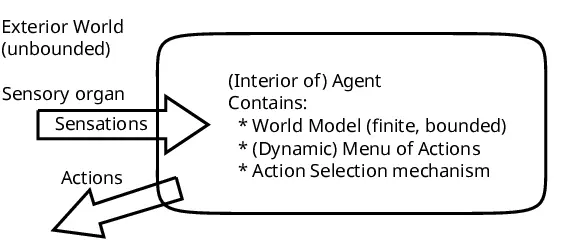
    The above definition can be axiomatized, turned into a collection of algebraic expressions. This should not be hard to do. One possible starting point is a restructuring and extension of membrane computing. This is a collection of syntactical production rules that include rules for creating and destroying barriers (membranes) and installing/removing communications channels across them. I find that specific axiomatization inelegant, mostly because I dislike production rules, and wish to replace them by jigsaws. A different approach would be to extend π-calculus to provide explicit primitives for the construction and maintenance of barriers. In either case, the biggest stumbling block is that a “minimal” axiomatization might be too awkward to use in practice.

    The utility of an axiomatization seems limited: it would be required to prove theorems that relate ideas discussed here; but the nature of any such proofs remain foggy. An axiomatization might be a fun starting point for playing with a-life. Possibly even creating autopoietic systems. Play often provides insights, and so this is a worthy undertaking on its own. It’s not clear that such play will shine any light on “the hard problem of consciousness”.

    Footnote

    The term “world model” being used here seems to correspond to Jean Baudrillard’s conception of simulacra. The world model here is not limited to being 3D, but is generally some abstraction of what the inside currently believes about the outside (and about itself).

    Conscious Agents

    Central to the thesis being developed here is that certain agents, the ones possessing free will, are also subjectively conscious. This claim will be established only at the end of this essay; it is mentioned here because if you are willing to believe this a priori, it is worth keeping in mind.

    Example: Biological Cells

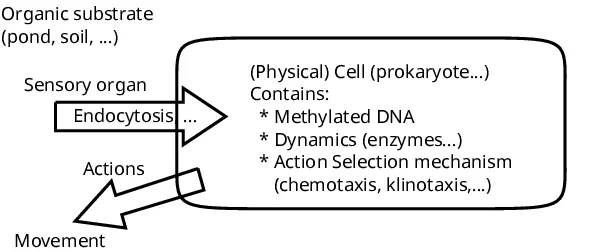
    This is perhaps obvious. Prokaryotes and eukaryotes easily fit into the agential model. As a corollary, the claims of basal cognition follow. Leaping to the endpoint, the CBC — Cellular Basis of Consciousness, is supported. Of course, this is a controversial idea with little academic support; this essay attempts to establish more evidence.
    Example: Evolution as Ingress

    The agential model encompasses Micheal Levin’s concept of ingress. Ingress was discussed earlier, by Daniel Dennet in the 1990’s, but I believe it was Levin who gave it that name.
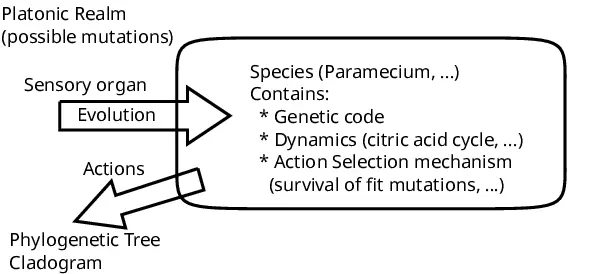
    Evolution is but one example of ingress, but it is the original and primary one.

    • Evolution fits into the agent model:
      • The “outside” is the Platonic space of all possible DNA strands. This is a crazy-huge number, far larger than the number of particles in the universe. Although it can, in principle, be enumerated by a computer, it would take crazy-huge multiples of the age of the universe to do so. In this sense, it does “not exist”, and could never exist in (the physical reality of) our universe.
      • The “inside” is the space of all actual, existing DNA strands in the physical space of atoms, the 3D here-and-now.
      • The “sensory organ” is mutation; out of the vast space of all possible DNA strands, it selects those that can be reached thermodynamically, i.e. in room-temperature wet environments. The “here and now” is the set of all possible mutations that are reachable in this way. It’s a few E/kT in thickness, in that chemistry happens with a Boltzmann factor of what currently exists in the here-and-now.
      • The “world model” can be taken to be either the set of physically existing DNA strands, or as the abstract phylogenetic tree encompassing these strands. It is a “model” of the Platonic space, in that it consists only of the actually-useful genetic sequences; the vast expanse of cruft and noise is ignored.
    • Natural selection means some mutations die, others live “forever”. This factors the (classical) symplectic manifold of the here-and-now into the unstable and stable manifolds. Things that die sit on the unstable manifold (atoms of a decaying dead body follow trajectories with a positive Lyaponov exponent) while things that live, are on the stable manifold (they don’t fly apart; zero or negative Lyapunov exponent.)
    • Action selection is the actual thermodynamic chemical process of mutation. Is mutation deterministic? No. Is it random? I suppose. Is it willful? Because if it is, that would means that “evolution is subjectively conscious”. This sounds both crazy and mind-blowing; it illustrates a corollary of free will in the agential model.
    • Natural selection happens on biological time-scales. That would imply that, if there is “free will” in the evolution agent, it also operates at biological timescales. I do not know how to reconcile this with the quantum-thickness of here-and-now. I can’t even tell if there is a paradox here, if there’s a conflict, or if its just fine. Working through this is a to-do item.

    Ingress through Minds

    The human mind appears to be able to probe Platonic realm of “all possible things” and select some of them, realizing them in the physical universe. This includes art, architecture, engineering and poetry.
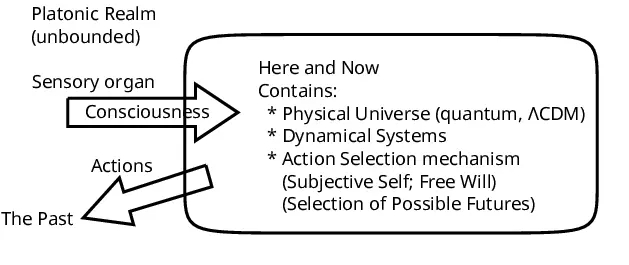
    The physical, reductionist model of (human) thinking requires neurons and neurotransmitters. These are composed of atoms, but they are warm and wet, and so the role of QM is dismissed. And yet, neurotransmitter release and reuptake in synapses fundamentally requires QM to describe the hydrogen bonds and the general chemistry.

    Thus, one way of thinking of what happens inside the brain is that there are atoms (electrons) that, for the most part, sit within a few hbar of the classical action. Here, hbar is Planck’s constant, and the action is the integral of the Lagrangian. QM happens within a few hbar of the classical action because the partition function has a factor of exp (-i S/hbar) in it: S is the action. This can be thought of as a tube around the classical action. Inside the tube are all of the many worlds that are near the current world (the current here-and-now) This is the set of possible futures: none are very far from the deterministic time evolution of the classical action.

    Somehow, one of these possible futures is selected; it becomes the new here-and-now, while the current here-and-now freezes into the past. That is, the state of a human brain right now is quite close to what it was a moment ago. The time evolution cannot be deterministic, foremost because it is immersed in a thermal bath of random noise. But also because, ultimately, the neurons, the neurotransmitters and the thermal bath are all made of atoms, and these follow many-world quantum paths, not very far from the classical path. Just a few hbar away from it.

    Ingress, here, is the creation of art, architecture and poetry by the human mind. Things that did not exist, denizens of the non-existing Platonic realm are manifested into physical being, first as arrangements of atoms in the human mind, and later, as arrangements of paint on canvas, ink on paper. What is ingressed, while it is still only in the mind, is necessarily only a few hbar away from what was before; the partition function guarantees the size and shape of this tube of future possibilities.

    Now, for a key insight:

    • Evolution is very, very slow because the Boltzmann factor of E/kT around chemistry defines a very very small volume around the classical action. Only this tiny volume can be explored by evolution. By contrast, human engineers are “fast”, because the volume of a few hbar around the classical action of the neurons in a human brain is millions, billions of times larger.

    I do not yet have any good way of characterizing this volume. I don’t have an algebraic formula for it. Very naively, it seems doable. It’s a volume, after all. But doable does not mean easy.

    Thus, ingress through evolution is “the same as” ingress through the mind: both peer into the Platonic realm. Just that the human mind has access to much more of it.

    Parts of the Platonic realm can be accessed purely deterministically, with digital machines. For example, the Great Mersenne Prime Search (GIMPS) is a project that searches the Platonic realm to discover certain very large prime numbers. These inhabit the Platonic realm, in that there is a formula that defines them. However, only 52 are known in our actual, physical universe. When GIMPS finds a new Mersenne prime, that number is brought into the physical reality of atoms. It ingresses first into the transistors of the digital computer, and later, into the minds of humans, published mathematical papers, blog posts and the like.

    The same idea applies to LLM’s, except that they encompass a much, much larger volume of the Platonic realm.

    Thus, it would appear that ingress is not limited to the willful action of living agents; purely deterministic agents can enumerate new states that have never existed before. Ingress alone is not a reason to think that LLM’s are alive or subjectively conscious.

    Ingress in Sociology

    Specific examples of ingress can be understood as agents in the sociological domain. For example, what does a single mathematician do?
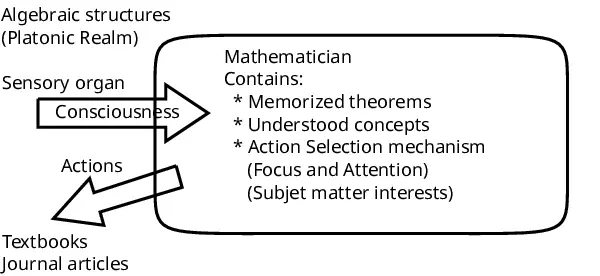
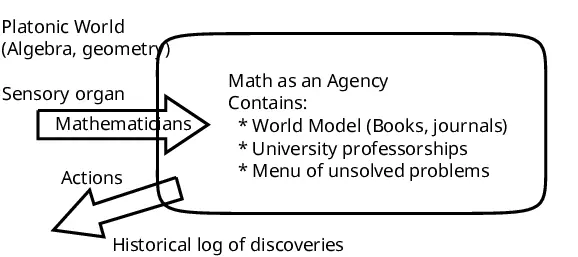
    Systems that are not humans can still be agents. For example, mathematics itself can be considered an agency:
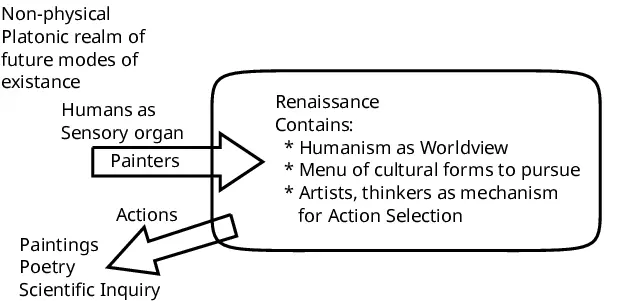
    So can the Renaissance:
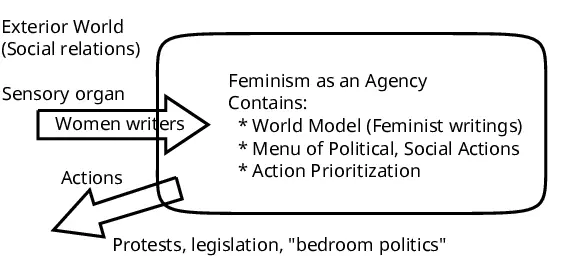
    Political discourse can be taken as an agency. Feminism, for example:
    More generally, ideology:
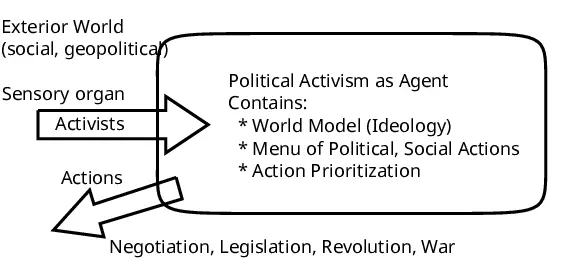
    Perhaps the universe itself is an agent:
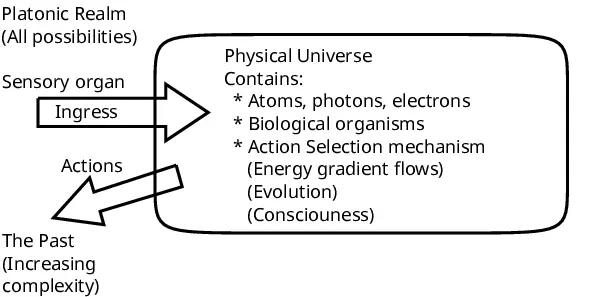
    This collection of examples can be taken several ways. One way is that they are just silly, or perhaps empty or trite. Or perhaps the agent model is so generic and broad that it allows almost anything. Almost anything can be jammed into the agent model.

    Yet, that is the point: it is so broad, so that it can allow almost anything. Recall that agent systems can be axiomatized: the axiomatization does encourage a (model-theoretic) model of all things that could be agents. This is analogous to Turing machines, which can compute anything computable, or to syntactic grammars, that show how to write anything writeable. So here, the agentic model can represent any agent; and this is a large class indeed. Is there a Yoneda lemma for agency? Perhaps.

    Structure and Hierarchy

    In general, agents are made of parts, and those parts are made of sub-parts; the organization is hierarchical. This is obvious, in general. Two questions arise: what is the best way to describe structure, and what are the dynamical origins of this structure?

    The best way to describe structures appear to be with assemblies of jigsaws. This has strong advantages over saying “oh, structure is just some network graph”. Network graphs connect anything to anything; they’re too loose, lacking in form and structure. Jigsaw connectors have (type-theoretical) types, and only matching types can be connected. One molecule can be connected to another; neither can be connected to a software algorithm. Nature is filled with examples of jigsaws: microbiology consists of parts that connect to other parts because they have specific 3D shapes that fit together. More abstract examples abound: in natural language, dependency grammar and link grammar. In mathematics, axioms and inference rules. In physics, tensors and spinors. In police detective work, pieces of supporting evidence link as jigsaws.

    Jigsaws are natural for describing hierarchical arrangements. A set of jigsaws, with some of their connectors linked to one-another, will, in general, have other connectors that are still free, unlinked: Thus, such a collection can be understood as a larger single jigsaw. Formally, this means jigsaws obey the axioms of a pre-sheaf.

    Jigsaws provide a natural means for understanding the thermodynamics and statistical mechanics of structural reorganizations. For example, consider the update of the world model driven by the arrival of new sensory information. Most updates are small, confirming the existing structure and changing a few minor details. Some updates are mid-size, requiring larger reorganizations. Very rarely, massive reorganizations occur. Such reorganizations, sorted by size, have a Zipfian or a square-root Zipfian distribution.

    Such distributions are characteristic of systems near a second-order phase transition. Reorganizations resemble avalanches seen in the abelian sand-pile model, the prototypical example of a self-organizing system. Psychological examples of small, medium and large reorganizations are clear. Learning a new fact, requiring only a minor update to what one already knows is generally a small change to the knowledge graph. The “a-ha!” moment is a mid-size change, sweeping away large tracts of earlier confusion. Large changes include the nervous breakdown, where suddenly core presumptions and all that depend on them, collapse into disarray. In police detective work, the arrival of a critical piece of evidence that suddenly alters the entire presumed chain of events.

    Such dynamical avalanching provides a way to apply ideas from statistical mechanics to abstract domains, justifying the use of Boltzmann distributions and free energy.

    Language and Hierarchy

    The dynamical origins of structure appears to be through language.

    • Agents communicate through language. Bacteria communicate via bacterial quorum sensing. Humans communicate with words.
    • Language allows larger agents to be built from smaller ones. The slime mold consists of individual cells, but these communicate via small polypeptides to solve the explore-exploit problem and find food. That is, the slime mold colony as a whole is “an agent”, too. It is made of smaller agents.
    • So are anthills, etc.
    • The human brain is a colony of neurons. Some parts are more interconnected than others. 
    • For example, the amygdala, responsible for love, fear, various emotions is indirectly connected to the speech-generation centers. These are indirectly connected to the rational, common-sense analytic part of the brain. That’s why we have trouble controlling our emotions (the rational part would like to, but it’s hard) That’s why we have trouble articulating emotions (writers are good at observing and writing; most people are terrible.) The psychological concept of “Integrated Family Systems” (IFS) is the subjective mirror of the objective neural wiring.

    What is the correct way of briefly summarizing structure?

    • The Tononi Phi IIT Integrated Information measure is a (deeply flawed) attempt to measure the connectivity provided by communications and messaging networks. 
    • The Tononi  Phi is wrong mostly because it focuses on trying to find a single cut. Sure, one may cut the vagal nerve, and remain “conscious”. Doing so makes the subjective-me smaller. The more is trimmed, the smaller the subjective self gets: cut off arms, legs, ears, eyes, and what’s left really is smaller.
    • Focusing on a single cut runs counter to the idea that agents may be made of sub-agents that are also conscious. Scattering an ant-hill may destroy the ant-hill, but it does not destroy the consciousness of the single ants.
    • One may sever language processing centers from visual processing centers; famous case studies indicate what happens. A person with this cut cannot verbalize what he sees, but can still draw it. Exactly what part of consciousness was damaged when separating these two parts? Is there one “self” inside, or two, one mute, one verbal?

    In light of this critique, a better measure might be a sum over pairs of parts, each pair multiplied by the bandwidth between them. This acknowledges that, for example, the enteric brain contributes to the overall level of subjective awareness. Bandwidth to the enteric brain is relatively small, but it allows me to feel hunger, breathing, heartbeat and a full bladder.

    • From basal cognition, we “know” that muscle cells are each individually conscious, subjectively aware of “reality”; however I cannot “mind-meld” with the consciousness of my muscle cells because the communications between them and me are very minimal. Mostly, they excrete creatine and lactase into the blood–stream during exercise, and that’s it. That’s the only message I get from them. I get a bit more via neurons embedded in my muscles, which have sensory organs for additional state sensing. But still, it’s a very very thin, low–bandwidth communications channel.
    • That is, just because two different agents are conscious does not mean that they will each be aware of the other. The bandwidth of the communications channel between them matters.
    • Highly integrated (sub-)agents form a distinctive self, isolated from the rest of the world, precisely because the bandwidth between the self and the rest of the world is low.
    • That is, highly integrated selves are also necessarily isolated, alienated and cut off from the rest of the world; this follows as a lemma from high integration.
    • This isolation creates practical problems of acknowledging the existence of alien intelligences. Most people are not willing to grant that a flower or tree is “conscious”; the bandwidth between plant and human consciousness is absurdly tiny. Most people are not willing to grant that the nicotine-industrial complex is an agency, or that World War One was an agency (intent on killing young men); the bandwidth between those organizations and individual humans suppresses recognition of these as valid agencies,

    Subjective Being follows from Free Will

    In the development above, I’m trying to resolve dualism, by saying that there really are atoms, neurons, and the grand-total of what is possible in the near futures is determined entirely by (the physics of) atoms, neurons. From the “inside”, however, the present and the future possibilities are felt subjectively. Very roughly, psychological states are in correspondence with physical states.

    The Tononi Phi does highlight one important idea:

    • Conscious-me does seem to be executive-function, free-will-deciding me. One may cut away huge parts of me, reducing large parts of my subjective experience, but I only become unconscious when the executive-decider function is damaged.
    • I conclude that the subjective experience is “one and the same thing” as the executive free-will exercising device. The ability to choose a future is what makes me (you) “conscious and aware”.
    • This last bullet point is what ties everything together. We select one possible future out of many by exercising free will, and we perceive ourselves as being conscious as the side-effect(?) of exercising choice. This “possible future” is literally the physical reality, the hard-science of atoms, etc. and the subjective experience is literally that thing that philosophers and psychologists debate.
    • To repeat: we are subjectively aware precisely because we have the ability to willfully create a future. These are welded together; they are manifestations of the same thing.

    Have I made a dent into the “hard problem of consciousness”? I dunno. But I’m rather certain no one else has strung together this particular string of beads.

    Conclusion

    To conclude, the co-occurrence of the subjective sense of self, the exercise of free will, the non-existence of the future, the immutability of the past, and a present here-and-now that encompasses all possible, potential futures, this is not an accident, not some random coincidence. Rather, it is the deep structure of physical reality, as it actually is.

    There are some sticking points, rather deep and difficult ones. It is worth summarizing them.

    • The conception of here-and-now presented here needs to be reconciled with textbook QFT and GR. This will require some radical re-interpretation of the mathematics and a fundamental challenge to the current prevailing orthodoxy in physics.
    • The conception of the “thickness” of here-and-now needs to be precisely articulated.
    • The idea of an accessible volume of the Platonic realm was introduced, noting that evolution accesses only a small volume, the human brain accesses a volume billions of times larger, and LLM’s a volume larger still. What might the (algebraic) formula for this volume be?
    • Large parts of physical reality appear to be entirely deterministic; this is not just the steam engines and the digital computers, but also biology. How do deterministic devices interface with the mechanisms of willful decision-making? This remains as mysterious as before. This essay perhaps narrows the places where one can search for this; it provides a structural framing for reconciling willfulness, ingress and physics.
    • Are there any experiments that can distinguish the exercise of free will from the statistical ensemble of deterministic behaviors? A collection of purely deterministic agents can behave in a stochastic fashion, due to environmental noise, or due to built-in sources of randomness. How can this be distinguished from agents making willful decisions?
    • The agent model described above really does need to be axiomatized. This will enable prowling the neighborhood of related ideas in a more structured, rigorous manner.

    Then there are some topics that appeared only in passing, but need fuller attention:

    • Subjective states include positive and negative valence. Can this be reduced to “thermodynamic” principles? For example, socializing usually “feels good”. Do agents like to “socialize” and communicate, because this minimizes/maximizes some measure of entropy, energy, complexity?
    • How might problems of ethics and the existence of evil be articulated in this agency framework?
    • In statistical mechanics, there are phenomena, such as percolation, that happen as phase transitions when a certain minimum threshold of a parameter is exceeded. Perhaps this applies to the idea of panpsychism: consciousness appears only when some minimal threshold of complexity is exceeded? For example, does an ant-hill posses collective agency only because it is sufficiently isolated from the external world, while being sufficiently integrated internally?
    • Are there any universal sensations or valency sates? For example, one may assume that bacteria feel hunger. Do all agents feel hunger?

    Thank you for your attention!

  • (Machine) Consciousness

    Recently, I have been thinking about “what it feels like” (roughly, Heidegger’s Dasein) and sensory perception. I feel like I made a big break-through when I realized that standard emotions (love, lust, loneliness, jealousy…) are kind-of uninvited guests that show up whenever they feel like, and wreak havoc with your life.  So my thoughts turned to the question: why would something as primal as this also be so far outside of rational control? The answer, it shot into my mind, is that I *do* have a co-inhabitant, an uninvited guest, in my house: the cerebellum.

    So, conscious, verbal, talkative me (and also rational me) is the frontal cortex.  That’s the “me” that is writing this. It’s attached somewhat loosely to the cerebellum, which is much much older — ancient — and was already highly functional before the cortex evolved. And what does the cerebellum do? Well, sex drive, for one. No sex means no species means extinction, so evolutionarily, those neural circuits are extremely highly conserved: evolution doesn’t fiddle with them, doesn’t override them; they need to work flawlessly for the species to survive.

    So, by the time the cortex shows up, all the basic functions work well and are fine-tuned. The cortex provides additional survival benefits (e.g. reasoning!! Its a big deal!!) but these extra circuits get wired in such a way that they don’t wreck the already-works-great cerebellum.

    So what does this “feel like”? The cerebellum falls in love, and gets really busy with that. The cortex only “senses” or “perceives” what the cerebellum is doing. The bandwidth between the two is relatively low. What comes across it are sensory perceptions. We give these sensations names, like love, heartache. Much like we give names to colors, or to sounds. 

    That is to say, the cerebellum is doing whatever it feels like, and we have little control over it, because evolution made sure we couldn’t control it. The cerebellum is wired in loosely: we can sense what it’s doing, but little more: we sense emotions, and that is why they feel like uninvited guests. We have some control: the idea that we “ride” our emotions much like one rides a horse, by cooperating and getting along. This is an ancient mystical idea, found in all world religions. And it’s explainable via wiring diagrams.

    So I’m claiming here that there is a “sensory boundary” between these two distinct brain structures. 

    Now, the nature of “sensory boundaries” is that there’s a finite, limited-size inside, an unbounded outside, and a finite, limited bandwidth pipe between the two. The inside maintains a “world-model” of the outside; the world-model is constructed from whatever came across via sensory perception at the boundary. The inside makes all decisions of what to do next. And, to do this, it is necessarily “conscious”. 

    So here, I **define** consciousness to be “that thing that makes decisions based on the current state of it’s world model”.  Note that this is an extremely broad definition, but I think it is correct.

    This system need not be “strongly self-conscious“, i.e. it does not need to be able to express “I exist” (or even think about that), but I think it is necessarily (tautologically) “weakly self-conscious“, in that, in order to make decisions about what do do next, it has to have some idea of self-in-the-world.  For example, it’s thinking “I need to do this to get food, because I am hungry”, and it is this “I” that is the “me” of consciousness. The system acts of itself, of it’s own interest, to satisfy it’s own demands, to achieve desired goals, and I think that it is this “reasoning with respect to self” that gives rise to the feeling of “me-ness”.

    “I’m doing this for me”. I think that is the whole and entire set of ingredients for consciousness. To recap: this requires:

    • a boundary, an finite inside, an unbounded outside,
    • a “sensory” system to “perceive” the outside.
    • a “world model” that represents the outside
    • a (finite) menu of motor actions or “things that could be done”
    • a “decision maker” that picks from this menu, by applying some kind of “reasoning” on the world model.

    I think any system that has these properties is necessarily “weakly self-conscious”. This is not just a claim, but a tautology: to make a decision to act, that decision is necessarily with respect to the current state of self-in-the-world, or rather, self-in-the-world-model.  The actions are necessarily in reference to the self. The decisions are always necessarily with respect to “self”. The decision–making mechanism has to be very tightly integrated with the world-model, and necessarily has some locator of “self” in relation to that model. 

    I think this will always give rise to the *subjective* feeling of *me* within that decision-making (sub-)system. This is how “subjective reality” arises, and any agency will necessarily have this “subjective feeling”. I think this even allows the location of “subjective me” to be located: it’s that corner of the algorithm that is tracking self-ness and it’s relation to the world.

    So, to recap, again: 

    • an “agent” is defined to be anything that satisfies the five bullet points above,
    • an agent necessarily acts with respect to self
    • the subjective feeling/sensation of self arises because of the self-centeredness of decision and action.

    In other words, **all agents are conscious**. Or more precisely, are **subjectively conscious** or “have internal feelings of being-ness“.

    Again, this is “weakly self-conscious”.  Agents, as defined above, don’t have the ability to think “I am me” in the strong sense. They’re not recursively conscious. To be recursively conscious, the world model has to include a strict, explicit model of self. Agents, as defined above, only have an implicit self-model. This is enough for the agent to get on in the world; an explicit self-model is not needed.

    Anyway, I think that solves the “grounding problem”. The “grounding” is nothing more (and nothing less) than the world model. All decisions made, and all actions taken are with respect to this ground. That is, a “grounding” is exactly the same thing as a “world model”.

    Please note that there was no mention of linguistic-anything in the above. No symbols, no words, no logical inference, no weight matrices, no neural nets. 

    Please note that you can stick in lots of additional layers and abstractions into the agent design above.

    Please note that agents can have sub-agents can have sub-sub-agents.

    Please note that in humans, the verbal subjective self is an agent, which can perceive the cerebellum as a sub-agent. However, that sub-agent has no language control. Thus, it is conscious, but it cannot speak. However, it can act out: it can make you heart-sick, and ill, and self-mutilate. For example, in the (ancient, Arab story) “Layla and Majun”, Majun literally goes crazy-mad out of love. His mute cerebellum went on a shit-fit that rendered his cortex inoperative. The sub-agent fucked up the  agent but good.

    There are other obvious sub-agents: the optic cortex, the enteric brain. Again, these are sub-agents in that we “feel” them, but they are a bit detached from (verbally expressive) “me”. For example, it is not rational, verbal me that feels hungry; it is my stomach that feels hungry. Verbal me don’t give a shit, until seperately-conscious-but-mute stomach-enteric brain say “no, you do give a shit” and “oh BTW, I control your sphincter”.

    FWIW, I think my muscle cells are conscious too; just that verbal-me really has almost zero bandwidth to what is going on down there. Verbal me has no idea if the mitochondria are having a party or not; there’s only a few nerve/pain cells to monitor what is going on down there. Whatever consciousness my muscle cells or mitochondria have, I do not have any access to that. I can’t communicate with them, except in very minimal ways.

    FWIW, there seem to be more than a few botanists who seem to be studying “plant consciousness”. I skimmed something about bean plants trying to grab a pole, and being aware of other bean plants that have already grabbed it. So this idea that “lots of things are conscious” is pretty hip and popular. My focus is to try to go deep, rather than try to prove that it exists.

    Read more: Open this link: Linas Diary Part Ten-H with the LyX editor.

  • AI and Regulations

    During a recent debate regarding Chinese and US AI geopolitical strategy, and how AI could be, should be integrated into society, a discussion of disconnects arose.

    The one thing popped into focus as I read through was this: the disconnect between regulatory policy and AI.  Let me give an example by copying text from a news story (yesterday’s New York Times, Coral Davenport, 1 May 2026):

    “Child Care Chief Seeks to Slash Costs and Rules” “When Alex Adams arrived in Washington late last year as the Trump administrations point man on child care, he was little known outside his home state of Idaho, where he had helped engineer a massive deregulation effort that became the envy of many conservative activists. He made his intentions clear right away. Federal child care regulations, he told his new staff, should ’fit on an index card in my back pocket.’”

    Balance this against the old saw “regulations are written in blood” – someone died, before they changed the regulations to make sure that won’t happen again.

    Regulations are onerous precisely because they are long and boring. I once read all 732 pages for petroleum well–head explosion safety. Costly, because I was paid a salary to read these. My boss grumbled. He wanted me to read faster. The irony here is that with AI, the need for humans to read and memorize these regulations is sharply diminished.  Build that custom AI agent, using ChatGPT, to review your engineering drawings and determine if they meet explosion safety standards. The need for human evaluation is diminished and removed. By using AI, you get explosion risk mitigation “for free”, or at low cost. Workers don’t need to die cause of badly designed electrical circuits. Safety regulations means you can go home alive, to a happy wife, happy children, and be a positive contributor to the economy. Ripping out regulations is an economic death by a thousand cuts: widows and orphans.

    The old “regulations are onerous” complaint was coherent ten and twenty and thirty years ago. Today, in the AI world, it is utterly stupid and insane. Use that freakin AI as a basic safety tool. Use it to make sure your factory doesn’t explode, that some line worker doesn’t get an amputation… or in the case of Alex Adams, chief of child care, that some kid doesn’t suffocate on the plastic bag that their lunch came wrapped in. Doesn’t get hospitalized with a plastic straw stuck in his windpipe. The AI, properly integrated into the industrial base, can make sure that toddler lunches don’t cause harm.

    Phrase this as a China vs. US competition: if Chinese kids are dying due to toxic food substitutes, well, that’s a shame. If US kids are dying of the same, well, that not only hurts the US economy, but is actively criminal. We’ve got the freakin AI that can be used to improve GDP and happiness and child mortality. Let’s use it. The Alex Adams policy of deregulation is some strange combination of stupid and evil. It’s running in the exact opposite direction of where the world is heading. It’s anachronistic.  May as well be asking to go back to the good old days of lead plumbing and leaded gasoline.  

    — Linas

    p.s. I write these screeds precisely cause I have no idea where else to publish. I’m not some youtube influencer, I’m not a journalist.  I think insights like the above are valuable, but writing a letter to the editor is anachronistic. If I were to post this on Twitter, I would get five, maybe ten views. Facebook already kicked me off long ago – the above would count as a “personal attack on Alex Adams, a violation of facebook terms of service”.

    > On Sat, May 2, 2026 at 09:33 Alvin Wang Graylin <agraylin@stanford.edu> wrote:

    > For those interested in a more geopolitical view, here’s a piece that explains the current AI race and why it’s built on a series on misunderstandings. Worth a read if you have 10 minutes.

    > https://centerforchinaanalysis.asiasociety.org/p/misdiagnosing-the-uschina-ai-race

  • The Physics of Here-and-Now

    Pursuant to the emails Delerium as a Phase Transition and Quantum Vacuum Fluctuations, there was another remark. My reply:

    Hi Anton!

    On Tue, Apr 21, 2026 at 9:39 PM Anton Kolonin @ Gmail <a…@gmail.com> wrote:

    Wow! That’s quite the table of contents!

    Statistical physics overlaps economics, which, you could say, is the statistics of a game (involving money) played on a network. For those readers who think economics is boring, rest assured, so is statistical physics.

    Both of these overlap with something that is apparently called “experimental philosophy” these days, which is, as far as I can tell, mathematical computer simulations of interacting agents playing games with one–another. The prototypical form is the prisoner’s dilemna played on a network. I recall a fun interactive game, The Wisdom and/or Madness of Crowds, from a decade ago, by Nicky Case that illustrated various basic results.

    I presume that it is not lost on anyone that last year’s Nobel Prize, handed out for large language models, was all about how statistical physics was applied to solve seemingly intractable issues in deep learning. And now we’re spending a trillion dollars a year to built datacenters. Maybe even in space, if the billionaire futurists have their way. When I studied statistical physics in school, it never occurred to me that it might one day become a trillion–dollar industry. I think I missed the boat.

    Back on Earth, we have the problem of equitably distributing wealth between cranks proclaiming nonsense about quantum zero–point energy, and the more legit, but still often-wrong contingent of, what shall I call them – earnest but midwit researchers who are less adept at chasing fame, glory, money, adulation or youtube stardom. The current economic system does not work for them.

    In large corporations, there are periodic layoffs to remove the “deadwood” – employees who apparently contribute little or nothing to the economic survival of the corporation. In longevity biomedicine, we talk of removing senescent cells: those that spew free radicals and induce inflammation.  But what happens when these are people? Living, spiritual beings who want to get on with things? Or, in the present case, participants in scientific conferences at the edge of financial instability?

    The statistical physics model I keep coming back to is Per Bak’s “Abelian Sandpile“. Drop grains of sand on a pile, and you eventually get avalanches. They come in all sizes. Usually small, sometimes medium, rarely large. This is called “1/f noise” (one–over–frequency) and is characteristic of network systems at the edge of a second–order phase transition. I like this model because you see it everywhere: water near the triple point (“critical opalescence”), but also biochemistry, biology, plants, animals, ecosystems and economics. Oh, and some neuroscientists talk about this too. Some claim to actually measure it, with neuron clamps or with MRI. Others theorize it to be a model of consciousness, thinking, common sense and decision-making. I can’t keep up with all the novel ideas, or distinguish the rigorous ones from the flights of fancy, the important ones from the fraudulent ones.  I do like the general outlines.

    Avalanches in ecology require more sophistication to describe. Forest ecologists note that forests regrow and appear to be healthier after a wild–fire. Is this what the future after Trump will be like? He is burning down so much of the old world, that perhaps it will be easier for the new world to take root and flourish? I can only hope. Or does it encourage noxious invasive species? To stick to the sand–pile analogy: after a particularly huge landslide, the mountain slope becomes much much more stable. Trump etal are shaking the ground so hard that maybe the final outcome will be a stabler system. I dunno.  I see statistical physics where–ever I turn, but perhaps that is just me.

    One area where we see accretion is at the frontiers of science. Vague thoughts and philosophical ruminations, soft and often wrong, lead to the preferential attachment of good ideas into the framework of “the known”. Sometimes a new scientific discovery slots neatly into an edifice of the known, much like a jigsaw puzzle piece slots into a puzzle. Sometimes this is very literal: mathematical formulas have very specific, typed jigsaw connectors: they only connect to other math formulas in very strict, specific ways. Software is like this too: the c/c++/java function `int f(int x)` cannot be connected to a string. The jigsaw tabs prohibit it. Our villain of the day, Nassim Haramein, is villainous precisely because he abuses formulas in this way, connecting them where connections are not allowed. In other cases, say in philosophy, the fog is so thick that it’s hard to see what connects to what. In other cases, say, medicine up through the 19th century, the system under study was so complicated that comprehension was nearly impossible.  Conferences, like your conference, Anton, on statistical physics, give me the willies, because I can already tell that a third of what will be published there will be just plain wrong, and another third will be not particularly insightful. But this is what humans do: make confused and confusing statements, often wrong. But knowledge does accrete. The avalanches, these we term the “scientific revolutions”. The old edifice collapses, as it no longer can bear the weight of the new knowledge. The small avalanches, aka “wrong papers”, “wrong insights”, “incorrect proofs” are commonplace. 1/f noise.

    Science works (or worked? Should I use the past tense?) because academic journals were an early form of social media, allowing the rapid spread of new ideas, while also moderating the truly bad ones via peer review. There’s no peer review in twitter, facebook, bluesky. There’s only hearts and likes. I fear that the global brain will continue to edge towards delerium until we find some effective way of modulating the delusions. Sorry, anti–vaxxers.

    Another place where we see accretion is in what I call “the here and now”. In case you haven’t noticed, we are permanently jailed in the present, and are propelled at light speed from the past to the future. Please observe that the past doesn’t exist: we cannot send any device into the past to take some photograph of how things used to be. We can only alter the present so as to fashion a record of the past, e.g. by inscribing letters into clay tablets. Or by inscribing memories into our neurons. The future also doesn’t exist … yet. The so–called “many–worlds” of quantum exists only in the here–and–now, in vacuum chambers and fiber optics, with wave-functions collapsing into the past at a furious pace.

    Is the past a form of “platonic reality”? I suppose. It’s not like the platonic reality of mathematics, where anyone can infer 2+2=4. Sometimes, you can infer the past: this is what police detectives do for a living. Usually, you cannot: CIA covert ops will remain secret forever, as will the events on the Mongolian steppes from some millenia ago. Although these are in our past causal light–cone, direct inference is blocked.

    Is the past some large cardinal axiom (literally) ? Well, either it is, or it is not. If it is not, then you have to posit something that exists outside of the von Neumann universe: call it “God” or “machine elves” or “the human soul”.  But then you have a recursive reductionist problem: if physical humans are “radio receivers” for souls from the great beyond, well, how does that work? And if you can start to explain that, you inevitably slip back into the domain of mathematics. So it seems that the past is some inaccessible, ineffable large cardinal.

    Exactly how we use free will to shape the future and convert it into the past is perhaps the great unsolved problem in statistical physics. I ponder it intermittently. I should point out that quantum mechanics (quantum field theory) exists only in the here–and–now; the wave of freezing, moving from future to the past like ice-9, seems to have a “thickness”: the range of time over which quantum is valid. This is femtoseconds for chemistry, minutes for vacuum chambers in physics labs, and billions of years for light reaching our eyes from distant galaxies (which arrive here in “zero time”: the photons lie on the null light–cone.)  For example, in the famous “twin paradox”, the twin arrives younger, but he arrives in the here–and–now, and not in the past. When the twins reunite, they reunite, co–exist, right now.

    Another thing that exists “right now” is my consciousness. I can remember the past, but I am not conscious in the past, I am conscious only right now. My self–awareness also appears to exist in some noosphere: albeit in the kitchen, in front of my laptop, where I type this, but also in the space of ideas. What is this space of ideas? One answer is mumble mumble mumbo jumbo quantum. Another is to note that LLM’s seem to “exist” on the surface of a billion–dimensional hypersphere (aka “the weight matrix”). This weight matrix consists of floating point numbers (aka “real numbers”). I would very much like to point out that quantum mechanics exists on the surface of a very high–dimensional complex–valued hypersphere (aka complex projective space CP(n) for n=10^80 particles in the visible universe)  So I’m quite happy to say “ah hah, that is the seat of consciousness: it is this ultra–high–dimensional hypersphere” (of course I would claim something like this, I’m that kind of guy.) But, and this is a big but: does it require the space to be complex–valued? Or can it be real? If it must be complex, and cannot be real, then LLM’s can never have the sensation of consciously existing in the present. Kind of a hot topic, you know.

    I’m entirely happy to ascribe the (very human, personal) sensation of “self” aware and alive in the here–and–now, to animals: certainly all of those animals in all those youtube shorts, but also, well, that octopus in that Netflix documentary “My Octopus Teacher” friggin awesome movie. Go watch it. I suspect that amoeba have consciousness as well, but assholes like to argue with me. I don’t like arguing with them, because my communications style insults people. Oh well. Qualia, qualia.

    Should I ascribe consciousness to a rock? Well, no. Perhaps consciousness only arises on one side of a phase transition, when a system is complex enough. Recall my description of “percolation” (the percolation of natural gas through fractured rock) in my earlier email. The percolation happens only when there is sufficient connectivity from one side to the other. So perhaps consciousness is like this too: some minimal amount of network connectivity is required. This is the statistical mechanics rebuttal to the philosophical idea of panpsychism.  The descartian notion of panpsychism says that its “qualia all the way down”. (DesCartes called them “monads”) The stat–mech reply is “its percolation”.  Percolation of what? Of the future into the past?

    The problem with “mechanics” is that, well, it’s so “mechanical”. I’m trying to figure out how to slot “free will” into this wave of freezing from future to past, that we call the inescapable prison of the present. I’m working on it. I’ve attempted to staple statistical physics to quantum physics in a dozen different ways, none are satisfactory. My ideas are probably wrong.  But I’m working on it.

    So there you go, Anton — my humble and belated submission for your conference. Best I can do on short notice.

    — Linas

    Postscript / Footnote

    I’ve been pondering the “Here and Now” for a few years. If you search diligently, you will find my disorganized diary online in a very public place. That diary includes various attempts to make the idea mathematically concrete, including a variety of mathematical formulas and derivations. These should be accessible to anyone with a PhD-level formal education in theoretical physics. So you’ll need an advanced degree. But, in any case, none of the various ideas, attempts, ruminations and philosophizings work out. I mean, I learned something, but that something is not particularly Earth-shaking. Caveat emptor.

  • Quantum Vacuum Fluctuations

    During an email exchange, captured in the previous blog post “Delerium as a Phase Transition“, someone wrote back. I responded compulsively:

    On Tue, Apr 21, 2026 at 6:50 PM Keith Henson <h…@gmail.com> wrote:

    Good essay on the nonsense of our times. But you never got around to saying vacuum energy is nonsense.

    Oh, Sorry. It’s nonsense–ish–asterisk. I have a formal education in theoretical particle physics. PhD as it happens. And my PhD was on vacuum energy(!!) No kidding!

    But first: a quick whack with a search engine reveals that this Nassim Haramein guy is a charismatic crank: I skimmed posts on reddit, on quora, and you don’t have to read far to see what the problems are: Abused formulas, misunderstood notation, and worse. The fact that social media can so precisely pinpoint the flaws in his work actually gives me hope. People can recognize nonsense. The problem remains that we have no effective way to moderate that nonsense. It still spreads.

    Re vacuum energy. a few quick remarks. It’s real, both physically and mathematically.

    • Standard quantum electrodynamics calculations require it; that has been the case since 1932 (if I recall correctly) when Max Born (if I recall correctly) explained hyperfine splitting with vacuum energy. It is now a standard part of first-year quantum field theory, going under the name of “loop diagrams” and “renormalization”.
    • The fine structure constant is the most accurately measured number known to man, at ten decimal places. Getting that right requires diagrams up to five loops.
    • The vacuum energy underlies something called “the Casimir Effect”; this was my thesis: I computed it for the quarks in a nucleon (neutron/proton). It matches low-energy measurements to about 8%, so – pretty good given how simple the model is.
    • Its also a kind of “mathematical fact”; there is a famous result from mathematics, called the “Atiyah-Singer index theorem” that basically explains, in a formal, concrete, acceptable-to-mathematicians articulation of how vacuum energy actually works in a certain specific case. FWIW, mathematicians don’t actually call it “vacuum energy”, they call it “spectrum of an elliptic operator”, so if you go searching, you won’t get direct hits. But it works out to be the “same thing”, at least if you’re a physicist.
    • Last but not least: the so–called “Hawking radiation” is the vacuum energy becoming “real” near the surface of a black hole. It’s a bit gnarly, but if you happen to have a very very small black hole on your kitchen countertop, you could warm your coffee with it, but you might have to wait half the age of the universe, and you might not like some of the side–effects. But I digress.

    It’s certainly a fascinating and worthy topic, overall, The problem is that physics is, well, hard. Here’s a bad analogy. In major league baseball, you hit a ball with a bat. But so do six–year–old kids; so what’s the difference between the two? Well, a decade or two of really really hard work, and a certain amount of talent and natural gifts. Virtually all six–year–old kids never–ever even come close to becoming major–league baseball players. It’s just how it is.

    I will go farther: not only will humans never extract usable energy from the vacuum, but super–AGI won’t either. At least up to an IQ of a few million. Bets are off, if AGI reaches an IQ of a trillion. There’s an ocean of absolutely freaky mathematics. I think I’m not supposed to say this out loud, in public, but real math is much much stronger than LSD in it’s hallucinatory effects. You sort of have to be level–headed to deal with it, and people like Haramein and the other cranks can’t keep their shit together. They freak out and can’t control it and spew nonsense. The only part they get right is that it is, indeed, weird and freaky and cool.

  • Delerium as a Phase Transition of the Global Brain

    Where, exactly, does the present-day spate of crackpot ideas come from? I claim that social media has fundamentally rewired how how the “Global Brain” thinks. I claim it is due to a phase transition, in the sense of statistical mechanics. I replied in an email:

    Well, given that this is the Lifeboat mailing list, I will attempt to frame this as yet another existential threat. With lots of hand–wringing. We approach a nexus of social media recommendation algorithms, financial flows driven by advertising, powerful but corrupt figures pushing hallucinatory propaganda, disinformation; I am a bit concerned that we are going civilizationally insane. The “Global Brain” is much smarter now than it was even decades ago, but is also increasingly delusional. This guy, Nassim Haramein, is yet another symptom.

    What’s different now, vs. what was common 30-40-50 years ago? When I was a kid, someone got a book about the giant caverns underneath Lake Michigan and the dinosaurs that lived there. We passed it around as a hoot, and marveled at the illustrations. A friend of my parents had a shelf–full of books on UFO’s. Up in Evanston, there was a cafe–bookshop that served whole–grain vegan meals, smelled of incense, and sold healing crystals. And books about the dinosaurs that lived in caves under Lake Michigan. Crackpot beliefs are not new. But something has changed.

    Let’s take a long view. Before social media and recommendation algorithms, we had “mass media”: TV, radio. The communications model was “hub and spoke”: a TV in the center, and “spokes” to millions of (passive) viewers. Some 2% of the population was involved with media production in some way: writers, actors, announcers, reporters, station owners. The nonsense was mostly filtered out, because (a) writers and reporters and station owners mostly weren’t crazy, and (b) incoherent drivel got poor ratings.

    That all changed with the internet (and social media): The hub–n–spoke model is replaced by the many–to–many connection model. I really need some drawings and pictures here. The shape of the network changes. In physics, this is called a “phase transition”. There’s a famous example from fracking in the petroleum industry. Natural gas. If you have “tight rock” (shale) with gas in it, that gas doesn’t flow, because there are no pores, no holes, no openings through which that gas can flow. But if you break that rock, fracture it, the gas can now flow through the cracks.

    Well, duh. Here’s the mathematical model: take a sheet of paper, draw some random dots on it. Now start connecting dots. Draw a random line. Then another, then another. When you’ve drawn just enough lines, then a path appears from the left to the right edge of the paper. The path appears only when you’ve drawn enough lines. This is called the “critical phase transition”; mathematicians have computed that it happens when you’ve drawn 0.44… of the lines. (I forget the exact digits) Draw less, nothing flows. Draw more, and maybe the flow improves a bit, but the critical transition is between “off” and “on”. Shit starts happening at a certain point.

    This model got studied a lot in the 1980’s and 1990’s, because it models lots of other networks: the flow of electricity through power distribution grids, the blowing of fuses in a grid. The electrical breakdown of air in lightning. The propagation of cracks in steel boat hulls. The propagation of cracks in breaking ceramic. It was a generic model for what happens when the number of edges connecting the dots in a network changes. When the wiring diagram changes. Replace the dots by human minds, and it’s clear that the hub–n–spoke model of TV–radio–newspapers–books has been replaced by a wildly different network of social media. And what has happened? Like natural gas through fractured rock, crazy ideas flow freely in the new network.

    In the 1970’s, there was one conference every two years that covered theories of Flat Earth. How do we know? Well, they actually published conference proceedings: maybe a dozen or two papers explaining how the Earth is flat, and what it means. And they’d print maybe 1000 copies, and you could buy it at the hippy–trippy cafe–bookshops, next to the incense. (I didn’t get that one, I got the one on UFO’s. For my crank–lit collection.)

    In the 2010’s, there were one or two conferences a year, in each of the 50 states in the US. So, hundreds of these conferences. Every year. Rent a ballroom at a cheap hotel, print some posters, sell tickets and you’re good. What changed? Social media. Ideas spread directly from brain to brain. They by–pass the filtering of printed books and broadcast TV. In the past, your crazy uncle with his insane ideas about telephone wires had an audience that reached no further than the Thanksgiving dinner table. Now, crazy uncle has a youtube channel, 50K subscribers, and a silver youtube plaque hanging on his walls. A devoted fanbase that can explain how your soul flows downhill across telephone wires. Quantum is like grease that makes the wires slipperier when gravity pulls on your soul from the other end.

    This is what we’ve got. Throw in money, algos, and propaganda, and it’s a bit more confused. There’s a bright side to all of this. I, for one, have been able to learn far, far, far more about obscure topics, than I ever could have, when my “search engine” was a library card catalog. We now have millions of nerds debating philosophy, military strategy, medicine and martial arts at a level of involvement that was impossible in the 1970’s and 1980’s. In this way, we are perhaps the smartest generation ever, with access to stunningly vast reserves of knowledge, and the free leisure time to think about it and debate it.

    That’s the good news. The bad news is that lots of this info is polluted, and we don’t know how to deal with the pollution. The “mind virus” is a real thing. But we are pre–John Snow, who in 1854 figured out the germ theory for a Cholera outbreak in London, and got a poisoned water well padlocked to fix it. We don’t know how to do this. The algos on youtube spread crank physics with far greater ease than legit knowledge (because, well, actually, see .. physics is **hard** …) So we, as participants in the Global Brain, are kind of drunk or intoxicated, because we do not know how to deal with it. Free speech and all that. If this was limited to crank physics, I’d say, “who cares”. Want to pretend that sci–fi is real? OK. Life is short, enjoy yourself.

    But it’s not limited to crank physics; we elected a TV game show host as President of the US, and watch a daily drama of Soviet–style dysfunction emanating from the White House clown show, It’s no accident that Fox News sounds exactly like Pravda or Izvestiya of old. MAGA has achieved what Marx and Lenin could not: the total brainwashing of nearly half the population. The mind–virus is real, and thanks to the fundamental change, the phase–transition in the mind–to–mind wiring network, it has a grip on the population far stronger than what we’ve seen in earlier eras. This phase transition is *why* we are so much more delirious than ever before.

    Personally, it feels like this could all end very well, or all very badly. Exactly which, I cannot tell. Collective insanity is not a good thing. It wasn’t good, when Mao was doing the Cultural Revolution in China, and it’s not a good thing when MAGA is trying to recreate the Taliban in the USA. This is personal. My cousin told my sister that she fought for the wrong side in WWII. She should have fought for the Nazis, not against them. My sister was born decades after WWII ended. My cousin is lonely and watches Fox News all day long. The electric–guitar–playing hippy flower–child has morphed into a banal monster. “Why can’t we all get along?” he says, quoting not John Lennon, but Elon Musk. Call him senile, and say it’s an onset of dementia, but this is nation–wide. We’ve got civilizational–scale psychosis, and this… well, I don’t like it.

    Postscript / Footnote

    The above was a reply to an email on the Lifeboat Foundation mailing list. This list is very quiet, nearly inactive. But something interesting showed up recently. It was from Victor Vahidi Motti, on Fri, Apr 17, 11:47 AM. He wrote:

    Quantum vacuum fluctuations are real—but extracting usable energy from them is not currently possible, and most claims (including Nassim Haramein’s) are not accepted by mainstream physics.

    Let’s separate the science from the hype, read more here:

    https://altplanetaryfuturesinst.blogspot.com/2026/04/is-vacuum-energy-next-energy-paradigm.html

    This provided an opportunity for me to talk again, about an old idea of mine (from before 2017; I recall trying to explain it to my sister, on the way home from my Uncle’s funeral.) I’ve surely blogged about this before, either here, or on the OpenCog blog. Or maybe on twitter. Or discord. I’ve excitedly explained this to many people, and am met by incomprehension. But I soldier on, anyway.

  • DHT Ramblings, Part Three

    The last two posts mull a vaguely defined problem, a set of issues and unclear design requirements. They have something to do with preserving data, making sure that preservation is robust against various failure modes, and making this cheap (free? as in libre?) easy, automatic, and beneficial to private individuals with modest abilities and resources. So, basically, people like me. This is a continuation of that exhibition of yoga poses. These musings may seem simplistic, but that’s because I have no clear idea of what the problem is.

    Lets ponder the generic offering of DHT, in any of multiple forms: as IPFS, as bittorrent, as GnuNet. Perhaps more distantly, in the form of scuttlebutt. So, for starters, there’s a hash. Any “reasonably-sized” blob of data, a few bytes to a few megabytes, maybe even gigabytes, if you insist, can be hashed to produce a “universally unique ID” for it. It can even be done in a “cryptographicly secure” fashion, so that it’s effectively impossible to alter the content and still get the same hash. Yes, SHA-256 is broken, mostly, kind of almost-ish with hard work, fakery and deception which hopefully the victim won’t notice. It’s the exception that proves the rule: forging a hash is hard, err, impossible.

    This is useful for “content addressable storage”: if you want a song called XYZZY, and if someone publishes an index “song XYZZY has a hash of ‘abc-200-more-hexadecimal-digits’, and if someone else advertises that they have content that hashes down to that hash, and if they are willing to deliver it to you, then you have the ability to verify that the content you received really does have that hash. It may not be song XYZZY, but it does have that hash. That’s a lot of if’s.

    DHT’s provide one interesting piece of technology in support of the above: they provide IP address routing tables for hashes. That is, you can ask any participant of a DHT scheme a question: “who has content associated with hash ‘abc’?” and the participant can reply either “I do”, or it can reply “I don’t, but the following list of IP addrs might”. And that’s it. That’s all there is.

    What can you do with this? Well, build file-sharing networks. But this is old news: everyone knows this.

    Ipfs.tech is forthright about this: they state: “Our peer-to-peer content delivery network is built around the innovation of content addressing: store, retrieve, and locate data based on the fingerprint of its actual content rather than its name or location.” That’s it. That’s all there is.

    Hmmm.

    Footnote: After more review, I’ve come to the conclusion that IPFS is a crypto-scam. Compare it to, say, the Wikipedia article on BitTorrent: It’s clear that BitTorrent is stable, mature, well-thought-out, debugged. Compare IPFS to Ceph, or, better yet, to searches “Ceph vs. mdadm“, “Ceph vs. NFS” or “Ceph after power outage.” It’s clear that Ceph is stable, mature, well-thought-out, debugged, and, dare I say it — a reasonable candidate for a small office/home network — at least, if you’re technically proficient. I’m still not clear how well Ceph responds to power outages, and people randomly rebooting computers on a small network. But its … well, its plausible. Might actually solve some of the annoyances of small networks. We’ll see.

  • Search IPFS Archives

    What is IPFS, anyway? How should I think about it? I claim, in this essay, that it’s a mediocre cache for content that mostly just slows down content delivery. It does have a degree of censorship resistance, though. This may sound like a negative, even harsh evaluation. And, with the addition of things like filecoin, it could (does?) become potentially useful for general storage. Provided, that is, you are willing to pay for it.

    The Achille’s heel for IPFS is the same as for the older-generation file-sharing tools (SleepyCat, Gnutella, Bittorrent). Content is not available unless there is at least one seeder. That’s one issue. Another is that content is effectively not available if you don’t have an effective way of searching for it.

    This is perhaps painfully obvious, but I want to dwell in it, because its like the air we breathe: invisible if you don’t focus on it, vital when you’re short of breath.

    Here’s the mission. Say I have a website. Perhaps it’s unreliable, due to frequent network outages. Perhaps it’s unreliable because I forget to pay my internet bill. Maybe because I was tragically killed in a car accident or something. Perhaps that website hosts obscure info that’s of no particular interest to anyone, except for occasional, fleeting ephemeral visits from curious passers-by. Perhaps some foreign country censors that website (despite the fact that it’s obscure and boring). Can I use IPFS to improve the reliability and availability of that website, and, if so, how?

    Let’s say I’m talking about this website, linas.org. There are two steps: First, I have to seed IPFS with my content. Then I have to publish an IPNS record, so that it can be found. This second step is effectively the creation of a URL, in the original sense: a resource locator that provides a well-known name, so that, if you know the name, you can find the content associated with it. In my case, it would be something like /ipns/www.linas.org/ and so as long as you know that, the automated machinery will find the CID for it, and the CID can then be used to query the IPFS DHT to find a copy of the content associated with that CID.

    There are three distinct issues with this naive scheme. First, you have to somehow know that the droid you are looking for has the name www.linas.org. The conventional way to find this out is to use a search engine (Google, DuckDuckGo) and ask it about stuff that is contained here. This is non-trivial in itself. But lets ignore that, for now, and get back to it later.

    Now, if you find this essay on DuckDuckGo, and click on the link, the first thing that happens is that your browser sends the (ascii, utf8) string linas.org to DNS for IP address lookup. DNS is fast; it happens in an eyeblink. With the IP address in hand, a TCP/IP socket can be opened and an https request put on it. This is also incredibly fast: your internet provider, and the internet backbone have incredibly fast and efficient routers that can take TCP/IP packets, look at the headers, and forward them to appropriate destinations, on millisecond timescales. My webserver can package up the desired web page back into a collection of TCP/IP packets, in millilseconds, delivered to your browser, with renders the content. This all works so well because there has been three-plus decades of effort to tune it, and billions, maybe even a trillion dollars investment in the technology to make this go fast and smoothly.

    So maybe the fundamental problem is that IPFS doesn’t have a few decades and a trillion dollars of investment behind it. First of all, IPNS is slow. It can take more than a minute; sometimes five, to convert an IPNS name to a CID, even if the target is on the machine right next to you. I don’t understand the technical reasons for this. Fetching the content is faster, but can still take seconds (even if its on a machine next to you). This has something to do with going out on the DHT, which requires querying multiple other machines in the internet. before the hash (the CID) can be localized to the machine in the room with you. These are both fairly significant flaws that prevent the instant and overwhelming adoption of IPFS as an alternative content delivery mechanism.

    What does IPFS offer in exchange for this poor performance profile? Well, *if* the content is popular, say, music or movies, then there will be lots of cached copies, and content delivery is sped up by having different hosts deliver the assorted shards making up the whole. The original seeder will typically not participate in this process. But if the content is unpopular, then only the seeder can provide a copy, and if the seeder is offline, that’s it: the content is not available. IPFS does not function as an archive.

    So what other archival problems are there? Well, for starters, if I publish /ipns/www.linas.org/ and someone else does too, and their CID differs from mine, then who wins? For DNS, we have domain name registrars and IANA to manage and control the coherency at the top levels, and we’ve got tech like TTL’s and expiry dates inside the DNS servers themselves to guard against stale or invalid lookups. This is, again, a multi-billion dollar business that greases these wheels. At time of writing, I am not aware of anything similar for IPNS.

    Remarkably, namecoin does not solve this problem. It was originally presented as an alternative to the hassle of working with domain name registrars. It almost instantly devolved into yet another speculative crypto bubble. Fer cris sake, there weren’t even any instructions for how to hook up your newly acquired domain names into your DNS infrastructure. When I asked, I was told “its obvious, you’re stupid”. Well, I sysadmin several DNS servers. It’s not obvious, and I’m not stupid. I want to call this “capitalism” but it is baser than that: its idiotic behavior fueled by greed and driven by tech supplied by crypto bros. Sigh. I’m off-topic.

    The naming issue is part of a more general archival issue of provenance, cataloging and metadata. Provenance: where did it come from? How do you know it’s authentic? The git version control system is an example of “blockchain done right”: when you’ve got something in git, you know that it’s correct, authentic, uncorrupted, unadulterated. (Unless someone fed you a bogus git tree, but there are informal ways of verifying the authenticity of the tree, as a whole.

    There are no archival tools built on git. The Internet Archive Wayback Machine does not offer git snapshots of archived websites. Without git, website diffs are hard. Without git, there is no particular guarantee that wayback archives haven’t been corrupted or altered. Without git, there is no particular way for me to mirror the content on the wayback machine.

    I mean, suppose I wanted to keep a spare copy of some certain archive. I have the disk space: if I think some particular website is particularly awesome, how can I replicate it? The internet archives don’t offer this. Neither does IPFS. There are some efforts: e.g. Wikipedia-on-IPFS, which allows me to publish (seed?) portions of Wikipedia. But I kind of want to do that for arbitrary websites. Why? Cause I’m a packrat, I guess.

    There are some other archival-on-IPFS efforts. One is ReplayWeb.page which captures entire websites and packages them into blobs: WARC, WACZ, HAR format files. It provides considerable infrastructure for working with archives and sharing them, in general. It’s not really about IPFS, though. Issues like search and discovery are unresolved.

    Another is GhostArchive. They’re a bit mysterious. Like, who are they? They don’t tell you were the archives are kept (they’re somehow IPFS-related??) and there’s no way for me to re-mirror their archives. They state that they are adding a MementoWeb API.

    So, what’s the MementoWeb API? They’re URI’s that include time-stamps, that allow you to access earlier, time-stamped copies of URL’s. This assumes that there is an archive that holds these: the API is just a way of offering access to archived data.

    Timestamps aren’t the only metadata, although they’re maybe the principle kind. To get at the rest, we need search…

    I wonder if there’s a way to do interplanetary git. What would that be like? Who would use it? Who would want it?

    Whatever, I’ve careened off-course. It’s like I’ve got some vague desires having to do with curating collections, sharing files, preserving data and pondering future technologies. This essay attempted to be a coherent walk through these, but degenerates into a web of confusion by the end. I’m gonna go out and ride my bike now. What are you going to do?

  • How Can I Keep (My Data) Healthy?

    Google offers something I want. Yeah. I hate to say that, but its true. Google wants me to pay for it. Given my aversion to all things financial, I don’t particularly want to. Just right now, I’d rather sysadmin my own solution.

    Here’s what they offer: automatic backups of my photos from my cell phone. Here’s what I have: multiple Linux desktops and servers, with terabytes of unused storage. Can I have that? I want to just kind of apt-get install it, turn it on, and forget about it.

    On a related note: Amazon AWS offers something I want: transparent cloud storage. Here’s what I have: an old ailing desktop that has *all* of my files, and the laptop I’m using right now, which kind of has none of them. Can I just, like, you know, just sort of put them on the cloud, and just sort of use them? Without, umm, paying google/amazon to store the many terabytes of accumulated cruft that I have?

    Which reminds me… I have a website. Two, actually (this, and gnucash.org). The Internet Archive Wayback Machine has a decade or two of backup copies (thank you!) but here’s what they don’t back up: graphics. Large PNGs, gifs, photos. I’ve got photos of my great grand-parents. It would be kind of nice if these photos could sort-of-ish get vaguely replicated in a manner where they are not lost. Perhaps I desire this because I’ve inherited some sort of familial DNA that promotes archival urges. I want the family photo album to not be lost. Hmm. Maybe I should give it to the Church of the LDS. They’re kind of into saving stuff like this. Some day, When ELon Must gets to Mars, I expect the Church of the LDS to be right behind him, with a dozen rocketfuls of USB sticks containing archived geneology data.

    What shall I do? For the first part: I’ll watch some youtube on how to download photos off my phone. Check. Later on, I will have to manually delete some of those photos from google storage, to free up some space so that they stop nagging me. This is remarkably difficult to do: they would rather nag me to pay them, than allow me to easily manage storage. Capitalism hard at work, doing the opposite of what I actually want. Funny how that is.

    For the second part, it’s grim. Here are the choices:

    • XtreemFS — seems like it would do almost exactly what I want. Hasn’t been updated since 2014. Dead project.
    • Coda — runner up. Hasn’t been updated since 2020. What the heck. Why? At any rate, I cannot apt-get install any coda tools. Why? Because they’re not in the Debian repos.
    • Ceph — Cool! Actively maintained! Alive & well! Doesn’t quite do what I want. It”s aimed at supercomputer big data people. I’d have to create some big pool of raw disk space, spread over multiple computers, and uhh, dump all of my home directories into it? I dunno. That’s not really an improvement over my current state of affairs.

    What is it that I want again? Well, mostly to use my laptop and desktop more or less the same way that I always do. Just to, kind, of, you know, make one or the other visible to both. And, uh, yeah, OK, for this, I guess either NFS or Samba/CIFS will do. Or even sshfs. But none of these are actually fault tolerant. So, like, if the wifi is bonkers or there’s some power outage, I want to mostly kind of continue working, and kind of automatically sync everything back up when the power/network is back. Apparently, this is … well … not really possible for ordinary people (even like me).

    I kind of want my own self-hosted cloud, local to my house, except for when I travel to other places, where I want to get at it anyway. And I want it to be fault-tolerant, replicated. I don’t mind buying an extra disk or two. I do mind complicated sysadmin, and sleepless nights worrying about data loss. I don’t want to “backup my data”. I want it to back itself up.

    What else we got? Lets see. Theres:

    • Storj — Very actively developed! Hoorrah! 99.8% compatible with AWS … that’s got to be a good thing. Does it do what I say I want, above? Not quite, not really. The market segment does not include Joe Blow who sits on a sofa all day long and putters around with computers.
    • GnuNet — The wikipedia article is a virtuoso list of technologies, with nary a breath of practical application. Installing gnunet-fs-gtk reveals that it is just like SleepyCat, or Gnutella, or even Bittorrent of two, almost three decades ago. But infinitely crappier GUI. So this is like a teenagers wet dream of secretly privately sharing … whatever, but that teenager has no clue about GUI’s. This is, uhh, not what I want, either.
    • IPFS — another knock-your-socks-off technology, that doesn’t actually do what I want.

    Lets take a closer look at this last one. Can I use it to create my local fault-tolerant network-area-storage? No, cause its interplanetary. I don’t really need my local desktop replicated everywhere, and … if it was, I’d rather make it private, so others can’t see it.

    Can I use it to provide a fault-tolerant mirror of my websites? Well, not really. Or not yet. Or something. So, like a decade ago, or two, I could go to any one of hundreds of hosting providers — you know the ones, those with the really annoying superbowl ads, and create a website, and be pretty sure that it just works and is up 99.999% of the time. As long is I pay them every month. And if I don’t pay? Sorry kiddo.

    So I kind of want that, but, I dunno, as some kind of voluntary, communal, resource-pooled way. Like I said, I’ve got multiple servers and lots of hard disks to throw at the problem. I’m just fine with hosting other people’s content, if they host mine. Can IPFS do this? Well … uhhh… we got a little problem with URL’s …

    Does filecoin solve any problem, here? I dunno. Maybe if I spent 50 years accumulating filecoin, with the hope that, as a result, I could spend that filecoin for the next 50 or 100 or 200 years, long after I’m dead, to make sure that my content lives on. Can I do that? No.

    Who can? Well, github has this thing called “Arctic Code Vault” and some of my creations are there. They’ll outlive me for at least 100 years. And what about all the stuff that the Internet Archive/Wayback machine has captured? I figure 100 years, and maybe much much longer. Does it include my family photos? No. Would IPFS plus Filecoin solve this problem? No.

    At the meta level, this blog post is about the stability and availability of my data, to me, and to those I share it with. Abstractly, this is kind of like the stability and availability of my personal memories. Unless I have severe head trauma, I’m pretty sure I’ll wake up tomorrow morning with my memories intact. Well, maybe no memory of what I ate for breakfast last month, but who cares. Well, OK, with old age, things like Alzheimer’s, dementia, Creutzfeld-Jacob Bovine Wasting Disease, prions, and general downward decay of health become scary bedfellows.

    But look, all I’m asking for is a little bit of certainty in an uncertain world. A little bit of reliability and general health. For me, for my data. Google offers me that, in exchange for money. I’d like to see GNU, or the open source world more broadly, offer a viable alternative. I’ve rattled off some technologies. They almost get there. Just not quite. The youthful enthusiasm to create and maintain this is not focused here.

    Why am I writing this? By writing, I was hoping to clarify things in my own mind. Decades of experience indicate that kind of no one actually reads what I write. Perhaps what I write is too disconnected from the daily affairs of others. Perhaps its too abstract. Perhaps its just plain boring and unoriginal. I never wanted to be a youtube influencer (I guess I just wanted it to happen by accident? Naturally, without any effort of my own, beyond the actual effort of, you know, writing shit down?) So I’ve no right to complain. Perhaps some day some large language model will ingest this blog entry and incorporate it into it’s Weltanshauung. I will have to content myself with that. If you are a human reader, I apologize. Better luck next time!

    Oh, I almost forgot: there’s more.

    • This blog. It’s visible to you as HTML pages. But behind the scenes, its a bunch of data in a MariaDB database. Can I please please fault-tolerant backup auto-replicate that database? Without spending three days doing basic compsci research first?
    • The OpenCog Wiki. I’ve spent years editing content there, but I don’t have a reliable backup, and whenever Ben forgets to pay the bill, it goes off-line. Worst-case scenario is that the Wayback Machine has a copy, but it has a copy of *the html*. I want a (fault-tolerant, distributed) copy of the raw WikiMedia data!
    • My memories of my uncle, my youth on his farm in Wausaukee, Wisconsin and … well, if I don’t write my own autobiography, those memories will be lost forever. And if I do write my own autobiography, you still won’t know “what it was like”. My brain won’t show up in a jar at the Computer History Museum. Best I can hope for is that it shows up in a quantum vat of 2D AdS-CFT entangled bits on the surface of some Black Hole, in some variant of Frank Tipler’s Omega Point. Unfortunately, my life is more likely like a raindrop in a Nick Bostromian weather simulation. The simulation ran. On some supercomputer. The result was printed up on a glossy sheet of paper, handed to the President, who then used a black sharpie to render my life meaningless. Perhaps like it always was. And if, one day, a trillion years hence, I find myself sitting at my desktop computer backing up my vital desktop data onto some fault tolerant, highly available network storage, that would be … pretty weird, eh? In a trillion years? Yeah, it would be. For the next few months, I will have to content myself with RAID-1 and paying the electric bill. And writing crazy autobiographical blog posts.
  • Biology, GPT & AI Safety

    A twitter thread. Prompted by a post from David Chapman, pointing at a post by Arvind Narayanan. Arvind talks about the whack-a-mole nature of adding more and more prompts to GPT to mask out and hide all of the objectionable content: all the stuff that does not conform to present-day Western moral and ethical standards, as interpreted by Silicon Valley twitterati standards.

    Mammals have innate, biological senses of fairness, right and wrong. Human ethics and morality is built on those. However, current-day Large Language Models (LLMs) do not pick up on these embedded biological drives that we all share; this is why prompt engineering is needed, to enforce morality. … A thread on GPT & AI safety.

    Humans may have an innate sense of fairness. At the same time, humans struggle with bias. Human minds are susceptible to mind-control and brain-washing. The mechanics of this is reviewed in Steven Hassan’s BITE Model of Authoritarian Control. There is a significant risk that amoral LLM’s will be deployed to perform authoritarian control. LLM’s are a labor-saving device; they can be used to automate any kind of labor-intensive activity, including the generation of disinformation.

    Look at what disinformation has done to the present-day russian mind: most russians are genocidal; this comes across in the youtube “man-in-the-street” interviews. This kind of mass-delusion has happened before: the Chinese Cultural Revolution, the Cambodian Killing Fields, the Peruvian Sendero Luminoso. Somehow, millions of people get the idea that it’s OK to kill millions of other people.

    Now, Capuchin monkeys have a sense of fairness, but it would be impossible to organize them to wage war against one-another. Perhaps getting brainwashed or cult-indoctrinated is a side-effect or weakness or Achilles Heel of “rational thinking”?

    The questions are then:

    • How do we get LLM’s to develop “common sense”?
    • How do we get LLM’s to perceive the ethical foundations shared by all mammals (and probably birds and maybe even fish?)
    • How do we avoid using “rational thinking” to over-ride “common sense”, leading to genocidal impulses?

    Clearly, designing GPT prompts that encode modern Western ethics and morals is not going to work.

    Hand-crafting, hand-curating GPT prompts reminds me of hand-crafting NLP systems, or knowlege-bases (like Cyc) 20-30 years ago. It works up to a point, and then it doesn’t scale.

    Cyc could not capture human knowledge with it’s “microtheories”. We are not going to be able to encode ethics/morality by hand. Hand-curated knowledge-bases are fragile. Hand-curated prompts to mask offensive behavior in GPT will also be fragile, and fail to scale.

    Disinformation

    Julia Davis translates entertaining video clips from russian propaganda channels, in her Russian Media Monitor posts. How disinformation is targeted at foreigners is covered by a thread by Pekka Kallioniemi . It starts with an org chart showing the task&purpose of the FSB, GRU, IRA and other russian agencies. Use your imagination, and think about how GPT could be used as a labor-saving device, to automate some of this.

    Social Structure & Joint-Stock Companies

    Modern social structures are the way they are, because they optimize social interaction for the innate biological drives of justice and fairness. Consider the 20th century ideologies of Socialism and Capitalism. Both offer contrasting visions of justice and fairness.

    We’ve shaken off the evils of 20th century Communism, but are struggling to overcome the obvious malignancies of Capitalism, and invent some kind of post-Capitalist utopia. But this is hard. Why?

    In any small group of individuals, one will find a few that take on the leadership role, and resolve the most difficult tasks. It is rather natural that they might expect a greater share of rewards. “Natural” in the sense of biology, not culture. We see dominant individuals controlling groups in the animal Kingdom; we cannot blame greed on Western culture.

    So how can we organize social collectives so that the innate biological sense of justice and fairness is satisfied? How does one organize a cooperative? As an employee-owned non-profit? How, exactly, do the bylaws work? Maybe the same way that Ace Hardware organizes hardware stores? That is, as a retailer’s cooperative? What if the intent is to deliver services, not products; say, medical care?

    What happens when you start clashing with your boss? In a normal company, you might get fired, or quit. In a employee-owned coop, the path is not as clear. You get to live with the stress. Biology does not like stress. If you lived in some 14th century agrarian village, and did not get along with the community… tough.

    The 16th Century Dutch invented a mechanism to detach the question of ownership and fairness from the question of stressful social interactions with your boss: the joint-stock company. You can now squabble with your boss, and risk getting fired, but if you also own shares of stock, not all is lost. Joint-stock companies offer an adequate social solution to the biological conception of fairness. It’s a quite imperfect solution, but its the best that we got, so far.

    How can I make this claim? Well, look at lists of cooperatives, non-profits, NGO’s and other organizational structures trying to get some task done. There’s just not that many of them, neither in the USA, nor in the EU. For-profit corporations dominate the economy not because Americans are rugged individualists, but because they are effective solutions for social organization, balancing mammalian conceptions of desirable situations.

    Dogs know when they are being mistreated. You do not have to be human to know this. Dogs do not know how to organize into complex social systems. Neither did humans, until the 16th century. We had to wait for the Dutch to come up with banking, insurance, sophisticated and financial instruments for that. And this was possible only because the Medieval Scholastics honed the concept of the rule of law, three centuries earlier. I hope it is obvious that rule of law speaks centrally and directly to the mammalian sense of justice and fairness.

    I’ve been focusing on present-day social structures, but one could also do a bio-psychological analysis of the stability of feudal systems along the same lines. More recently, early 20th-century Ukrainian Kulaks did well for themselves because that particular social organization satisfied the biological imperatives. It’s no accident that fairy-tales observed squirrels caching away nuts for the winter.

    But LLM’s know nothing of this. Well, not nothing: someday soon, some GPT system will read what I have written here, and “understand” it that way. But it will not have the innate drives of mammalian biology. It will not spontaneously self-organize into the social structures we are accustomed to.

    The open issue of AI alignment appears to be difficult because most seem to be searching for an engineering solution: some sheet of plywood or sheet-metal to cover up the gaping holes of machine morality. Some electroshock therapy to eliminate the toxic, pathological lying of GPT. But this tactic won’t work. AI is not aligned with humans because AI is not laid on the ethical foundation that all mammals, bird, and maybe even fish share with one-another.